

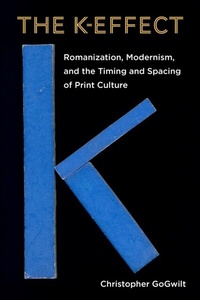
The K-Effect
Romanization, Modernism, and the Timing and Spacing of Print Culture
Published on 5. December 2023
240 pages
978-1-5315-0510-3 (ISBN)
Description

The K-Effect shows how the roman alphabet has functioned as a standardizing global model for modern print culture. Investigating the history and ongoing effects of romanization, Christopher GoGwilt reads modernism in a global and comparative perspective, through the works of Joseph Conrad and others.
The book explores the ambiguous effect of romanized transliteration both in the service of colonization and as an instrument of decolonization. This simultaneously standardizing and destabilizing effect is abbreviated in the way the letter K indexes changing hierarchies in the relation between languages and scripts. The book traces this K-effect through the linguistic work of transliteration and its aesthetic organization in transnational modernism.
The book examines a variety of different cases of romanization: the historical shift from Arabic script to romanized print form in writing Malay; the politicization of language and script reforms across Russia and Central Europe; the role of Chinese debates about romanization in shaping global transformations in print media; and the place of romanization between ancient Sanskrit models of language and script and contemporary digital forms of coding. Each case study develops an analysis of Conrad's fiction read in comparison with such other writers as James Joyce, Lu Xun, Franz Kafka, and Pramoedya Ananta Toer.
The first sustained cultural study of romanization, The K-Effect proposes an important new way to assess the multi-lingual and multi-script coordinates of modern print culture.
The book explores the ambiguous effect of romanized transliteration both in the service of colonization and as an instrument of decolonization. This simultaneously standardizing and destabilizing effect is abbreviated in the way the letter K indexes changing hierarchies in the relation between languages and scripts. The book traces this K-effect through the linguistic work of transliteration and its aesthetic organization in transnational modernism.
The book examines a variety of different cases of romanization: the historical shift from Arabic script to romanized print form in writing Malay; the politicization of language and script reforms across Russia and Central Europe; the role of Chinese debates about romanization in shaping global transformations in print media; and the place of romanization between ancient Sanskrit models of language and script and contemporary digital forms of coding. Each case study develops an analysis of Conrad's fiction read in comparison with such other writers as James Joyce, Lu Xun, Franz Kafka, and Pramoedya Ananta Toer.
The first sustained cultural study of romanization, The K-Effect proposes an important new way to assess the multi-lingual and multi-script coordinates of modern print culture.
More details
Edition
New edition
Language
English
Place of publication
New York
United States
Target group
Professional and scholarly
Edition type
New edition
Illustrations
12 b/w illustrations
File size
7,65 MB
ISBN-13
978-1-5315-0510-3 (9781531505103)
Copyright in bibliographic data and cover images is held by Nielsen Book Services Limited or by the publishers or by their respective licensors: all rights reserved.
Schweitzer Classification
Other editions
Additional editions
Christopher GoGwilt
The K-Effect
Romanization, Modernism, and the Timing and Spacing of Print Culture
Book
12/2023
Fordham University Press
€117.50
Shipment within 3-4 weeks
Person
Christopher GoGwilt is Professor of English and Comparative Literature at Fordham University. He is the author of The Passage of Literature: Genealogies of Modernism in Conrad, Rhys, and Pramoedya (Oxford, 2011, winner, Modernist Studies Association Book Prize), The Fiction of Geopolitics: Afterimages of Culture from Wilkie Collins to Alfred Hitchcock (Stanford, 2000), and The Invention of the West: Joseph Conrad and the Double-Mapping of Europe and Empire (Stanford, 1995).
Content
Introduction: Conrad's "timely appearance in English" 1
The K-effect, 6 * Conrad's "timely appearance in English," 13 * The K-effect circa 1911, 21 *
Overview of the Book, 25
1 The English Case of Romanization: From Conrad's "blank space" to Joyce's "iSpace" 31
Defining Romanization: The Oxford English Dictionary and Joseph Conrad, 32 *
Conrad's Accusative Case: Lord Jim and Nostromo, 51 * Joycean "iSpace"
and the Conradian "blank space," 59
2 The Russian Face of Romanization:
The K in Conrad and Kafka 72
Language, Script, and Reform in the Russian Empire, 77 *
Under Western Eyes, A Personal Record, and "Prince Roman," 83 *
Kafka and Conrad: The Character and Function of K in Central Europe, 102
3 The Chinese Character of Romanization: Conrad and Lu Xun 117
The Chinese Script Revolution and Romanization, 118 *
Conrad's Chinese Characters: Almayer's Folly to Victory, 127 *
Conrad and Lu Xun: The Interface of Chinese and Roman Characters, 144
4 Sanskritization, Romanization, Digitization 157 Sanskritization, 165 *
Sanskritization and Romanization in the OED and in Pramoedya Ananta Toer, 174 *
Digitization, 179
Acknowledgments 191
Notes 195
Bibliography 217
Index 227
The K-effect, 6 * Conrad's "timely appearance in English," 13 * The K-effect circa 1911, 21 *
Overview of the Book, 25
1 The English Case of Romanization: From Conrad's "blank space" to Joyce's "iSpace" 31
Defining Romanization: The Oxford English Dictionary and Joseph Conrad, 32 *
Conrad's Accusative Case: Lord Jim and Nostromo, 51 * Joycean "iSpace"
and the Conradian "blank space," 59
2 The Russian Face of Romanization:
The K in Conrad and Kafka 72
Language, Script, and Reform in the Russian Empire, 77 *
Under Western Eyes, A Personal Record, and "Prince Roman," 83 *
Kafka and Conrad: The Character and Function of K in Central Europe, 102
3 The Chinese Character of Romanization: Conrad and Lu Xun 117
The Chinese Script Revolution and Romanization, 118 *
Conrad's Chinese Characters: Almayer's Folly to Victory, 127 *
Conrad and Lu Xun: The Interface of Chinese and Roman Characters, 144
4 Sanskritization, Romanization, Digitization 157 Sanskritization, 165 *
Sanskritization and Romanization in the OED and in Pramoedya Ananta Toer, 174 *
Digitization, 179
Acknowledgments 191
Notes 195
Bibliography 217
Index 227
