

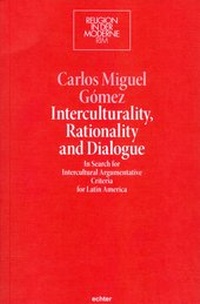
Interculturality, Rationality and Dialogue
In Search for Intercultural Argumentative Criteria for Latin America
Published on 10. April 2012
XIV, 333 pages
978-3-429-04624-8 (ISBN)
Description

This work is a philosophical investigation into the argumentative conditions for intercultural dialogue in Latin America. Through a critical discussion of some key theories of argumentation and intercultural dialogue and a thoughtful analysis of the Latin-American context of diversity, this book develops an intercultural model of argumentation based on the criteria of Intercultural Reasonableness and Discursive Interpellation. These criteria, which have a contextual and dialogical character, aim to offer the appropriate normative ground for a polylogical argumentative dialogue, in which the parties can make use of their own types of language and rationality without presupposing a common standard for the rational evaluation of arguments.
More details
Other editions
Additional editions
Carlos Miguel Gómez
Interculturality, Rationality and Dialogue
In Search for Intercultural Argumentative Criteria for Latin America
E-Book
04/2012
Echter
€29.99
Available for download
Carlos Miguel Gómez
Interculturality, Rationality and Dialogue
In Search for Intercultural Argumentative Criteria for Latin America
Book
03/2012
1st Edition
Echter
€36.00
Article exhausted; check different version
Person
Carlos Miguel Gómez Born in 1976 in Bucaramanga, Colombia. Ph. D. Philosophy of Religion (Frankfurt, Germany), M. A. Religious Studies (Lancaster, U.K.), B. A. Philosophy (Bogotá, Colombia), B. A. Literature (Bogotá Colombia). Currently he researches at CETRE (Centro de Estudios Teológicos y de las Religiones), Universidad del Rosario, Bogotá.
Content
- Cover
- Titel
- Impressum
- Widmung
- Contents
- Acknowledgements
- Note on the Quotation of Sources in Spanish
- List of Diagrams
- Introduction
- PART I: DIVERSITY AND THE CHALLENGES TO DIALOGUE
- 1. The Argumentative Dimension of Intercultural Dialogue
- 1.1. Introduction
- 1.2. The Context for Dialogue
- 1.2.1. Between Inculturation and Dialogue: The Challenges of the Latin American Catholic Church
- 1.2.1.1. The Commitment of the Church with Indigenous Peoples
- 1.2.1.2. The Gospel and the Cultures
- 1.2.2. The Struggles for Recognition of Indigenous Peoples and the Emergence of Multicultural Models
- 1.2.2.1. Indigenous Reconstructed Claims and Regained Rights
- 1.2.2.2. Democratic Participation as Intercultural Deliberation
- 1.2.2.3. Legal Pluralism and The Resolution of Intercultural Conflicts
- 1.3. The Borders of Dialogue
- 1.3.1. The Normative Base of Intercultural Dialogue
- 1.3.2. Grice's Conversational Maxims Interculturally Examined
- 1.4. Difficulties for Establishing Intercultural Normative Criteria for Dialogue
- 1.4.1. The Objection of Incommensurability as Radical Relativism
- 1.4.2. The Objection of Normativity as Neo-Colonialism
- 1.4.2.1. Interculturality as a Critique to Illegitimate Universalization
- 1.4.2.2. Between Dialectical and Dialogical Dialogue
- 1.5. Conclusion: A first Insight into the Function and Shape of the Intercultural Normative Criteria for Dialogue
- 2. Heterogenic Rationalities
- 2.1. Introduction
- 2.2. Rationalities as Culturally Relative Types of Logic
- 2.2.1. Problems with the Hypothesis of Logical Relativism
- 2.3. Rationalities as Incompatible Worldviews
- 2.3.1. The Case of Andean Rationality
- 2.3.2. Criticisms of the Idea of Different 'Conceptual Schemes'
- 2.4. Rationalities as Alternative Reasoning Patterns
- 2.4.1. Rival Explanatory Patterns
- 2.4.1.1. Mythical Causality
- 2.4.1.2. Non Causal Explanatory Principles
- 2.4.2. Competing Patterns of Justification: the Word of Origin as Primary Ground
- 2.5. Conclusion
- 3. Towards an Intercultural Reasonableness
- 3.1. Introduction
- 3.2. From an Intercultural Theory of Rationality to a Notion of Intercultural Reasonableness
- 3.3. Assessing Reasonableness Interculturally: The Pragma-Dialectical Model
- 3.3.1. Does the Pragma-Dialectical Approach offer an Interculturally Valid Model of Reasonableness?
- 3.3.1.1. The Pragma-dialectical Reasonableness is Mono-cultural
- 3.3.1.2. The Pragma-dialectical Reasonableness does not avoid Relativism
- 3.3.1.3. A Critical Discussion does not fit the needs of Intercultural Dialogue
- 3.4. Rethinking Reasonableness Interculturally
- 3.4.1. Rationality and Reasonableness
- 3.4.2. Intercultural Reasonableness as Multi-logical Recognition and Interaction
- 3.4.3. Some Interculturally Unreasonable Moves in Dialogue
- 3.4.3.1. Appeal to radical difference
- 3.4.3.2. Illegitimate Universalization
- 3.4.3.3. Fictitious consensus
- 3.4.3.4. Argumentative violence
- 3.5. Conclusion
- PART II: BUILDING INTERCULTURAL CHAKANAS
- 4. The Interconnection of Traditions I: An Interpretation of Intercultural Disagreements
- 4.1. Introduction
- 4.2. What is a Claim?
- 4.2.1. Claims as Complex Speech Acts
- 4.3. Types of Claims
- 4.3.1. Types of Conflicting Claims in Latin American Intercultural Dialogues
- 4.3.2. Habermas' Argumentation Theory Interculturally Revisited
- 4.4. Types of Disagreements
- 4.5. Presuppositions of Disagreement
- 5. The Interconnection of Traditions II: Discursive Interpellation
- 5.1. Introduction
- 5.2. Challenge
- 5.3. Demand
- 5.4. Offering
- 5.5. 'Oppression' and 'Shared Problems' as Factors of Interdependence
- Conclusion: Pluralistic Argumentation
- 1. The Justification of Argumentative Intercultural Criteria
- 2. The Process of Intercultural Dialogue in Latin America
- 3. The Outcome of Dialogue
- 4. The Limits of the Argumentative Dimension of Intercultural Dialogue
- Appendix: List of Intercultural Argumentative Criteria
- Bibliography
