

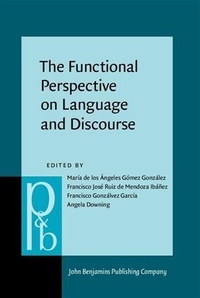
The Functional Perspective on Language and Discourse
Applications and implications
1st Edition
Published on 16. May 2014
VIII, 292 pages
978-90-272-7020-7 (ISBN)
Description

Over the last forty years, the functionalist approach to linguistic description and explanation has given rise to several major schools of thought that share two crucial assumptions: (i) form is not independent of meaning/function or language use; and (ii) linguistic description and explanation need to take into account the communicative function of language. This volume offers readers interested in functional linguistics a selected sample of studies that jointly prove the efficacy of the analytical tools and procedures broadly accepted within the functionalist tradition in order to investigate language and discourse, with special focus on key pragmatic/discourse notions such as contextualization, grammaticalisation, reference, politeness, (in-)directness, discourse markers, speech acts, subjective evaluation and sentiment analysis in texts, among others. In addition, this volume offers specific corpus-based techniques for the objective contextualisation of linguistic data, which is crucial given the central role allotted to context in both functional linguistics and pragmatics/discourse analysis.
More details
Other editions
Additional editions
Maria de los Angeles Gomez Gonzalez | Francisco Jose Ruiz de Mendoza Ibanez | Francisco Gonzalvez-Garcia
The Functional Perspective on Language and Discourse
Applications and implications
Book
05/2014
John Benjamins Publishing Co
€100.70
Shipment within 10-15 days
Persons
Content
- The Functional Perspective on Language and Discourse
- Editorial page
- Title page
- LCC data
- Table of contents
- Contributors
- On the relatedness of functionalism and pragmatics
- 1. Preliminary remarks
- 2. Pragmatics and functionalism
- 3. Chris Butler's contributions to functionalism and pragmatics
- 4. The contributions in this volume
- References
- Part I. Methods in the analysis of language and discourse
- Developing comprehensive criteria of adequacy: The challenge of hybridity
- 1. Introduction
- 2. In pursuit of a comprehensive model of everything
- 2.1 Butler's desiderata explored
- 2.2 Conceptualising the enterprise
- 3. Hybridity
- 3.1 Incompatible part-systems
- 3.2 Accommodating hybridity in language
- 4. Building a picture of hybridity in language
- 4.1 Indeterminacy
- 4.2 Bricolage: The diachronic origins of (some) hybridity
- 4.3 Managing hybridity
- 5. Hybridity and its consequences for linguistic modelling
- 5.1 Hybridity in typologies: Sociocultural and cognitive influences
- 5.2 The perpetuation of hybridity through acquisition and cognition
- 6. Conclusion
- References
- A method of analysing recontextualisation in the communication of science
- 1. Introduction
- 2. Recontextualisation
- 2.1 Approach to analysis
- 2.2 Analysis of recontextualisation
- 3. Resemiotisation
- 3.1 Approach to analysis
- 3.2 Analysis of resemiotisation
- 4. Conclusion
- Acknowledgements
- Corpus
- References
- Contrastive corpus annotation in the CONTRANOT project: Issues and problems
- 1. Introduction
- 2. Background issues: The CONTRANOT project
- 3. Contrastive annotation of thematisation
- 4. Contrastive annotation of modality features
- 5. Evaluation of the annotations
- 6. Summary and concluding remarks
- References
- Appendix 1
- Definition of Thematic Field (English)
- English Core Tagset for Theme categories (Declarative clauses)
- Extended Tagset for English (Thematic Head Types)
- Appendix 2
- Definition of Thematic Field (Spanish)
- Spanish Core Tagset for Theme categories (Declarative clauses)
- Extended Tagset for Spanish (Thematic Head Types)
- Appendix 3
- Definition of Modality
- Core Tagset for Modality categories
- Form and function in evaluative language: The use of corpora to identify contextual valence shifters
- 1. Introduction
- 2. Linguistic approaches to the study of evaluation
- 2.1 Evaluating evaluation terms: Attitude, affect, stance, appraisal and evaluation
- 2.2 Corpus approaches to evaluation: Grammar patterns and local grammars
- 3. Computational approaches to sentiment analysis
- 4. Sentitext: A sentiment analysis system for Spanish
- 4.1 Lexical resources
- 4.2 Global sentiment value
- 5. Context rules and contextual valence shifters: The use of corpora to identify and modulate valence assignment in text
- 6. Conclusion
- References
- Life before Nation: Bibliometrics and L2 vocabulary studies in 1982
- 1. Introduction
- 2. The 1982 data
- 3. The 2006 data
- 4. The changes 1982-2006
- 5. Conclusion
- References
- Part II. Pragmatics and grammar
- A lexico-paradigmatic approach to English setting-constructions
- 1. Introduction
- 2. A grammatico-semantic account of English setting-constructions
- 3. Data analysis
- 4. Final remarks
- References
- How did we think?
- 1. Introduction
- 2. Method
- 3. Global semantic evolution
- 4. Global structural evolution
- 5. Correlations between meaning types and structural developments
- 6. Further reflections on the semantic development
- 7. Conclusion
- The adverb truly in Present-Day English
- 1. Introduction
- 2. The diachronic development of truly
- 3. Truly in present-day English
- 3.1 Frequency
- 3.2 "Truly" as premodifier in an adjective phrase
- 3.3 "Truly" within the clause
- 3.4 "Truly" as a propositional modifier
- 3.5 "Truly" as a discourse marker
- 4. Translation correspondences of "Truly" in French and Dutch
- 5. Discussion and conclusions
- References
- Part III. Current trends in pragmatics and discourse analysis
- Nominal reference and the dynamics of discourse: A cognitive-functional approach
- 1. Introduction
- 2. NPs with definite versus indefinite identifiers and relative versus absolute quantifiers
- 2.1 NPs with definite identification
- 2.2 NPs with indefinite identifiers
- 2.3 NPs with relative quantifiers
- 2.4 NPs with absolute quantifiers
- 3. A dynamic approach to discourse referents
- 3.1 Martin and Peters' (1985) analysis
- 3.2 An alternative analysis
- 4. Conclusion
- References
- "Pragmatic punting" and prosody: Evidence from corpora
- 1. Introduction
- 2. Context dynamism and communication
- 3. Pragmatic punting and prosody
- 4. Analysis and results
- 4.1 Analysis of "I mean"
- 4.1.1 London Lund Corpus
- 4.1.2 LINDSEI Corpus
- 4.2 Analysis of "you know"
- 4.2.1 London Lund Corpus
- 4.2.2 LINDSEI Corpus
- 5. Discussion
- 6. Conclusions
- References
- Besides as a connective
- 1. Introduction
- 2. Besides in Present-Day English
- 2.1 Descriptive overview
- 2.2 Yeung's (2009) analysis
- 3. Data analysis
- 3.1 "Besides" as an objective marker
- 3.1.1 Argument deriving from a different source
- 3.1.2 Brevity of the clause expressing the argument following "besides"
- 3.2 "Besides" as an (inter)subjective marker
- 3.2.1 A sense of "absoluteness"
- 3.2.2 Providing a personal view
- 3.2.3 The use of humour and/or irony
- 3.2.4 "Besides" in combination with rhetorical questions
- 4. A historical perspective
- 5. A final word on findings and implications
- References
- Searle and Sinclair on communicative acts: A sketch of a research problem
- 1. Introduction
- 1.1 The two positions
- 1.2 Speech acts and extended lexical units
- 2. Searle on the social world
- 2.1 Searle on reality
- 2.2 Searle on objective and subjective
- 2.3 Searle on social constructionism
- 3. Phraseology, texts, text-types and social institutions
- 3.1 Example 1: Words and social reality
- 3.2 Example 2: Phraseology and cultural connotations
- 3.3 Example 3: Speech acts, text-types, social institutions, etc
- Acknowlegements
- References
- Strategies of (in)directness in Spanish speakers' production of complaints and disagreements in English and Spanish
- 1. Introduction
- 2. Theoretical background
- 2.1 Politeness, face and indirectness across cultures
- 2.2 Thought processes and speech acts of complaint, disapproval and disagreement
- 2.3 Implications for interlanguage pragmatics, in particular for Spanish learners of English
- 3. Data and methodology
- 3.1 Data
- 3.2 Methodology
- 4. Results
- 4.1 Speech acts
- 4.1.1 Thought processes and speech acts in the three situations
- 4.2 Politeness strategies
- 4.2.1 Politeness strategies in thought processes
- 4.2.2 Politeness strategies in actual speech acts uttered
- 5. Discussion: Strategies for indirectness
- 5.1 Thought processes
- 5.1.1 Situation 1 (equal power, distance, medium rate of imposition)
- 5.1.2 Thought processes in situation 2
- 5.1.3 Thought processes in situation 3
- 5.2 Actual speech acts uttered
- 5.2.1 Actual speech situation 1: Mitigated requests
- 5.2.2 Actual speech situation 2: Mitigated disapproval
- 5.2.3 Actual speech situation 3: Combined strategies
- 6. Conclusions
- References
- Name index
- Term index
