

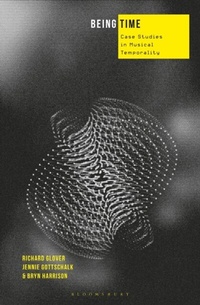
Being Time
Case Studies in Musical Temporality
1st Edition
Published on 27. December 2018
200 pages
978-1-62892-272-1 (ISBN)
Description

Being Time invites a deep consideration of the personal experience of temporality in music, focusing on the perceptual role of the listener. Through individual case studies, this book centers on musical works that deal with time in radical ways. These include pieces by Morton Feldman, James Saunders, Chiyoko Szlavnics, Ryoji Ikeda, Toshiya Tsunoda, Laurie Spiegel and Andre O. Moeller. Multiple perspectives are explored through a series of encounters, initially between an individual and a work, and subsequently with each author's varying experiences of temporality. The authors compare their responses to features such as repetition, speed, duration and scale from a perceptual standpoint, drawing in reflections on aspects such as musical memory and anticipation. The observations made in this book are accessible and relevant to readers who are interested in exploring issues of temporality from a broad range of disciplinary perspectives.
Reviews / Votes
This is one of the richest, most innovative treatments of temporality's relation to music to appear in the last decade. Musicologists, composers, sound artists, and interdisciplinary scholars interested in the experience of time will find this book rewarding. Summing Up: Highly recommended. Upper-division undergraduates through faculty and professionals. * CHOICE * Being Time invites readers to share in the subjective reflections of its three authors, who are also accomplished composers ... The selection of musical material is adventurous and uncompromising ... [It] offers closely monitored, musicologically precise commentaries. * The Wire Magazine * Being Time is fearless in its approach and makes a powerful case for musical experience as a fundamentally intersubjective encounter. It is deeply experimental-a humane and pedagogical project. * Ryan Dohoney, Assistant Professor of Musicology at Northwestern University, USA, author of Saving Abstraction: Morton Feldman, the de Menils, and the Rothko Chapel (forthcoming) * Being Time locates the potentialities of a work in a listener's ears, mind, and body; centralising listening as the phenomenal, temporal process of seeking identity, form, context, and meaning by reverberations that energize the sensory experiences of location, dislocation; the material and the immaterial; and the mirroring and unmooring of personal and social narratives. This book seeks to find and expand our ways of talking and writing about music and sound art practices, appreciating perception as a critical part of reception. * Michelle Lou, Composer and Sound Artist, USA *More details
Edition
1. Auflage
Language
English
Place of publication
New York
United States
Publishing group
Bloomsbury Publishing PLC (Digital)
ISBN-13
978-1-62892-272-1 (9781628922721)
Copyright in bibliographic data and cover images is held by Nielsen Book Services Limited or by the publishers or by their respective licensors: all rights reserved.
Schweitzer Classification
Other editions
Additional editions
Book
12/2018
Bloomsbury Academic USA
€50.94
Shipment within 3-4 weeks
Persons
Richard Glover is a composer and Reader in Music at the University of Wolverhampton, UK.
Jennie Gottschalk is a composer and the author of Experimental Music Since 1970.
Bryn Harrison is a composer and Reader in Composition at the University of Huddersfield, UK.
Jennie Gottschalk is a composer and the author of Experimental Music Since 1970.
Bryn Harrison is a composer and Reader in Composition at the University of Huddersfield, UK.
Content
Acknowledgements
Introduction
Richard Glover, Jennie Gottschalk, and Bryn Harrison
Chapter One: Foreshadowing and Recollection: Listening Through Morton Feldman's Piano, Violin, Viola, Cello
Bryn Harrison
Postlude to Chapter One
Richard Glover
Chapter Two: Musical brevity in James Saunders' Compatibility hides itself and 511 possible mosaics
Bryn Harrison
Postlude to Chapter Two
Jennie Gottschalk
Chapter Three: Separation and Continuity in Chiyoko Szlavnics' Gradients of Detail
Richard Glover
Postlude to Chapter Three
Jennie Gottschalk
Chapter Four: Filtering Temporality in Ryoji Ikeda's +/-
Richard Glover
Postlude to Chapter Four
Bryn Harrison
Chapter Five: Granulated Time: Toshiya Tsunoda's O Kokos Tis Anixis
Jennie Gottschalk
Postlude to Chapter Five
Bryn Harrison
Chapter Six: Monoliths: Laurie Spiegel's The Expanding Universe and Andre O. Moeller's musik fuer orgel und eine(n) tonsetzer(in)
Jennie Gottschalk
Postlude to Chapter Six
Richard Glover
Chapter Seven: Observations on Musical Behaviors and Temporality
Richard Glover, Jennie Gottschalk, and Bryn Harrison
Epilogue
Appendix: Suggested Further Reading and Listening
Introduction
Richard Glover, Jennie Gottschalk, and Bryn Harrison
Chapter One: Foreshadowing and Recollection: Listening Through Morton Feldman's Piano, Violin, Viola, Cello
Bryn Harrison
Postlude to Chapter One
Richard Glover
Chapter Two: Musical brevity in James Saunders' Compatibility hides itself and 511 possible mosaics
Bryn Harrison
Postlude to Chapter Two
Jennie Gottschalk
Chapter Three: Separation and Continuity in Chiyoko Szlavnics' Gradients of Detail
Richard Glover
Postlude to Chapter Three
Jennie Gottschalk
Chapter Four: Filtering Temporality in Ryoji Ikeda's +/-
Richard Glover
Postlude to Chapter Four
Bryn Harrison
Chapter Five: Granulated Time: Toshiya Tsunoda's O Kokos Tis Anixis
Jennie Gottschalk
Postlude to Chapter Five
Bryn Harrison
Chapter Six: Monoliths: Laurie Spiegel's The Expanding Universe and Andre O. Moeller's musik fuer orgel und eine(n) tonsetzer(in)
Jennie Gottschalk
Postlude to Chapter Six
Richard Glover
Chapter Seven: Observations on Musical Behaviors and Temporality
Richard Glover, Jennie Gottschalk, and Bryn Harrison
Epilogue
Appendix: Suggested Further Reading and Listening
