

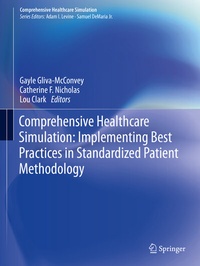
Comprehensive Healthcare Simulation: Implementing Best Practices in Standardized Patient Methodology
Description

This book brings to life best practices of Human Simulation; maximizing the Standardized Patient (SP) methodology that has played a major role in health professions learning and assessment since the 1960s. Each chapter reflects the Association of SP Educators Standards of Best Practices (SOBPs) and provides guidance for implementation. Multiple insights are offered through embedded interviews with international experts to provide examples illustrating successful strategies.
The Human Simulation Continuum Model, a practical and theoretical framework, is introduced to guide educators in decision-making processes associated with the full range of human simulation. The Continuum Model spans improvisations, structured role-play, embedded participants, and simulated-standardized patients. This book also provides the full "how-to" for SP methodology covering topics including; case/scenario development, creating training material, training techniques for case portrayal, training communication and feedback skills, GTA/MUTA/PTA training, SP program administration and professional development for SP Educators.
A pragmatic, user-friendly addition to the Comprehensive Healthcare Simulation series, Implementing Best Practices in Standardized Patient Methodology is the first book framed by the ASPE SOBPs, embracing best practices in human simulation and marshaling the vast expertise of a myriad of SP Educators.
More details
Other editions
Additional editions
Persons
Gayle Gliva-McConvey
Consultant
Gliva-McConvey & Associates
Virginia Beach, VA
USA
Catherine F. Nicholas, Ed D, MS, PA
Director of Simulation Education and Operations
Clinical Simulation Laboratory
University of Vermont
Burlington, VT
USA
Lou Clark, PhD, MFA
Executive Director
M-Simulation
Office of Academic Clinical Affairs
University of Minnesota
Minneapolis, MN
USA
