

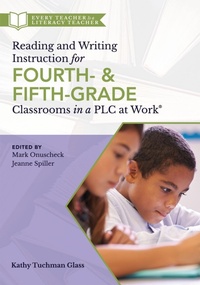
Reading and Writing Instruction for Fourth- and Fifth-Grade Classrooms in a PLC at Work®
Description

Prepare students to succeed with increasingly sophisticated reading and writing challenges. Designed for teachers of grades 4-5, this resource helps readers address the pivotal shift in learning expectations that occurs during the upper elementary years. Myriad templates, tools, and strategies are included to support collaborative teams as they work to establish a rich and robust plan for quality literacy instruction, assessment, and intervention.
Use this resource to inspire fourth- and fifth-graders to excel in reading and writing:
- Understand the role PLCs and collaborative teams play in literacy development and reading comprehension strategies.
- Obtain strategies and tools, such as the pre-unit protocol, for unpacking and clarifying literacy standards.
- Explore adaptable, research-based instructional strategies, and learn how to plan high-quality literacy instruction that boosts student reading and writing skills.
- Examine the four components of the gradual release model--(1) focused instruction, (2) guided instruction, (3) collaborative learning, and (4) independent learning.
- Observe how to collaboratively score assessments and conduct effective data inquiry and analysis.
- Study the powerful impact literacy has on student engagement and inclusivity.
Contents:
Introduction: Every Teacher Is a Literacy Teacher
Chapter 1: Establish Clarity About Student Learning Expectations
Chapter 2: Examine Assessment Options for Literacy
Chapter 3: Create a Learning Progression to Guide Instruction and Assessment
Chapter 4: Develop Collective Understanding of Learning Expectations
Chapter 5: Respond to Data to Ensure All Students Learn
Chapter 6: Differentiate Instruction With Gradual Release of Responsibility
Chapter 7: Plan High-Quality Literacy Instruction
Chapter 8: Select Appropriate Instructional Strategies
Chapter 9: Consider Equity in Literacy
Epilogue
Appendix A: List of Figures and Tables
Appendix B: Templates and Tools
Appendix C: Process for Prioritizing Standards
Appendix D: Depth of Knowledge Overview
Appendix E: Essential Understandings and Guiding Questions
References and Resources
Index
More details
Other editions
Additional editions
Content
- Intro
- Acknowledgments
- Table of Contents
- About the Series Editors
- About the Author
- Introduction
- Chapter 1
- Chapter 2
- Chapter 3
- Chapter 4
- Chapter 5
- Chapter 6
- Chapter 7
- Chapter 8
- Chapter 9
- Epilogue
- Untitled
- Appendix A
- Appendix B
- Appendix C
- Appendix D
- Appendix E
- References and Resources
- Index
