

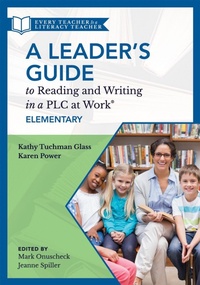
Leader's Guide to Reading and Writing in a PLC at Work®, Elementary
Description

Confidently lead preK-5 literacy improvement in your professional learning community (PLC). Aligned to the Every Teacher Is a Literacy Teacher series, this results-focused guide outlines how to take urgent action to address deficiencies and increase literacy rates. Learn how to bring a new level of focus to your teacher teams and help them do the important daily work of ensuring every student successfully reads and writes at or beyond grade level.
- Understand the importance and goals of literacy-focused instruction in an elementary setting.
- Gain specific suggestions for four types of leaders: (1) district, (2) school, (3) coach, and (4) teacher.
- Help collaborative teams emphasize literacy knowledge and reading and writing skills in a curriculum's essential standards.
- Create effective data-inquiry practices that inform team decision-making for those who require additional support or extension.
- Facilitate high-quality literacy instruction using the gradual release of responsibility framework.
- Develop equity in literacy instructional strategies to ensure growth and development for all.
Contents:
Introduction: Leaders of Literacy
Chapter 1: Establish Clarity About Student Learning Expectations
Chapter 2: Examine Assessment Options for Literacy
Chapter 3: Create a Learning Progression to Guide Instruction and Assessment
Chapter 4: Develop Collective Understanding of Learning Expectations
Chapter 5: Respond to Student Data to Ensure All Students Learn
Chapter 6: Design Lessons Using the Gradual Release of Responsibility Instructional Framework
Chapter 7: Plan for High-Quality Instruction in Literacy
Chapter 8: Select Appropriate Instructional Strategies
Chapter 9: Consider Equity in Literacy
Epilogue
Appendix A: Reference Points, Templates, and Tools
Appendix B: List of Figures and Tables
References and Resources
Index
More details
Other editions
Additional editions
Content
- Intro
- Acknowledgments
- Table of Contents
- About the Authors
- About the Series Editors
- Introduction
- Chapter 1
- Chapter 2
- Chapter 3
- Chapter 4
- Chapter 5
- Chapter 6
- Chapter 7
- Chapter 8
- Chapter 9
- Epilogue
- Appendix A
- Appendix B
- References and Resources
- Index
