

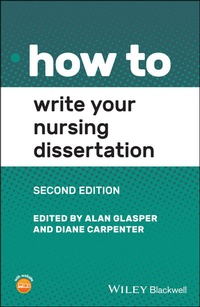
How to Write Your Nursing Dissertation
Description

How to Write Your Nursing Dissertation provides nursing and healthcare students with authoritative information on developing, writing, and presenting an evidence-based practice healthcare dissertation, project or evidence-informed decision-making assignment. Written by experienced healthcare professionals, this comprehensive textbook offers clear and straightforward guidance on sourcing, accessing, and critically appraising evidence, helping students develop their clinical research and writing skills. The authors address the common difficulties encountered throughout the process of writing a dissertation, project or evidence-informed decision-making assignment, and offer expert tips and practical advice for managing time, developing study skills, interpreting statistics, publishing aspects of the work in a journal or at a conference, and more.
Now in its second edition, this bestselling guide presents relatable and engaging scenarios to illustrate the setting of standards, explore legal and ethical frameworks, examine auditing and benchmarking, and demonstrate how evidence is applied to real-world problems. Covering the entire dissertation, project or evidence-informed decision-making assignment process from a nursing and healthcare perspective, this innovative textbook:
* Helps students develop and appropriately answer a clear dissertation, project or evidence-informed decision-making assignment
* Addresses the fundamental aspects of evidence-based practice in an accessible and readable style
* Features new and updated content on mini dissertations, final assessments, and evidence-informed decision-making projects that many healthcare institutions now require
* Presents up-to-date information that meets the needs of new healthcare roles, such as the Nursing Associate and Healthcare Assistant
* Includes access to a companion website containing downloadable information, an unabridged dissertation sample, and links to additional resources
How to Write Your Nursing Dissertation is a must-have guide for nursing and healthcare students, trainees, other healthcare students required to complete an evidence-based practice project, and anyone looking to strengthen their critical appraisal and assignment writing skills.
More details
Other editions
Additional editions
Persons
ALAN GLASPER is Emeritus Professor of Nursing Studies, University of Southampton, UK. He is also the editor-in-chief of the international journal Comprehensive Child and Adolescent Nursing.
DIANE CARPENTER is Lecturer in Mental Health Nursing, School of Nursing and Midwifery, Faculty of Health and Human Sciences, University of Plymouth, UK.
Content
List of contributors xiii
Foreword xvii
Preface xx
About the companion website xxii
The Scenarios xxiiii
Section 1 Starting your dissertation journey 1
1 Starting the journey of your final-year project 3 Megan Bonner-Janes
What is a final-year project? 3
Why do nurses need to do a research-based project? 5
Undergraduate versus postgraduate projects 6
What are the features of a degree education? 7
Features of a final-year project 8
Planning your final-year project: essential considerations 9
Completing your final-year project and gaining a good classification 11
Don't panic! 13
2 Introduction to writing your evidence-based practice dissertation/project 14 Alan Glasper, and Diane Carpenter
Sample guidelines for students undertaking a nursing associate project, an undergraduate healthcare project/dissertation or a master's degree project 14
Typical learning outcomes for a nursing associate course 2000-word literature review 15
Typical learning outcomes for an undergraduate evidence-based practice dissertation/project 15
Typical learning outcomes for a postgraduate evidence-based practice dissertation/project 16
The dissertation/project/assignment 17
Guidelines for students undertaking a nursing associate evidence-based practice assignment 18
Guidelines for students undertaking an undergraduate evidence-based practice final project 19
Guidelines for students undertaking an undergraduate evidence-based practice dissertation 20
Guidelines for a typical postgraduate evidence-based practice dissertation/project module learning outcomes 22
Conclusion 23
3 Clinical effectiveness and evidence-based practice: background and history 24 Mary O'Toole and Alan Glasper
Introduction 24
Historical aspects of evidence-based practice 25
The contribution of the nursing profession to evidence-based practice 27
How is evidence sourced? 27
Conclusion 29
4 What is evidence-based practice and clinical effectiveness? 31 Andrée le May
Clinical effectiveness 31
Evidence-based practice 35
Making care more effective 38
5 The challenges of delivering practice based on best evidence (in primary, secondary and tertiary settings) 43 Andrée le May
An evidence base for practice 43
Barriers to the use of research evidence in practice 45
Encouraging the use of research evidence in practice 48
Conclusion 53
Section 2 Sourcing and accessing evidence for your dissertation 57
6 Sourcing the best evidence 59 Diane Carpenter and Alan Glasper
Exploring and refining your question 59
Searching for research articles 62
Devising your search strategy 66
Accessing journal literature 69
The Cochrane Library 70
Websites and other resources 74
Support from your library service 75
Conclusion 78
7 What is grey literature and where can it be found? 80 Diane Carpenter and Alan Glasper
What is 'grey literature'? 80
Where can I find grey literature? 81
Important websites 82
What about Google scholar? 82
8 Harvard or Vancouver: getting it right all the time 83 Diane Carpenter and Alan Glasper
Vancouver system 84
Harvard system 85
Use of computer referencing packages 87
Conclusion 88
9 Posing an evidence-based practice question: using the PICO and SPICE models 89 Alan Glasper and Diane Carpenter
What is the PICO model? 90
Examples of PICO formulated questions 91
What is the SPICE model? 94
Section 3 Developing your healthcare/evidence-based practice dissertation 97
10 Managing your time wisely 99 Diane Carpenter and Alan Glasper
An evidence-based practice healthcare dissertation/final project or evidence-informed decision-making assignment as a frame of mind 100
Conclusion 104
11 Developing your study skills 106 Diane Carpenter, and Alan Glasper
Knowing yourself 108
Being organised 111
Organising things in terms of what goes where 112
Consolidating your ideas and activities by talking to others about it 112
12 Getting the most from your personal tutor 114 Ellen Kitson-Reynolds
Before approaching your academic support 114
How to get started 115
Agreeing a working pattern 116
Anticipating and preventing problems 116
Good planning is the essence 117
Supervision at a distance 118
Additional support 118
Section 4 Preparing to use research evidence in your dissertation 121
13 Clinical standards, audit and inspection 123 Diane Carpenter and Alan Glasper
What is healthcare governance? 124
What are the seven pillars of clinical governance? Are they still relevant in contemporary practice? 126
The role of the Care Quality Commission 127
NICE quality standards 132
Developing audit tools to measure compliance to policy standards 136
Healthcare regulators 139
Responding to an adverse incident 143
14 Understanding quantitative research 146 Diane Carpenter and Alan Glasper
Is it a quantitative study? 146
Why quantitative? 148
Types of quantitative studies 148
Key elements in a quantitative study 151
Strengths of quantitative studies 154
Limitations 154
Conclusion 154
15 Understanding qualitative research 156 Diane Carpenter and Alan Glasper
Why qualitative? 157
Types of qualitative studies 158
Key elements in a qualitative study 159
Strengths of qualitative studies 160
Limitations 162
Conclusion 163
16 Using historical literature 164 Diane Carpenter and Alan Glasper
What is the use of history in a world focused on scientific evidence? 165
Where does historical research fit methodologically? 165
Would such a study constitute primary research or would it be possible to appraise historical research that others had done? 167
Could I possibly justify doing a historical evidence-based practice project? 168
How do I go about undertaking a study based on historical evidence? 168
Section 5 Critically appraising evidence 175
17 Selecting and using appraisal tools: how to interrogate research papers 177 Diane Carpenter and Alan Glasper
Introduction 177
What is critical appraisal? What are critical appraisal tools? Why is critical appraisal of published research important? What does critical appraisal mean to nurses and other healthcare professionals? 178
What is the best critical appraisal tool to use? 179
Commencing your critique 180
Is an individual paper worth adding to the shortlist? Preparing your initial long shortlist 181
Commencing your initial read and review of an empirical journal paper 181
Points to consider about the paper(s) before using any critiquing tool 183
Applying a critiquing framework tool of your choice to your selected papers 185
Critiquing models 187
Conclusion 196
18 Critically reviewing qualitative papers using a CASP critiquing tool 199 Diane Carpenter and Alan Glasper
Screening questions 200
The CASP qualitative questions 201
Data analysis 204
Research findings 204
The value of the research 205
Reflection 205
19 Critically reviewing quantitative papers using a CASP critiquing tool 207 Diane Carpenter and Alan Glasper
Question 1 'Did the study ask a clearly focused question?' 208
Question 2 'Was this a randomised controlled trial and was it appropriately so?' 209
Question 3 'Were participants appropriately allocated to intervention and control groups?' 211
Question 4 'Were participants, staff and study personnel "blind" to participants study group?' 211
Question 5 'Were all the participants who entered the trial accounted for at its conclusion?' 213
Question 6 'Were the participants in all groups followed up and data collected in the same way?' 213
Question 7 'Did the study have enough participants to minimise the play of chance?' 213
Question 8 'How are the results presented and what is the main result?' 214
Question 9 'How precise are these results?' 215
Question 10 'Were all important outcomes considered so the results can be applied?' 215
20 Critically reviewing a journal paper using the Parahoo model 217 Diane Carpenter and Alan Glasper
Introduction 217
Framework for appraisal 218
Conclusion 228
Section 6 Taking your dissertation further: disseminating evidence, knowledge transfer; writing as a professional skill 231
21 Publishing your work or making a conference or poster presentation 233 Diane Carpenter and Alan Glasper
Your dissertation or final assignment is complete: what next? 233
Motivation 234
Conference poster or abstract and presentation at a conference 235
Writing a paper for publication 241
What will you do with your evidence-based practice healthcare dissertation/final project or evidence-informed decision-making assignment? 247
22 Reflecting on your evidence-based practice healthcare dissertation/final project or evidence-informed decision-making assignment journey 248 Justine Barksby
Reflection 248
Frameworks for reflection 250
Some final points on reflection 256
Conclusion 257
23 Building the architecture of your dissertation 258 Diane Carpenter and Alan Glasper
Writing your evidence-based practice healthcare dissertation/final project or evidence-informed decision-making assignment 258
Section 7 Bonus chapters (website only) 265
24 Public health: writing a master's level dissertation Sarah Adrienne Hughes
25 Critically reviewing a journal paper using the Rees model Diane Carpenter and Colin Rees
26 Managing a learning difference Michelle Cowen
27 Research governance in practice Jane March-McDonald
28 Using evidence in practice
Index 267
Chapter 1
Starting the journey of your final-year project
Megan Bonner-Janes
University of Southampton, UK
What is a final-year project?
The landscape of nurse training is evolving to become more flexible and accessible. Whether you have embarked on an apprenticeship leading to a degree in nursing or a foundation degree nursing associate qualification, are attending a higher education institution and undertaking a full-time direct entry degree in nursing, or perhaps you were awarded your nursing registration before the profession became all-graduate in 2013 and have now chosen to 'top-up' to a BSc or BN, you will be required to complete a final year project.
There are variations in the names awarded to these projects between education providers; dissertation, research project, evidenced-based practice project or portfolio for example. The form, structure and expected content of this project will also vary between institutions, with some requiring a 'traditional' 10 000-word evidence-based practice enquiry, while others may request a significantly shorter literature review, aimed at writing for a specific relevant journal with a view to publication. This might sound unfairly disparate, but often it is easier to work with a larger word count than it is a restricted one. Perhaps you will be required to critique the literature underpinning a specific piece of healthcare guidance, and then design an audit to test whether the recommendations are happening in practice.
Although there are many potential methodologies (research word for recipe) that you could be asked to follow, there are nevertheless commonalities between them all which remain constant, and so for the purposes of this book, we will refer to this polynymous piece of work as a 'final year project' or 'dissertation'.
It is unlikely at undergraduate level that you would be asked to generate any new empirical evidence, meaning you will not be conducting research to generate new evidence yourself; rather you will be required to focus on a specific topic by systematically reviewing the literature in relation to that topic.
Other potential common features of a final-year project include:
- larger word count than other essays in the same programme;
- a requirement for you to show understanding of research methods and methodologies;
- a requirement for you to demonstrate your ability to be analytical and critical in your thinking and writing
- more credits than other essays (generally double the credit weighting compared with other assignments in the same programme).
A final-year project is often viewed as the culmination of a programme of learning which helps consolidate the student's knowledge, skills and understanding of the research base of the discipline.
Whether you are accessing a foundation degree to become a Nursing Associate, or are a fully registered nurse undertaking postgraduate study, it is essential to understand the task required of you.
Scenario
Alisha left school without taking A-levels; she sought employment as a healthcare assistant at her local NHS Trust. Her ward managers recognised that Alisha had potential and when the new Nursing Associate Foundation Degree by the local university was launched in 2018 they sponsored her to undertake this new course. Alisha is now in her second and final year and is looking forward to registering with the Nursing and Midwifery Council as a qualified Nursing Associate. However, Alisha must successfully complete an evidence-based practice project of 4000 words before completing the course. She and her friend Charlotte, who is a third-year student nurse, often meet in the library.
Charlotte is a third-year undergraduate student nurse and has been recently assessed as having a learning difference. She has been having regular support meetings with the faculty learning support manager. She has to write a 7000-word evidence-based practice assignment.
Sue, a senior staff nurse, has an Advanced Diploma in Nursing and is aware of the move to an all-graduate profession for new applicants to nursing. This has prompted her to embark on a 'top-up degree' programme at a nearby university to enable her to achieve graduate status. To meet the programme requirements she will need to complete a 10 000-word evidence-based practice final-year project (dissertation).
Sam, a friend of Sue, is a ward manager and graduated with a Bachelor in Nursing degree 10 years earlier and now wants to study for an MSc in Nursing. For the MSc evidence-based practice final-year project he will have to write a thesis of 20 000 words in length.
SUE:
'Why do we have to write such a long final year project?'SAM:
'That is a good question Sue. We should first explore what an evidence-based practice final-year project is so we can understand why it is a significant aspect of our degree programmes and what we need to achieve. This article I have been reading indicates some key aspects of a final-year project.'Activity 1.1
Before reading further it will be helpful for you to consider exactly what the module requirements are for your final-year project. What is the task that you have been set?
Talk to other people who have undertaken the task previously, or who are currently undertaking the same project, to determine how they have approached or intend to approach the task. It is likely that your course will provide a number of exemplars of previous projects.
Note that the website that accompanies this book also has exemplar projects available, take a look to see which most closely resembles the project you are undertaking.
Why do nurses need to do a research-based project?
The Nursing and Midwifery Council (NMC) is the regulatory body for registered nurses and nurses in training across England, Wales, Scotland and Northern Ireland. They provide the standards of competence which underpin nursing practice and education. In Future Nurse: Standards for Proficiency for Registered Nurses it states:
The confidence and ability to think critically, apply knowledge and skills, and provide expert, evidence-based, direct nursing care therefore lies at the centre of all registered nursing practice.
(NMC 2018:3)
Healthcare practitioners need to be able to ask questions about practice, access healthcare research and evidence, and report the key ideas and findings effectively and accurately to others. Preparing a final-year project will provide you with the skills that you need to be able to search for, and critically evaluate, relevant theoretical knowledge and literature, which will underpin your practice, improve your knowledge, inform your practice, and therefore improve outcomes for patients and service users.
It is therefore the process of writing a final-year project that is arguably more important than the final project document itself. Production of a final-year evidence-based project is the primary means to achieving an honours or a master's degree.
Undergraduate versus postgraduate projects
Normally an undergraduate project will be based on a critique of a small selection of evidence and be applied to one focused aspect of practice. It will provide insight and hands-on experience of the process of engaging in evidence-based practice and should inform individual or local professional clinical practice.
The requirement of a master's programme is that the evidence-based project demonstrates how the student has 'mastered' a core aspect of healthcare practice, related research knowledge and discipline-related content.
There is a qualitative difference between the master's final-year project and the undergraduate final-year project as well as the quantitative difference recognised by the word allowance. This normally relates to the depth, breadth and analysis demonstrated in the written work. A master's final-year project will systematically critique a greater amount of evidence from a range of different sources, demonstrating a significant appreciation of underlying issues, application, and impact of the findings for the wider practice context.
Undergraduate evidence-based practice projects tend to focus on 'what' and 'where' questions related to practice, while master's level work will move on to asking more analytical questions that focus on the 'how' and 'why' of practice.
The UK Quality Assurance Agency (QAA) Subject Benchmark Statement provides a means of describing standards for the award of qualifications at a given level. The capabilities and attributes of those who undertake final-year projects for particular qualifications should demonstrate the appropriate level of study. This is always indicated in the programme final-year project assignment guidelines and the learning outcomes made available to students. More detail on this can be found in Chapter 2.
What are the features of a degree education?
Increasingly, degree...
