

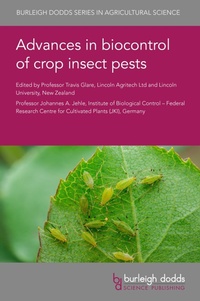
Advances in Biocontrol of Crop Insect Pests
Published on 25. March 2025
312 pages
978-1-80146-840-4 (ISBN)
Description

"I enjoyed this book. All chapters are authored by recognised experts from government, industry and academia and are generally well-written. Each chapter concludes with 'Where to look for further information,' which is distinct from the references. This was a useful touch which, as a biocontrol practitioner, I found myself using for follow up research. In summary, this book proves a valuable update to the biocontrol literature and should become a valuable addition to research libraries." (Book Review Published in Biocontrol Science and Technology)
As a result of increasing consumer and regulatory concern about the environmental impact of synthetic pesticide use, the biocontrol sector has rapidly expanded and continues to diversify in its product offering, with a suggested estimate of over 1700 different biocontrol products now available on the market.
Advances in biocontrol of crop insect pests provides a detailed overview of some of the key developments in this area, including the techniques used to disrupt insect pest behaviour, such as the use of semiochemicals and genetic engineering. The book also reviews recent advances in understanding plant defences against insect pest attacks and how these defences can be improved to limit crop damage and yield.
Through its exploration of the recent advances in the biocontrol sector, the book highlights the potential of novel biocontrol agents to reduce agriculture's environmental impact, whilst also considering the key formulation issues and regulatory challenges that may arise during the product development stage.
As a result of increasing consumer and regulatory concern about the environmental impact of synthetic pesticide use, the biocontrol sector has rapidly expanded and continues to diversify in its product offering, with a suggested estimate of over 1700 different biocontrol products now available on the market.
Advances in biocontrol of crop insect pests provides a detailed overview of some of the key developments in this area, including the techniques used to disrupt insect pest behaviour, such as the use of semiochemicals and genetic engineering. The book also reviews recent advances in understanding plant defences against insect pest attacks and how these defences can be improved to limit crop damage and yield.
Through its exploration of the recent advances in the biocontrol sector, the book highlights the potential of novel biocontrol agents to reduce agriculture's environmental impact, whilst also considering the key formulation issues and regulatory challenges that may arise during the product development stage.
Reviews / Votes
"I enjoyed this book. All chapters are authored by recognised experts from government, industry and academia and are generally well-written. Each chapter concludes with 'Where to look for further information,' which is distinct from the references. This was a useful touch which, as a biocontrol practitioner, I found myself using for follow up research. In summary, this book proves a valuable update to the biocontrol literature and should become a valuable addition to research libraries." (Book Review Published in Biocontrol Science and Technology)More details
Series
Language
English
Place of publication
Cambridge
United Kingdom
Target group
College/higher education
Professional and scholarly
University and other researchers in entomology and crop protection;governments and other private sector agencies responsible for regulating biocontrol products;agrochemical companies manufacturing and selling crop protection products;as well as agronomists providing advisory services on aspects of biocontrol
Illustrations
Color tables, photos and figures
File size
7,35 MB
ISBN-13
978-1-80146-840-4 (9781801468404)
DOI
10.19103/AS.2024.0149
Copyright in bibliographic data and cover images is held by Nielsen Book Services Limited or by the publishers or by their respective licensors: all rights reserved.
Schweitzer Classification
Other editions
Additional editions
Travis R. Glare | Travis R. Glare
Advances in Biocontrol of Crop Insect Pests
Book
03/2025
Burleigh Dodds Science Publishing Limited
€232.20
Shipment within 3-4 weeks
Persons
Professor Travis Glare is CEO of Lincoln Agritech Ltd. and Professor of Applied Entomology at Lincoln University, New Zealand. He has an international reputation and has published widely in the field of entomopathogenic microbes and use of biopesticides. He has worked on a range of international projects to develop novel biopesticides.
Professor Johannes A. Jehle is Head of the Institute of Biological Control at the Federal Research Centre for Cultivated Plants (Julius Kuehn Institute) in Dossenheim and Adjunct Professor at the Technical University Darmstadt, Germany. He is also Vice-President of the West Palaearctic Regional Section of the International Organisation for Biological and Integrated Control (IOBC-WPRS), a member of the IOBC-WPRS Working Group on Microbial and Nematode Control, and previous President of the Society of Invertebrate Pathology (SIP). A member of the editorial boards of several journals, Professor Jehle is internationally known for his research on entomopathogenic viruses and microbial control of pest insects.
Dr Linda Muskat is a professor of Phytopathology and Plant Protection in Viticulture and Horticulture at Hochschule Geisenheim University. Her primary research interest is the development and application of living microbial biocontrol agents for plant protection. Claudia Preininger is a formulation expert and senior researcher at the AIT Austrian Institute of Technology. With a background in chemistry and marketing & sales, her career expands over several material-related fields including diagnostic assay development, immobilization of proteins and microorganisms for sensors, and microarrays and since 2015, the design of biological agroformulations. She currently has responsibility for the development of sustainable bioformulations suitable for seed coatings, foliar spray and soil amendment in the field of plant growth promotion and biocontrol. Professor Michael J. Stout is L. D. Newsom Professor of Integrated Pest Management at Louisiana State University, USA.
Professor Johannes A. Jehle is Head of the Institute of Biological Control at the Federal Research Centre for Cultivated Plants (Julius Kuehn Institute) in Dossenheim and Adjunct Professor at the Technical University Darmstadt, Germany. He is also Vice-President of the West Palaearctic Regional Section of the International Organisation for Biological and Integrated Control (IOBC-WPRS), a member of the IOBC-WPRS Working Group on Microbial and Nematode Control, and previous President of the Society of Invertebrate Pathology (SIP). A member of the editorial boards of several journals, Professor Jehle is internationally known for his research on entomopathogenic viruses and microbial control of pest insects.
Dr Linda Muskat is a professor of Phytopathology and Plant Protection in Viticulture and Horticulture at Hochschule Geisenheim University. Her primary research interest is the development and application of living microbial biocontrol agents for plant protection. Claudia Preininger is a formulation expert and senior researcher at the AIT Austrian Institute of Technology. With a background in chemistry and marketing & sales, her career expands over several material-related fields including diagnostic assay development, immobilization of proteins and microorganisms for sensors, and microarrays and since 2015, the design of biological agroformulations. She currently has responsibility for the development of sustainable bioformulations suitable for seed coatings, foliar spray and soil amendment in the field of plant growth promotion and biocontrol. Professor Michael J. Stout is L. D. Newsom Professor of Integrated Pest Management at Louisiana State University, USA.
Editor
Bio-Protection Research Centre, Lincoln University (New Zealand)
Institute of Biological Control - Federal Research Centre for Cultivated Plants (JKI)
Contributions
Plant and Food Research
North Carolina State University
CSIC (Spain)
SOLASTA Bio Ltd.
ENEA Research Centre Trisaia-Rotondella (MT) (Italy)
University of Applied Sciences - Bielefeld
Austrian Institute of Technology
Biopesticides and Pollution Prevention Division - Environmental Protection Agency
Content
Part 1 Understanding and disrupting insect pests
1.Understanding the use of vision and olfaction by thrips and other small flying insects to enhance biological control: D.A.J. Teulon and M-C. Nielsen, The New Zealand Institute for Plant and Food Research Limited, New Zealand; K. Lopez-Reyes, Lund University, Sweden; R. Meyhoefer, Leibniz Universitaet Hannover, Germany; and R.W.H.M. Van Tol, BugResearch Consultancy, The Netherlands;
2.Genetic engineering of insects to inhibit insect pest reproduction: Alexis L. Kriete, Sarah E. Hudadoff, Ariel E. Tarrand, Amarish K. Yadav and Maxwell J. Scott, North Carolina State University, USA;
3.Developing plant-based insect biocontrol agents: Daniel Tapia Garcia, Maria Fe Andres and Azucena Gonzalez Coloma, Instituto de Ciencias Agrarias - Consejo Superior de Investigaciones Cientificas (CSIC), Spain;
4.Developments in peptide-based biocontrol agents to manage insect pests: Yousef M. Abul-Haija, Lewis J. Archibald, Alexander J. Finney, Hugh A. Nicholson, Julian A. T. Dow, and Shireen-Anne Davies, SOLASTA Bio Ltd., UK;
5.Using gene silencing (RNA interference) techniques to produce safe insecticidal compounds: Salvatore Arpaia, ENEA (Italian National Agency for New Technologies, Energy and Sustainable Economic Development), Italy;
6.Exploiting plant phenotypic plasticity in promoting crop resistance to insect pests: Michael J. Stout, Louisiana State University Agricultural Center, USA; Lina Bernaola, Texas A&M University AgriLife Research Center, USA; James M. Villegas, Louisiana State University Agricultural Center, USA; and Emily C. Kraus, University of California - Agriculture and Natural Resources, USA;
Part 2 Improving biocontrol product development and use
7.Key issues in formulation of biocontrol agents for plant protection: Linda C. Muskat, Hochschule Geisenheim University, Germany;
8.Challenges in commercialising microbial-based biopesticides for controlling insect pests: Travis R. Glare, Lincoln University, New Zealand;
9.Developments in application technologies for biocontrol agents for insect pest control: Claudia Preininger and Viktoria Stagl, AIT Austrian Institute of Technology, Austria;
10.Challenges in risk assessment of biopesticides for insect pests: Shannon Borges and Mike Mendelsohn, Office of Pesticide Programs - U.S. Environmental Protection Agency, USA;
1.Understanding the use of vision and olfaction by thrips and other small flying insects to enhance biological control: D.A.J. Teulon and M-C. Nielsen, The New Zealand Institute for Plant and Food Research Limited, New Zealand; K. Lopez-Reyes, Lund University, Sweden; R. Meyhoefer, Leibniz Universitaet Hannover, Germany; and R.W.H.M. Van Tol, BugResearch Consultancy, The Netherlands;
2.Genetic engineering of insects to inhibit insect pest reproduction: Alexis L. Kriete, Sarah E. Hudadoff, Ariel E. Tarrand, Amarish K. Yadav and Maxwell J. Scott, North Carolina State University, USA;
3.Developing plant-based insect biocontrol agents: Daniel Tapia Garcia, Maria Fe Andres and Azucena Gonzalez Coloma, Instituto de Ciencias Agrarias - Consejo Superior de Investigaciones Cientificas (CSIC), Spain;
4.Developments in peptide-based biocontrol agents to manage insect pests: Yousef M. Abul-Haija, Lewis J. Archibald, Alexander J. Finney, Hugh A. Nicholson, Julian A. T. Dow, and Shireen-Anne Davies, SOLASTA Bio Ltd., UK;
5.Using gene silencing (RNA interference) techniques to produce safe insecticidal compounds: Salvatore Arpaia, ENEA (Italian National Agency for New Technologies, Energy and Sustainable Economic Development), Italy;
6.Exploiting plant phenotypic plasticity in promoting crop resistance to insect pests: Michael J. Stout, Louisiana State University Agricultural Center, USA; Lina Bernaola, Texas A&M University AgriLife Research Center, USA; James M. Villegas, Louisiana State University Agricultural Center, USA; and Emily C. Kraus, University of California - Agriculture and Natural Resources, USA;
Part 2 Improving biocontrol product development and use
7.Key issues in formulation of biocontrol agents for plant protection: Linda C. Muskat, Hochschule Geisenheim University, Germany;
8.Challenges in commercialising microbial-based biopesticides for controlling insect pests: Travis R. Glare, Lincoln University, New Zealand;
9.Developments in application technologies for biocontrol agents for insect pest control: Claudia Preininger and Viktoria Stagl, AIT Austrian Institute of Technology, Austria;
10.Challenges in risk assessment of biopesticides for insect pests: Shannon Borges and Mike Mendelsohn, Office of Pesticide Programs - U.S. Environmental Protection Agency, USA;
