
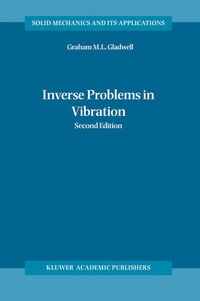
Inverse Problems in Vibration
Description
Alles über E-Books | Antworten auf Fragen rund um E-Books, Kopierschutz und Dateiformate finden Sie in unserem Info- & Hilfebereich.
In the first, 1986, edition of this book, inverse problems in vibration were interpreted strictly: problems concerning the reconstruction of a unique, undamped vibrating system, of a specified type, from specified vibratory behaviour, particularly specified natural frequencies and/or natural mode shapes.
In this new edition the scope of the book has been widened to include topics such as isospectral systems- families of systems which all exhibit some specified behaviour; applications of the concept of Toda flow; new, non-classical approaches to inverse Sturm-Liouville problems; qualitative properties of the modes of some finite element models; damage identification.
With its emphasis on analysis, on qualitative results, rather than on computation, the book will appeal to researchers in vibration theory, matrix analysis, differential and integral equations, matrix analysis, non-destructive testing, modal analysis, vibration isolation, etc.
"This book is a necessary addition to the library of engineers and mathematicians working in vibration theory." Mathematical Reviews
Reviews / Votes
"This book is a necessary addition to the library of engineers and mathematicians working in vibration theory."
Mathematical Reviews
More details
Other editions
Additional editions
Previous edition

Content
System requirements
File format: PDF
Copy protection: Watermark-DRM (Digital Rights Management)
System requirements:
- Computer (Windows; MacOS X; Linux): Use the free software Adobe Reader, Adobe Digital Editions, or any other PDF viewer of your choice (see eBook Help).
- Tablet/Smartphone (Android; iOS): Install the free app Adobe Digital Editions or another reading app for eBooks, e.g., PocketBook (see eBook Help).
- E-reader: Bookeen, Kobo, Pocketbook, Sony, Tolino and many more (only limited: Kindle).
The file format PDF always displays a book page identically on any hardware. This makes PDF suitable for complex layouts such as those used in textbooks and reference books (images, tables, columns, footnotes). Unfortunately, on the small screens of e-readers or smartphones, PDFs are rather annoying, requiring too much scrolling.
This eBook uses Watermark-DRM, a „soft” copy protection. This means that there are no technical restrictions to prevent illegal distribution. However, there is a personalised watermark embedded in the eBook that can be used to identify the purchaser of the eBook in the event of misuse and to provide evidence for legal purposes.
For more information, see our eBook Help page.