

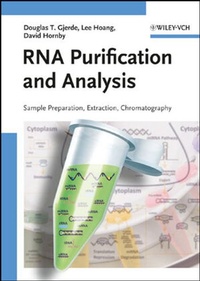
RNA Purification and Analysis
Sample Preparation, Extraction, Chromatography
1st Edition
Published on 10. July 2009
XI, 195 pages
978-3-527-62720-2 (ISBN)
Description

This first book on the market covers the many new and important RNA species discovered over the past five years, explaining current methods for the enrichment, separation and purification of these novel RNAs.
Building up from general principles of RNA biochemistry and biophysics, this book addresses the practical aspects relevant to the laboratory researcher throughout, while discussing the performance and potential problems of the methods discussed. An appendix contains a glossary with the important terms and techniques used in RNA analysis.
By explaining the basic and working principles of the methods, the book allows biochemists and molecular biologists to gain much more expertise than by simply repeating a pre-formulated protocol, enabling them to select the procedure and materials best suited to the RNA analysis task at hand. As a result, they will be able to develop new protocols where needed and optimize and fine-tune the general purpose standard protocols that come with the purification equipment and instrumentation.
Building up from general principles of RNA biochemistry and biophysics, this book addresses the practical aspects relevant to the laboratory researcher throughout, while discussing the performance and potential problems of the methods discussed. An appendix contains a glossary with the important terms and techniques used in RNA analysis.
By explaining the basic and working principles of the methods, the book allows biochemists and molecular biologists to gain much more expertise than by simply repeating a pre-formulated protocol, enabling them to select the procedure and materials best suited to the RNA analysis task at hand. As a result, they will be able to develop new protocols where needed and optimize and fine-tune the general purpose standard protocols that come with the purification equipment and instrumentation.
More details
Other editions
Additional editions
Douglas T. Gjerde | Lee Hoang | David Hornby
RNA Purification and Analysis
Software
08/2009
Wiley-VCH
€190.00
No shipping information available
Douglas T. Gjerde | Lee Hoang | David Hornby
RNA Purification and Analysis
Sample Preparation, Extraction, Chromatography
Book
07/2009
1st Edition
Wiley-VCH
€135.00
Article exhausted; check different version
Persons
Douglas Gjerde received his PhD in analytical chemistry from Iowa State University (USA). After having worked in large and small companies for a number of years, Dr. Gjerde founded Sarasep (now merged into Transgenomic) in 1990 for the production and commercialization of nucleic acid separation technologies. He has authored and coauthored numerous articles and 4 books and holds nearly fifty patents in separation science.
Lee Hoang is a graduate of the University of California, Santa Cruz (USA) where he obtained a Ph.D. in Molecular Biology in 2006. He is now an applications scientist at PhyNexus in San Jose, a company specializing on protein purification that was founded by Douglas Gjerde.
David Hornby studied biochemistry at the University of Sheffield (UK). Since 1999 he is a full professor for Molecular Biology and Biotechnology at the same institution. He has also co-founded two start-up companies (Invector and Protealysis), based on novel technologies for RNA separation and stabilisation, for which he holds the patents. His current research focuses on RNAi biochemistry and proteomics technologies.
Lee Hoang is a graduate of the University of California, Santa Cruz (USA) where he obtained a Ph.D. in Molecular Biology in 2006. He is now an applications scientist at PhyNexus in San Jose, a company specializing on protein purification that was founded by Douglas Gjerde.
David Hornby studied biochemistry at the University of Sheffield (UK). Since 1999 he is a full professor for Molecular Biology and Biotechnology at the same institution. He has also co-founded two start-up companies (Invector and Protealysis), based on novel technologies for RNA separation and stabilisation, for which he holds the patents. His current research focuses on RNAi biochemistry and proteomics technologies.
Content
RNA EXTRACTION, SEPARATION AND ANALYSIS
The need to be able to extract, manipulate and analyze RNA
Using chemical tools to solve the problem of analysis of biological problems
The principle of chromatography and solid phase extraction
RNA Chromatography
Enzymatic treatment of RNA and analysis
Content and organization of this book
BIOLOGICAL AND CHEMICAL RNA
Why Classify RNA with biology and chemistry?
Prokaryote cellular RNA
Prokaryote sample type
Eukaryote cellular RNA
Eukaryote sample type
Other Samples (Virus, Soil, Rock)
Synthetic RNA
RNA SEPARATION - SUBSTRATES, FUNCTIONAL GROUPS, MECHANISMS AND CONTROL
Solid phase interaction
The solid phase substrate and attachment of functional groups
Reverse phase ion pairing separation mechanism
Ion exchange separation mechanism
Chaotropic denaturing interaction mechanism
Hybridization / SELEX
Gel Filtration
RNA EXTRACTION AND ANALYSIS
Transcription
Translation
Gene regulation
Use of siRNA to investigate gene function
RNA CHROMATOGRAPHY
Development of RNA Chromatography
RNA Chromatography instrumentation
RNA Chromatography conditions
Temperature modes of RNA Chromatography
Comparison of gel electrophoresis and liquid chromatography
Analysis of human telomerase RNA under non denaturing conditions
RNA CHROMATOGRAPHY, SEPARATION AND ANALYSIS
Features of RNA Chromatography
Separation of double-stranded and single-stranded RNA
Separation of cellular RNA species
Separation of messenger RNA from total and ribosomal RNA
Analysis of transfer RNA
Chromatography and analysis of synthetic oligo ribonucleotides
Application of RNA and DNA Chromatography in cDNA library synthesis
Chromatography analyses of RT-PCR and competitive RT-PCR products
Alternative splicing
Differential messenger RNA display via RNA Chromatography
RNA STRUCTURE-FUNCTION PROBING
Definition of the Structure-function paradigm
Structure determination of RNA
Footprinting, model building and functional investigations
APPENDIX
Chromatographic Separation Equotations and Priciples for RNA Separation
HPLC Instrumentation and Operation
RNA Chromatographic System Cleaning and Passivation Treatment
The need to be able to extract, manipulate and analyze RNA
Using chemical tools to solve the problem of analysis of biological problems
The principle of chromatography and solid phase extraction
RNA Chromatography
Enzymatic treatment of RNA and analysis
Content and organization of this book
BIOLOGICAL AND CHEMICAL RNA
Why Classify RNA with biology and chemistry?
Prokaryote cellular RNA
Prokaryote sample type
Eukaryote cellular RNA
Eukaryote sample type
Other Samples (Virus, Soil, Rock)
Synthetic RNA
RNA SEPARATION - SUBSTRATES, FUNCTIONAL GROUPS, MECHANISMS AND CONTROL
Solid phase interaction
The solid phase substrate and attachment of functional groups
Reverse phase ion pairing separation mechanism
Ion exchange separation mechanism
Chaotropic denaturing interaction mechanism
Hybridization / SELEX
Gel Filtration
RNA EXTRACTION AND ANALYSIS
Transcription
Translation
Gene regulation
Use of siRNA to investigate gene function
RNA CHROMATOGRAPHY
Development of RNA Chromatography
RNA Chromatography instrumentation
RNA Chromatography conditions
Temperature modes of RNA Chromatography
Comparison of gel electrophoresis and liquid chromatography
Analysis of human telomerase RNA under non denaturing conditions
RNA CHROMATOGRAPHY, SEPARATION AND ANALYSIS
Features of RNA Chromatography
Separation of double-stranded and single-stranded RNA
Separation of cellular RNA species
Separation of messenger RNA from total and ribosomal RNA
Analysis of transfer RNA
Chromatography and analysis of synthetic oligo ribonucleotides
Application of RNA and DNA Chromatography in cDNA library synthesis
Chromatography analyses of RT-PCR and competitive RT-PCR products
Alternative splicing
Differential messenger RNA display via RNA Chromatography
RNA STRUCTURE-FUNCTION PROBING
Definition of the Structure-function paradigm
Structure determination of RNA
Footprinting, model building and functional investigations
APPENDIX
Chromatographic Separation Equotations and Priciples for RNA Separation
HPLC Instrumentation and Operation
RNA Chromatographic System Cleaning and Passivation Treatment
