

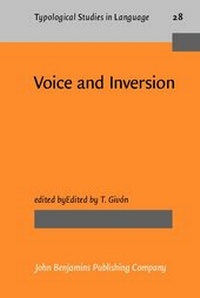
Voice and Inversion
1st Edition
Published on 30. May 1994
VIII, 402 pages
978-90-272-7655-1 (ISBN)
Description

This collection aims first to establish a structure-independent, language-independent definition of pragmatic voice, and more specifically then a universal functional definition of "inverse". The grammar and pragmatic function of the four major voice constructions - direct-active, inverse, passive, antipassive - are surveyed using narrative texts from 14 languages: Koyukon (Athabascan), Plains Cree (Algonquian), Chepang (Tibeto-Burman), Squamish and Bella Coola (Salish), Sahaptin (Sahaptian), Kutenai (isolate), Surinam Carib (Carib), Spanish and Greek (Indo-European), Korean, Maasai (Nilotic), Cebuano and Karao (Philippine). The comparative quantified study of pragmatic voice functions tests the validity of a universal functional definition of voice and in particular of "inverse". The cross-language comparison of grammatical structures that code the various voice functions then lays down the foundation for a non-trivial cross-language typology of "inverse".
More details
Other editions
Additional editions
T. Givon
Voice and Inversion
Book
05/1994
John Benjamins Publishing Co
€143.10
Shipment within 10-15 days
Person
Content
- VOICE AND INVERSION
- Editorial page
- Title page
- Copyright page
- Table of contents
- Abbreviations
- I. INTRODUCTION
- The pragmatics of de-transitive voice: Functional and typological aspects of inversion*
- 1. Introduction
- 1.1. The functional domain of voice
- 1.2. The functional basis of grammatical typology
- 2. The semantics of transitivity
- 3. The pragmatics of voice and de-transitivity
- 4. The definition and measurement of topicality
- 4.1. Anaphoric and cataphoric dimensions
- 4.2. Quantitative measures4.2.1. Topicality
- 4.2.1. Topicality measures
- 4.2.2. Frequency distribution in text
- 4.2.3. Frequency of non-anaphoric agent or patient deletion
- 5. Syntactic-typological correlates of de-transitive voice
- 5.1. Preamble: Subjecthood and the active-direct voice
- 5.2. Grammatical relations in the de-transitive clause
- 5.2.1. Syntactic demotion
- 5.2.2. Syntactic promotion
- 5.3. Toward a cross-linguistic grammatical typology of inverse voice constructions
- 5.3.1. Preamble
- 5.3.2. Pronominal (morphological) vs. word-order inverse
- 5.3.2.1. Pronominal inverses
- 5.3.2.2. Word-order inverse
- 5.3.3. Full-NP case marking in the inverse clause
- 5.3.4. Semantic vs. pragmatic inverse
- 5.3.5. Promotional vs. non-promotional inverse
- 6. Some diachronic aspects of the inverse voice
- 6.1. Preamble
- 6.2. From word-order inverse to pronominal inverse
- 6.3. From pragmatic to semantic inverse
- 6.4. From inverse to ergative
- 6.5. Promotional vs. non-promotional inverses and the rise of obviate agent marking
- 6.6. From nominalized clause to a pronominal inverse
- 6.7. From inverse to passive and from passive to inverse
- 7. In this volume
- NOTES
- REFERENCES
- II. MORPHOLOGICAL INVERSES
- Passives and inverse constructions
- 1. Introduction
- 2. Methodology - diagnosing inverse clauses
- 3.1. The inverse in Koyukon (Athabaskan)
- 3.2. The inverse in Chepang
- 3.3. The inverse in Plains Cree
- 3.4. The inverse in Tibeto-Burman languages
- 3.5. The inverse in Mapudungan
- 4. Conclusion
- REFERENCES
- The discourse function of the Kutenai inverse1
- 0. Introduction
- 1. Some basic properties of Kutenai
- 1.1. Nonthird person subjects and objects
- 1.2. Third person subjects and objects
- 1.3. The transitivity of inverse clauses
- 1.4. Passive
- 1.5. Proximate sequences
- 1.6. Double obviative clauses
- 2. Text counts
- 2.1. Overall frequencies
- 2.2. Referential distance
- 2.3. Persistence
- 2.4. Pronominal participants vs. overt noun phrases
- 2.5. Proximate vs. nonproximate in immediately preceding discourse
- 2.6. Summary
- 3. Explaining the residue
- 3.1. Direct clauses in which the ? was proximate in the preceding discourse
- 3.2. Inverse clauses where the A was proximate in the preceding discourse
- 3.3. Inverse clauses in which neither participant was proximate in the preceding discourse
- 3.4. Inverse clauses in which the ? is an overt NP
- 4. The contrast between the Kutenai inverse and the English passive
- 4. Conclusion
- NOTES
- REFERENCES
- Direct, inverse and passive in Northwest Sahaptin*
- 1. Introduction
- 2. Transitive clauses in Sahaptin
- 2.1. General characteristics
- 2.2. The direct and inverse clauses
- 2.2.1. The semantic ('obligatory') inverse
- 2.2.2. The pragmatic ('optional) inverse
- 2.3. Passive clauses
- 3. The discourse function of the pragmatic inverse
- 3.1. Switching away from the proximate agent
- 3.2. Switching back to the proximate agent
- 4. Methodology
- 4.1. Texts
- 4.2. Clause types
- 4.3. Quantified measures of topicality
- 4.3.1. Referential distance
- 4.3.2. Topic persistence
- 5. Results
- 5.1. Frequency distribution of voice clauses in text
- 5.2. Quantitative measures of relative topicality
- 5.2.1. Anaphoric referential distance (RD)
- 5.2.2. Cataphoric topic persistence (TP)
- 5.3. Frequency of non-anaphoric agent deletion
- 6. Discussion
- NOTES
- REFERENCES
- The inverse in Squamish
- 1. Introduction
- 2. The pragmatics of voice in Chamorro
- 3. Some grammatical characteristics of Squamish
- 3.1. Word order
- 3.1.1. The ergative-active clause
- 3.1.2. The de-transitive clause
- 3.2. Morphology
- 3.2.1. The active-transitive (ergative) clause
- 3.2.1.1. Transitive suffix
- 3.2.1.2. Pronominal verb agreement
- 3.2.1.3. Residues of semantic inversion
- 3.2.1.4. Nominal case marking
- 3.2.2. The de-transitive (DT) clause
- 3.2.2.1. Transitive suffix
- 3.2.2.2. Pronominal verb agreement
- 3.2.2.3. Nominal case marking
- 3.2.2.4. The oblique case
- 3.2.2.4.1. Verbs with obligatory oblique objects
- 3.2.2.4.1. Optional oblique arguments
- 3.2.2.4.3. The oblique determiner tVa
- 3.2.3. Antipassive clauses
- 3.2.3.1. Transitivity marking
- 3.2.3.2. Pronominal verb agreement
- 3.2.3.3. Nominal case marking
- 4. Quantitative study of the topicality of agents and patients in semanti-cally-transitive clauses
- 4.1. Squamish texts
- 4.2. Clause types
- 4.3. Quantified methods of assessing topicality
- 4.3.1. Referential distance
- 4.3.2. Topic persistence
- 4.4. Hypothesis
- 5. Results
- 5.1. Overall text-frequency
- 5.2. Referential distance (RD)
- 5.3. Topic persistence
- 6. Discussion
- 6.1. Text frequency
- 6.2. Functional characteristics
- 6.3. Morpho-syntactic structure
- 6.4. Residual problems
- NOTES
- REFERENCES
- De-transitive clauses in Bella Coola:Passive vs. Inverse
- 1. Introduction
- 1.1. A functional perspective on voice constructions
- 1.2. The functional definition of de-transitive voices
- 1.2.1. Passive vs. inverse
- 1.2.2. Active vs. antipassive
- 2. The grammar of voice constructions in Bella Coola
- 2.1. Person marking suffixes
- 2.2. Morphology of semantically-transitive verbs
- 2.2.1. Syntactically-transitive verb roots
- 2.2.1.1. Derived intransitive constructions
- 2.2.2. Derived transitive constructions
- 3. Methodology
- 3.1. Text
- 3.2. Clause selection
- 3.3. Text-based quantitative methodology
- 3.4. Pragmatic and semantic classification of referents
- 4. Results
- 4.1. Frequency text-distribution of voice constructions
- 4.2. The active-transitive -is vs. the de-transitive -im
- 4.2.1. Topicality measures
- 4.2.2. Distribution of referent-types
- 4.3. Antipassive constructions
- 5. Discussion
- 5.1. The pragmatic function of de-transitive (-im) clause
- 5.2. The function of -a and -m antipassives
- NOTES
- REFERENCES
- APPENDIX: The diachronic development of the Bella Coola morphology
- 1. Pronominal suffixes
- 1.1. Third-person suffixes
- 1.2. Speech-act participant (SAP) suffixes
- 2. Verbal morphology
- 2.1. Transitivizing morphemes
- 2.2. De-transitivizing morphemes
- The pragmatics of de-transitive voice in Spanish: From passive to inverse?
- 1. Introduction
- 2. The grammar of de-transitive clauses in Spanish
- 2.1. The be-marked passives
- 2.2. The se-marked constructions5
- 2.2.1. Semantic de-transitive se-marked clauses
- 2.2.1.1. Reflexive and reciprocal clauses
- 2.2.1.2. The se-marked middle-voice clause
- 2.2.2. The se-marked pragmatic de-transitive constructions
- 2.2.2.1. The se-marked promotional passive
- 2.2.2.2. The se-marked impersonal clause
- 3. Text-study methodology
- 3.1. Measures of topicality
- 3.2. Texts and clause-types
- 4. Results
- 4.2. Frequency of agent deletion
- 4.3. Anaphoric referential distance
- 4.4. Cataphoric topic persistence
- 5. Discussion
- 5.1. Overall distribution in text
- 5.2. Percent of expressed agents in de-transitive clauses
- 5.3. Topicality measures
- NOTES
- REFERENCES
- Semantic and pragmatic inverse: 'Inverse alignment' and inverse voice' in Carib of Surinam
- 1. Introduction: different types of inverse1
- 1.1. Inverse alignment and inverse voice
- 1.2. The organization of this paper
- 2. The Carib inverse constructions
- 2.1. The SAP inverse alignment
- 2.2 The "prefixless verb" SAP inverse
- 2.3. The ambiguity of the 3A30 inverse
- 2.3.1. The 3A 30 alternants: n- versus the "prefixless verb
- 2.3.2. Morphosyntactic problems with a direct-inverse analysis for 3A 30
- 2.3.2.1. Linking the prefixless verb to inverse
- 2.3.2.2. On the idiosyncracy of the prefix n- '3A30'
- 3. The history of the Cariban inverse prefixes
- 3.1 The SAP inverse as a descendent of the "prefixless verb
- 3.2 On possible antecedent for n- '3A3O '
- 4. A functional diagnosis
- 4.1. The functional profile of inverse voice
- 4.2 The methodology for diagnosing inverse voice
- 4.2.1. Definition of referent
- 4.2.2 Definition of clause
- 4.2.3 Topicality measurements
- 4.3 Results
- 4.4 Functional competition: identifiability over voice
- 4.5 On the rise of a new inverse voice construction
- 5. The diachronic dimension of the Carib inverses
- NOTES
- REFERENCES
- III. WORD-ORDER INVERSES
- The pragmatics of Modern Greek voice: Active, inverse and passive
- 1. Introduction
- 1.1. Theoretical issues
- 1.2. The functional definition of voice
- 1.3. The inverse voice
- 1.4. Modern Greek
- 1.5. Hypothesis
- 2. Voice in Modern Greek
- 2.1. The active clause
- 2.2. The passive
- 2.2.1. Aspect
- 2.2.2. The perfective (aorist) passive
- 2.2.3. The imperfective-aspect passive
- 2.2.4. The perfect-aspect passive
- 2.2.4.1. The BE-passive
- 2.2.4.2. The HAVE-passive
- 2.3. The impersonal subject construction
- 2.4. The inverse construction
- 3. Quantitative text-based study
- 3.1. Texts
- 3.2. Quantified text-based methodology
- 3.2.1. Topic persistence (TP)
- 3.2.2. Referential distance (RD)
- 3.3. Results
- 3.3.1. Descriptive statistics
- 3.3.1.1. Frequency distribution of voice constructions
- 3.3.1.2. Cataphoric topic persistence
- 3.3.1.3. Anaphoric referential distance
- 3.3.1.4. Comparison of cataphoric and anaphoric measures
- 3.3.1.5. Agent deletion in the two de-transitive voices
- 3.4. Inferential statistics
- 3.4.1. Individual comparisons
- 3.4.1.1. Agents
- 3.4.1.2. Patients
- 3.4.2. Interactions
- 4. Discussion
- 4.1. Summary of findings
- 4.1.1. The inverse construction
- 4.1.2. Significance of the results
- 4.2. Some cross-linguistic comparisons
- 4.2.1. Structural properties
- 4.2.2. Functional properties
- 4.2.3. The inverse in intransitive clauses
- 4.3. The inverse as a pragmatic compromise
- 4.3.1. The pragmatic conflict
- 4.3.2. Structural and functional overlaps
- NOTES
- REFERENCES
- The pragmatics of voice in Korean
- 1. Introduction
- 2. A grammar sketch of Korean
- 2.1. Case marking
- 2.2. Transitivity
- 2.2.1. General
- 2.2.2. The passive de-transitive marker -hi (-i/-li/-ki)
- 2.2.3. Lexical passives
- 2.2.4. Reflexive de-transitives with the suffix -ci
- 2.3. Word order
- 3. The grammar of de-transitive voice constructions
- 3.1. Active/direct clauses
- 3.2. The promotional (canonical) passive clause
- 3.3. Inverse clauses
- 3.3.1. osv inverse clauses with an accusative-marked object
- 3.3.2. ov inverse clauses with topic-marked object
- 3.4. The impersonal subject clause
- 3.5. Antipassiveclauses
- 4. Methodology
- 4.1. Topicality measures
- 4.2. Clause types
- 4.3. Text
- 5. Results
- 5.1. Overall text frequency of voice constructions
- 5.2. Topicality measures
- 5.2.1. Active/direct clauses
- 5.2.2. osv inverse clauses
- 5.2.3. Canonical passive clauses
- 6. Discussion
- 6.1. Overall comparison of topicality measures
- 6.2. Conclusions
- NOTES
- REFERENCES
- Active, inverse and passive in Maasai
- 1. Introduction
- 2.Maasai morphosyntax
- 2.1. Constituent order and case marking
- 2.2. Person prefixes: direct vs. inverse
- 2.3 The i-construction
- 3. Methodology
- 4. Pragmatic functions of vos, vso and i -constructions
- 5. General order principle
- 6. The status of lexical NPS
- NOTES
- REFERENCES
- The pragmatics of voice in a Philippine language: Actor-focus and goal-focus in Cebuano narrative
- 1. Introduction
- 2. The corpus
- 3. Definitions
- 3.1 Formal devices
- 3.2 Lexically transitive
- 4. The qualitative study: goal-focus and actor focus in non-perfective aspect
- 4.1 Grammatical determination of GF and AF forms
- 4.2 Semantic considerations in the choice of AF and GF forms
- 4.2.1 Future
- 4.2.2 Imperfective
- 4.2.3 Abilitative
- 4.2.4 Perfect
- 4.3 Pragmatic factors
- 5. The quantitative study: deployment of goal-focus and actor focus perfective aspect clauses in the corpus
- 5.1 Lexical transitivity
- 5.2 Constituent Order
- 5.3 Focus and foregrounding (main event line)
- 5.4 Scalar topicality
- 5.4.1 Goal-focus constructions
- 5.4.2 Actor-focus constructions
- 5.4.3 Summary
- 6. Examples
- 6.1 Goal-focus + AP as active-transitive
- 6.2 Goal-focus + AP as antipassive
- 6.3 Goal-focus + PA as functional inverse
- 6.4 Goal-focus + PA as passive
- 6.5 Actor-focus as active transitive
- 6.6 Actor-focus as antipassive
- 7. Conclusion
- NOTES
- REFERENCES
- Voice and ergativity in Karao
- 1. Introduction
- 2. Morpho-syntax of Karao voice system
- 2.1. Voice system and basic verbal clauses
- 2.2. Clause types encoding semantically transitive verbs
- 2.2.1. Syntactically transitive construction
- 2.2.2. Syntactically de-transitive construction 1
- 2.2.3. Syntactically de-transitive construction 2
- 2.2.4. Left-dislocation construction
- 3. A functional definition of voice
- 4. A functional analysis of Karao voice
- 4.1. Frequency distribution of clause types encoding semantically transitive verbs in narrative text
- 4.2. Relative topicality of agent and patient
- 4.2.1. Preamble
- 4.2.2. Topicality measures
- 4.2.2.1. Referential distance
- 4.2.2.2. Topic persistence
- 4.3. Frequency distribution of non-referring, non-anaphoric agents and patients
- 4.4. Texts
- 4.5. Selection of verbs and clauses
- 5. Results
- 5.1. Frequency distribution of clause types encoding semantically transitive verbs in Karao narrative text
- 5.2. Relative topicality of agent and patient in Karao
- 5.2.1. Active-direct voice construction
- 5.2.2. Inverse voice construction
- 5.2.3. Left-disio cation construction
- 5.2.4. Antipassive voice construction
- 5.2.5. Passive voice construction
- 5.2.6. Summary of topicality measures
- 5.3. Frequency distribution of non-referring, non-anaphoric agents and patients in Karao
- 6. Conclusion
- 6.1. Summary of voice functions in Karao
- 6.2. Voice and ergativity
- ABBREVIATIONS
- NOTES
- REFERENCES
