

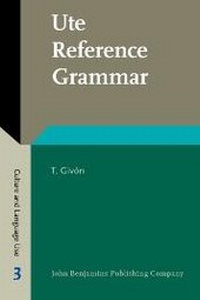
Ute Reference Grammar
1st Edition
Published on 25. May 2011
XXIII, 441 pages
978-90-272-8741-0 (ISBN)
Description

Ute is a Uto-Aztecan language of the northernmost (Numic) branch, currently spoken on three reservations in western Colorado and eastern Utah. Like many other native languages of Northern America, Ute is severely endangered. This book is part of the effort toward its preservation. Typologically, Ute offers a cluster of intriguing features, best viewed from the perspective of diachronic change and grammaticalization. The book presents a comprehensive synchronic description of grammatical structures and their communicative functions, as well as a diachronic account of a grammar in the midst of change. The book is the first of a 3-volume series which also includes a collection of oral texts and a dictionary. Ute speakers and tribal members may find in the present volume a step-by-step description of how words are combined into meaningful communication. Linguists may find a detailed account of one language, an account that is unabashedly informed by universals of grammar, communication and change.
More details
Other editions
Additional editions
T. Givon
Ute Reference Grammar
Book
05/2011
John Benjamins Publishing Co
€116.60
Shipment within 10-15 days
Person
Content
- Ute Reference Grammar
- Editorial page
- Title page
- LCC data
- Dedication page
- Table of contents
- Preface
- Foreword
- Namu-máy-vaa-tu
- First word
- Chapter 1. Introduction
- 1.1. Ute, Numic and Uto-Aztecan
- 1.2. Earlier sources
- 1.3. What is grammar?
- 1.4. What is a reference grammar?
- 1.4.1 Mental vs. descriptive grammar
- 1.4.2 Descriptive vs. pedagogic grammar
- 1.4.3 Synchronic vs. diachronic grammar
- 1.4.4 Literacy and spoken language
- 1.5. The data
- 1.6. Intended audiences and uses
- 1.7. Organization of the book
- 1.8. Abbreviations of grammatical terms
- Chapter 2. Sound system and orthography
- 2.1. Preliminaries
- 2.2. Vowels
- 2.2.1 Vowels and their pronunciation
- 2.2.2 Short vs. long vowels
- 2.2.3 Stressed vs. unstressed vowels
- 2.2.4 Silent vowels
- 2.3. Consonants and their pronunciation
- 2.4. Hyphenation conventions
- 2.5. Capitalization conventions
- Chapter 3. Word classes and word structure
- 3.1. Preliminaries
- 3.2. Lexical word classes
- 3.2.1 Membership criteria
- 3.2.2 Nouns
- 3.2.2.1 Semantic properties
- 3.2.2.2 Syntactic properties
- 3.2.2.3 Morphological properties
- 3.2.2.3.1 Noun suffixes and noun classes
- 3.2.2.3.2 Plural formation
- 3.2.2.3.3 Grammatical ('case') roles
- 3.2.2.3.4 Possessor suffix pronouns
- 3.2.2.3.5 Noun compounds
- 3.2.3 Adjectives
- 3.2.3.1 Semantic characteristics
- 3.2.3.2 Syntactic characteristic
- 3.2.3.3 Morphological characteristics
- 3.2.4 Numerals and ordinals
- 3.2.5 Quantifiers
- 3.2.6 Verbs
- 3.2.6.1 Plural subject agreement
- 3.2.6.2 Causative
- 3.2.6.3 Benefactive
- 3.2.6.4 Passive
- 3.2.6.5 Tense-aspect-modality
- 3.2.6.6 Negation
- 3.2.6.7 Suffix pronouns
- 3.2.6.8 First-syllable stem reduplication
- 3.2.6.9 Incorporated stems
- 3.2.7 Adverbs
- 3.2.7.1 Time adverbs
- 3.2.7.2 Manner adverbs
- 3.2.7.3 Epistemic adverbs
- 3.2.8 Demonstratives, articles and pronouns
- 3.2.8.1 Demonstratives
- 3.2.8.2 Definite articles
- 3.2.8.3 Personal pronouns
- 3.2.9 Interjections
- Chapter 4. Simple clauses
- 4.1. Syntactic description
- 4.1.1 Theme, variations and clause-types
- 4.1.2 States, events, and actions
- 4.1.3 Participant roles
- 4.1.4 Grammatical relations
- 4.1.5 Constituency and hierarchic structure
- 4.1.6 Word order
- 4.2. Dummy-subject verbs
- 4.3. Copular verbs and non-verbal predicates
- 4.4. Simple intransitive verbs
- 4.5. Intransitive clauses with an indirect object
- 4.5.1 Syntactic characterization
- 4.5.2 Locative indirect objects
- 4.5.3 Locative post-positions
- 4.5.4 Dynamic locative post-positions
- 4.5.5 Non-locative indirect objects
- 4.6. Transitive verbs
- 4.6.1 Transitivity
- 4.6.2 Simple transitive verbs
- 4.7. Bi-transitive verbs
- 4.7.1 Verbs with a locative indirect object
- 4.7.2 Verbs with a dative indirect object
- 4.7.3 Verbs with an associative indirect object
- 4.7.4 Verbs with the instrumental-locative variation
- 4.8. Verbs with verbal complements
- 4.8.1 Modal-aspectual verbs
- 4.8.2 Manipulation verbs
- 4.8.3 Perception-cognition-utterance verbs
- 4.9. Optional participant roles
- 4.9.1 Benefactive
- 4.9.2 Associative
- 4.9.3 Instrumental
- 4.9.4 Manner
- 4.9.5 Optional locatives
- Chapter 5. The diachrony of Ute case-marking
- 5.1. Introduction
- 5.2. Subject, object and genitive
- 5.2.1 Current state: Recapitulation
- 5.2.2 Traces of the oblique suffix -y/-i
- 5.2.2.1 Traces on object or genitive nouns
- 5.2.2.2 Traces on Demonstratives and pronouns
- 5.2.2.3 Traces in nominalized clauses
- 5.2.2.4 The epenthetic suffix -y
- 5.2.3 The oblique suffix -a
- 5.2.3.1 The suffix -a as a genitive marker
- 5.2.3.2 The suffix -a as an object marker
- 5.2.4 The object suffix -ku
- 5.2.5 Interim summary
- 5.2.6 Object and genitive: The hidden footprints of nominalization
- 5.2.6.1 Preliminaries
- 5.2.7 The diachrony of Ute object marking: Reconstruction
- 5.2.7.1 The suffixes -a and -y
- 5.2.7.2 The demise of the suffix -y
- 5.2.7.3 The object suffix -ku
- 5.3. Post-positions and indirect objects
- 5.3.1 Introduction
- 5.3.2 Large-size locative post-positions
- 5.3.2.1 Noun-derived post-positions
- 5.3.2.2 Verb-derived post-positions
- 5.3.2.3 Older monosyllabic de-verbal post-positions
- 5.3.2.4 The oldest locative post-positions -na, -mi and -ma
- 5.4. Discussion
- Chapter 6. Tense, aspect, modality and negation
- 6.1. Introduction
- 6.1.1 Perspective
- 6.1.2 Tense
- 6.1.3 Aspect
- 6.1.4 Modality
- 6.2. The immediate aspect
- 6.3. The anterior aspect
- 6.4. The remote past
- 6.5. Imperfective remote-past
- 6.6. The finite habitual aspect
- 6.7. The nominal habitual aspect
- 6.8. The distributive aspect
- 6.9. Future and irrealis
- 6.9.1 Simple future
- 6.9.2 Present subjunctive
- 6.9.3 Habitual subjunctive
- 6.9.4 Future-in-past
- 6.9.5 The intentional mode
- 6.9.6 The exhortative mode
- 6.9.7 The strong-obligation mode
- 6.9.8 The other-directed hope-wish mode
- 6.9.9 The counter-fact hope-wish mode
- 6.9.10 Hypothetical counter-fact modes
- 6.10. Discourse-sensitive aspectual markers
- 6.10.1 The digression aspect
- 6.10.2 The closure aspect
- 6.11. Residual cases
- 6.11.1 The inceptive aspect
- 6.11.2 The completive aspect
- 6.11.3 The verbal suffix -kwa
- 6.11.4 Other old co-lexicalized suffixes
- Chapter 7. Noun phrases-I
- 7.1. Introduction
- 7.2. Referential coherence in discourse
- 7.3. Indefinite referents: First introduction
- 7.3.1 Definiteness and access to knowledge
- 7.3.2 Indefinite nominals
- 7.3.3 Non-referring and generic nominals
- 7.4. Demonstratives and definite articles
- 7.4.1 Demonstrative modifiers
- 7.4.2 Definite articles
- 7.4.3 Demonstratives as pronouns
- 7.5. Personal pronouns
- 7.6. Clitic anaphoric pronouns and zero anaphora
- 7.6.1 Preliminaries
- 7.6.2 Zero anaphora: The default case for referential continuity
- 7.6.3 Subject vs. object clitics: In search of a general principle
- 7.6.4 Pronominal agreement
- 7.6.5 Cliticization locus: Second-position clitics?
- 7.7. Flexible word-order and referential coherence
- 7.8. Final reflections
- Chapter 8. Noun phrases-II
- 8.1. Orientation
- 8.2. Modifying adjectives
- 8.2.1 Restrictive vs. non-restrictive modification
- 8.2.2 Adjectives used as pronouns
- 8.2.3 Morphological note
- 8.3. Numerals, ordinals and quantifiers
- 8.3.1 Numerals
- 8.3.2 Ordinals
- 8.3.3 Quantifiers
- 8.3.4 Partitive constructions
- 8.4. Possessive modifiers
- 8.5. Noun compounds
- 8.6. Nominalized clauses as noun phrases
- 8.6.1 Preliminaries: Finiteness and nominalization
- 8.6.2 Nominalized clauses in Ute
- 8.7. Noun-phrase conjunction
- 8.8. Diachronic notes
- Chapter 9. Verbal complements
- 9.1. Orientation
- 9.2. Modal-aspectual verbs
- 9.3. Manipulation verbs
- 9.3.1 Non-implicative manipulation verbs
- 9.3.2 Implicative verbs and the causative construction
- 9.3.2.1 Introduction
- 9.3.2.2 Verb classes and case-marking
- 9.3.2.3 Syntactic constraints on causativization
- 9.3.2.4 Semantic constraints on causativization
- 9.4. Perception-cognition-utterance verbs
- 9.4.1 Indicative complements
- 9.4.2 Conditional complements
- 9.4.3 WH-question complements
- 9.4.4 Direct-quote complements
- 9.5. Clausal subjects
- 9.5.1 Preamble
- 9.5.2 Nominalized verb phrases as subjects
- 9.5.3 Full-size clausal subjects
- Chapter 10. De-Transitive Voice
- 10.1. Voice and transitivity
- 10.1.1 Overview
- 10.1.2 Semantic dimensions of voice
- 10.1.3 Pragmatic dimensions of voice
- 10.1.4 Syntactic dimensions of voice
- 10.2. Reflexive clauses
- 10.2.1 The simple reflexive
- 10.2.1.1 Reflexives in main clauses
- 10.2.1.2 Reflexives in complement clauses
- 10.2.2 The possessive reflexive
- 10.3. Reciprocal clauses
- 10.4. Middle-voice
- 10.5. The impersonal passive
- 10.5.1 Structural dimensions
- 10.5.2 Usage context of the passive in natural text
- 10.5.3 The passive as middle-voice
- 10.6. The antipassive
- 10.7. The inverse voice
- Chapter 11. The diachrony of Ute passives
- 11.1. Orientation
- 11.2. The diachrony of the Ute -ta passive
- 11.3. The other passive
- 11.4. Conclusion
- Chapter 12. Relative clauses
- 12.1. Orientation
- 12.2. Functional dimensions
- 12.2.1 Definite head nouns: Anaphoric grounding
- 12.2.2 Referring indefinite head nouns: Cataphoric grounding
- 12.2.3 Non-referring head nouns: Irrealis and the problem of strict co-reference
- 12.3. Structural dimensions
- 12.4. Subject relative clauses
- 12.5. Object relative clauses
- 12.6. Indirect-object relative clauses
- 12.7. Some text-derived examples
- 12.8. Headless relative clauses
- 12.9. Non-restrictive relative clauses
- Chapter 13. Contrastive focus and emphasis
- 13.1. Introduction
- 13.2. Contrastive focus constructions
- 13.2.1 Cleft
- 13.2.2 Pseudo-cleft
- 13.3. Emphatic re-focusing morphemes
- 13.3.1 The suffix -nukwa
- 13.3.2 The topicalizing suffix -ga
- 13.3.3 The emphatic suffix -ku/-gu
- Chapter 14. Non-declarative speech acts
- 14.1. Introduction
- 14.1.1 Orientation
- 14.1.2 Speech-acts
- 14.2. Manipulative speech-acts
- 14.2.1 Imperatives
- 14.2.2 Negative imperative
- 14.2.3 Exhortatives
- 14.2.4 The obligative mode
- 14.2.5 The strong obligative mode
- 14.2.6 The subjunctive of hope or wish
- 14.2.7 Counter-fact hypothetical subjunctive
- 14.2.8 The counter-fact hypothetical mode
- 14.3. Interrogatives
- 14.3.1 Yes/no questions
- 14.3.1.1 Preliminaries
- 14.3.1.2 Affirmative yes/no questions
- 14.3.1.3 Negative yes/no questions
- 14.3.1.4 The use of negative yes/no questions as polite requests
- 14.3.2 Constituent (WH-) question
- 14.3.2.1 Preliminaries
- 14.3.2.2 Subject WH-questions: Referring vs. non-referring
- 14.3.2.3 Predicate questions
- 14.3.2.4 Object WH-questions and word-order
- 14.3.2.5 Object-of-possession WH-questions
- 14.3.2.6 Indirect-object and adverbial WH-questions
- 14.3.2.7 Possessor WH-questions
- 14.3.2.8 Quantity questions
- 14.3.3 Cleft and pseudo-cleft WH-questions
- 14.3.4 WH-questions and modal uncertainty
- 14.3.5 A variant WH-question pattern
- Chapter 15. Possession
- 15.1. Orientation
- 15.2. Inalienable possession
- 15.3. Negative inalienable possession
- 15.4. Alienable possession
- 15.5. Negative alienable possession
- 15.6. Existential clauses
- 15.7. Negative existential clauses
- Chapter 16. Comparative constructions
- 16.1. Introduction
- 16.2. Comparison of adjectival quality
- 16.3. Comparison of manner or extent of verbs
- 16.4. Comparison of quantity of objects
- 16.5. Comparison of quantity of subjects
- 16.6. Downward comparison (less)
- 16.6.1 Adjectives
- 16.6.2 Verbs and adverbs
- 16.6.3 Number or quantity of objects
- 16.7. Superlatives
- Chapter 17. Adverbial clauses
- 17.1. Preliminaries
- 17.2. Temporal adverbial clauses
- 17.3. Relative order of main vs. adverbial clause
- 17.4. Conditional adverbial clauses
- 17.4.1 Irrealis conditionals
- 17.4.2 Counter-fact ('hypothetical') conditionals
- 17.5. Concessive clauses
- 17.6. Cause or reason clauses
- 17.7. Purpose clauses
- 17.7.1 Equi-subject purpose clauses
- 17.7.2 Switch-subject purpose clauses
- 17.8. Participial clauses
- 17.8.1 Ku-marked participial clauses
- 17.8.2 Ga-marked participial clauses
- 17.9. Diachronic notes
- 17.9.1 The adverbial subordinator -ku
- 17.9.2 The participial subordinator -ga
- Appendix: The use of -ga-marked participial clauses in oral texts
- Chapter 18. Clause chaining and discourse coherence
- 18.1. Introduction
- 18.2. Chain-medial contexts: Maximal continuity, minimal marking
- 18.3. Chain-initial contexts: Minimal continuity, maximal marking
- 18.4. Flexible word-order and discourse coherence
- 18.5. Notes on the diachrony of inter-clausal connectives
- 18.5.1 The compositional assembly of inter-clausal connectives
- 18.5.2 The old conjunctive suffix -su-
- Chapter 19. Lexical derivation patterns
- 19.1. Introduction
- 19.2. Noun-producing derivations
- 19.2.1 Noun-to-noun derivations
- 19.2.1.1 The diminutive derivations with -pu/-vu
- 19.2.1.2 The diminutive derivation with -chi
- 19.2.1.3 The diminutive derivation with -taa/-raa
- 19.2.1.4 The 'old' 'defunct' 'departed' derivation with -ga-pu
- 19.2.1.5 The possessor derivation with -ga 'have'
- 19.2.1.6 Noun compounding
- 19.2.2 Verb-to-noun derivations (nominalizations)
- 19.2.2.1 The subject/agent nominalization with -mi-tu
- 19.2.2.2 The old subject/agent nominalization with -chi
- 19.2.2.3 The old object nominalization with -pu
- 19.2.2.4 The object nominalization with -ka-pu
- 19.2.2.5 The object nominalization with -ka-tu
- 19.2.2.6 The instrument nominalization with -'na-pu
- 19.2.2.7 The action nominalization with -pu/-vu
- 19.2.2.8 The action nominalization with -pi
- 19.2.2.9 The action nominalization with -ta
- 19.3. Verb-producing derivations
- 19.3.1 Verb-to-verb derivations
- 19.3.1.1 The intensive derivation with -'ni
- 19.3.1.2 The distributive derivation
- 19.3.1.3 The causative derivation with -ti-
- 19.3.1.4 The inchoative derivation with -wi -
- 19.3.2 Noun/adjective-to-verb derivations
- 19.3.2.1 The causative derivation with -may-
- 19.3.2.2 The causative derivation with -ri -
- 19.3.2.3 The inchoative derivation with -ri -
- 19.3.2.4 The inchoative derivation with -'ini-/-mani -
- 19.3.3 Incorporation as verbal derivation
- 19.4. Adjective-producing derivations
- 19.4.1 Preliminaries
- 19.4.2 The potential derivation with -ta-ru
- 19.4.3 The derivation with -ni
- 19.5. Adverb producing derivation
- Chapter 20. Interjections
- Bibliography
- Index
