

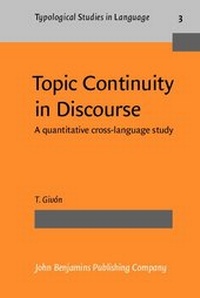
Topic Continuity in Discourse
A quantitative cross-language study
1st Edition
Published on 1. January 1983
VI, 492 pages
978-90-272-8025-1 (ISBN)
Description

The functional notion of "topic" or "topicality" has suffered, traditionally, from two distinct drawbacks. First, it has remained largely ill defined or intuitively defined. And second, quite often its definition boiled down to structure-dependent circularity. This volume represents a major departure from past practices, without rejecting both their intuitive appeal and the many good results yielded by them. First, "topic" and "topicality" are re-analyzed as a scalar property, rather than as an either/or discrete prime. Second, the graded property of "topicality" is firmly connected with sensible cognitive notions culled from gestalt psychology, such as "predictability" or "continuity". Third, we develop and utilize precise measures and quantified methods by which the property of "topicality" of clausal arguments can be studied in connected discourse, and thus be properly hinged in its rightful context, that of topic identification, maintenance and recoverability in discourse. Fourth, we show that many grammatical phenomena which used to be studied by linguists in isolation, all partake in one functional domain of grammar, that of topic identification. Finally, we demonstrate the validity of this new approach to the study of "topic" and "topicality" by applying the same text-based quantifying method to a number of typologically-diverse languages, in studying actual texts. Languages studied here are: Written and spoken English, spoken Spanish, Biblical Hebrew, Amharic, Hausa, Japanese, Chamorro and Ute.
More details
Other editions
Additional editions
Book
01/1983
John Benjamins Publishing Co
€148.40
Shipment within 10-15 days
Person
Content
- TOPIC CONTINUITY IN DISCOURSE: A QUANTITATIVE CROSS-LANGUAGE STUDY
- Editorial page
- Title page
- Copyright page
- Table of contents
- TABLE OF CONTENTS
- INTRODUCTION
- 1. The 'topic' strand: Micro traditions
- 2. The 'paragraph' strand: Macro traditions
- 3. Major topic functions within the thematic paragraph
- 4. The discourse file: Topic availability to the hearer
- 5. Factors affecting topic availability
- 6. Discourse measurements of topic continuity
- 6.1. Referential distance ('look-back')
- 6.2. Potential interference ('ambiguity')
- 6.3. Persistence ('decay')
- 7. The grammatical coding of topic continuity
- 7.1. Preliminaries: Functional domains and syntactic coding
- 7.2. Scales in the coding of topic accessibility
- 7.2.1. The scale o f phonological size
- 7.2.2. The word-order scale
- 7.2.3. The scale of roles and animacy
- 7.3. Topicality and passive vs. active
- 7.4. Topic continuity and main vs. subordinate clauses
- 7.5. Referential-indefinite NP's and existential-presentative devices
- 7.6. Topic continuity and definite-marking morphology
- 7.7. The use of restrictive modifiers
- 8. The studies in this volume
- 9. Typological predictions in the grammar of topic continuity
- 9.1. Zero anaphora, pronouns and agreement
- 9.2. Word-order variation and dislocations
- 9.2.1. Languages with rigid word-order
- 9.2.2. Languages with pragmatically-flexible word-order
- 9.3. Indefinites and existential-presentative constructions
- 9.4. Topic continuity and morphology
- NOTES
- REFERENCES
- NOTES
- TOPICCONTINUITYIN JAPANESE
- TABLE OF CONTENTS
- 1.0 Introduction
- 1.1 Word Order
- 1.2 Case Relationships
- 2.0 Grammatical devices investigated
- 2.1 Ellipsis (Zero anaphora)
- 2.1.1 Ellipsis of Subject
- 2.1.2 Ellipsis of Object
- 2.2 Stressed / independen Pronouns
- 2.3 Right-dislocated definite NP (Postposed NP)
- 2.4 Scrambling
- 2.5 Postpositional particles
- 2.5.1 Subject/Topic Marking Particles
- 2.5.2 Object Marking Particles
- 2.6 Summary of grammatical devices examined
- 3.0 Description of methodology
- 3.1 Texts
- 3.2 Measurements
- 4.0 Numerical Results of Measurements
- 4.1 Topic Continuity Properties of Subjects/Topics
- 4.1.1 Distance
- 4.1.1.1 Momotaro
- 4. 1.1.2 Female conversational interaction
- 4.1.1.3 Male conversational interaction
- 4.1.1 .4 Generalizations about distance
- 4.1.2 Decay
- 4.2 Topic Continuity Properties of Direct Objects
- 4.2.1 Distance
- 4.2.2 Decay
- 4.3 Topic Continuity Properties if Indirect Objects
- 5.0 Discussion
- 5.1 Distance
- 5.2 Decay
- 6.0 Conclusion
- NOTES
- REFERENCES
- APPENDIX A
- APPENDIX B
- APPENDIX C
- TOPICCONTINUITY IN WRITTEN AMHARICNARRATIVE
- TABLE OF CONTENTS
- 1. Introduction
- 2. The SOV Syntax, Clause Types and Paragraph Structure of Amharic
- 3. Some Other Features of Amharic Grammar
- 3.1. Case and Verb Agreement
- 3.2. Independent Pronouns
- 3.3. Definiteness and Indefîniteness
- 3.4. Passive
- 3.5.TopicMarkers
- 4. The Use o f Topic-Continuity Devices in Amhàric
- 5. Results of Counts
- 5.1. ZERO-ANAPHORA
- 5.2. VERB A GREEMENT
- 5.3. INDEPENDENT PRONOUNS
- 5.4. DEFINITENPSUBJECTS
- 5.5 DEFINITE NP OBJECTS With and Without OBJECT AGREEMENT
- 5.6. REFERENTIAL-INDEFINITE NPs
- 5.7. PASSIVE SUBJECTS
- 5.8. DEFINITE SUBJECTS NP with -m
- 5.9 SUBORDINATE and MAIN CLA USES
- 5.10. Frequency of Construction Types
- 6. Discussion and Evaluation
- 6.1. LOOKBACK
- 6.2. POTENTIAL AMBIGUITY
- 6.3. DECAY
- 7. Summary
- REFERENCES
- TOPICCONTINUITY AND WORD-ORDER PRAGMATICS IN UTE
- TABLE OF CONTENTS
- 1. Introduction: Ute and the Ute texts
- 2. The grammatical devices investigated
- 2.1. Subject marking devices
- 2.1.1. Zero anaphora
- 2.1.2. Clitic pronouns/grammatical agreement
- 2.1.3. Independent pronouns in the VS word-order
- 2.1.4. Independent pronouns in the SV word-order
- 2.1.5. Definite NP's in the VS word-order
- 2.1.6. Definite NP's in the SV word-order
- 2.1.7. Double-occurring subject (S VS word-order)
- 2.1.8. Referential-indefinite subjects
- 2.2. Direct-Object marking devices
- 2.2.1. Zero anaphora
- 2.2.2. Clitic pronouns / grammatical agreement
- 2.2.3. Independent pronouns
- 2.2.4. Full definite NP's in the OV word-order
- 2.2.5. Full definite NP's in the VO word-order
- 2.2.6. Double appearance of definite object NP (OVO)
- 2.2.7. Indefinite NP's
- 2.3. Locative Objects
- 2.3.1. Independent pronouns with locative suffix
- 2.3.2. Deictic locative objects
- 2.3.3. Full NP definite locative objects
- 2.3.4. Indefinite full NP locative objects
- 2.4. Manner objects/adverbs
- 3. Methodology of text counting
- 3.1. Referentmldistance ( 'look-back ')
- 3.2. Per sistence ( 'decay ')
- 3.3. Same-subject (SS) vs. different subject (DS)
- 3.4. Contiguity to major thematic breaks ¡junctures (Subject NP's only
- 4. Numerical results of measurements
- 4. Numerical results of measurements4.1. Topic-continuity properties of subjects
- 4.1.1. Referential distance ( 'lookback')
- 4.1.2. Persistence as subject ( 'decay '
- 4.1.3. The same subject (SS) vs. different subject (DS) measurement
- 4.1.4. Contiguity to a major thematic break/juncture
- 4.2. Topic continuity properties of direct objects
- 4.2.1. Referential distance ('lookback')
- 4.2.2. Persistence ( 'decay ')
- 4.3. Topic continuity properties of indirect objects
- 4.3.1. The referential distance measurement ('lookback')
- 4.3.2. Persistence ('decay')
- 4.4. Animacy
- 4.5. Word-order distribution
- 5.Discussion
- 5.1. Referential distance and topic continuity
- 5.2. Continuity, animacy and topicality
- 5.3. Topic persistence ( 'decay ')
- 5.4. Topic persistence, animacy and case-roles
- 5.5. Continuity and switch-reference
- 5.6. Topic continuity and thematic continuity
- 5.7. The discourse-pragmatics of word-order variation in Ute
- 5.8. Topicality, topic-continuity and word-order change
- NOTES
- REFERENCES
- APPENDIX 1
- APPENDIX II: Ute Pronouns and Demonstratives
- TOPIC CONTINUITY IN BIBLICAL HEBREW NARRATIVE
- TABLEOF CONTNETS
- 1. Introduction
- 2. Data base and measurements
- 3. Topic marking constructions in EBH
- 3.1. Zero anaphora
- 3.2. Subject-verb agreement
- 3.3. Object and genitive suffix pronouns
- 3.4. Independent pronouns
- 3.5. The VS/SV word-order variation with definite subjects
- 3.6. Y-movement ('contrastive topicalization')
- 3.7. Passive
- 3.8. R eferen tial-indefin ite NP's
- 4. Results of text counts
- 4.1. Zero anaphora
- 4.2. Clitic pronouns /verb agreement
- 4.3. Stressed/independent pronouns
- 4.4. Post-verbal definite NP's (VS, VO word-order)
- 4.5. Pre-verbal (S V ordered) definite subjects
- 4.6. Referential inde fin ite NP 's
- 4.7. Y- movement of definite NP's
- 4.8. VS-ordered definite subjects of passive clauses
- 5. Discussion
- 5.1. Referential distance ('look-back') and topic continuity
- 5.2. Potential interference and topic continuity
- 5.3. The persistence ('decay') measurement: Continuity in subsequent discourse
- NOTES
- REFERENCES
- TOPIC CONTINUITY AND DISCONTINmTY IN DISCOURSE: A STUDY OF SPOKEN LATIN-AMERICAN SPANISH
- TABLE OF CONTENTS
- ABBREVIATIONS
- 0. Introduction
- 1. The grammatical devices according to continuity/discontinuity: examples
- 1.0. The data
- 1.1. Verb-agreement and unstressed pronouns
- 1.2. Stressed pronouns
- 1.3. Stressed pronouns or MP's and coreferential clitics
- 1.4. Definite NP's
- 1.4.1. Non-modified definite NP's
- 1.4.2. Modified definite NP's
- 1.4.3. Definite NP's modified by a relative clause
- 1.5. Names
- 1.6. Existentials and presentatives
- 1.7. Word-order
- 2. Numeric results and tables
- 2.1. Verb-agreement and unstressed pronouns
- 2.2. Stressed pronouns
- 2.3. Stressed pronouns or NP's and coreferential clitics
- 2.4. Definite NP's
- 2.5. Names
- 2.6. Existentials and presentatives
- 2.7. Word-order
- 3. Conclusions
- NOTES
- REFERENCES
- TOPIC CONTINUITY IN WRITTEN ENGLISH NARRATIVE
- TABLE OF CONTENTS
- 1. Introduction
- 2. Data base
- 3. Methodology
- 4. Topic-marking constructions in English
- 5. Results
- 5.1. Human/non-human and topic continuity
- 5.2. Clause type and topic continuity
- 5.3. Case-roles and topic continuity
- 5.4. Grammatical devices coding topic continuity
- 6. Conclusion
- REFERENCES
- TOPIC CONTINUITY IN SPOKEN ENGLISH
- TABLE OF CONTENTS
- 1. Introduction
- 2. Topic marking devices studied
- 2.1.Zero anaphora
- 2.2. Pronouns
- 2.3. Definite NP's [Def]
- 2.4. Possessed definite NP's [DEF-P]
- 2.5. Definite NP's followed by a pause [DEF-PAUSE]
- 2.6. Definite NP's involving repetition [DEF-REP
- 2.7. Left dislocation [LD]
- 2.8. Right dislocation [RD]
- 2.9. Demonstrative pronouns [DEM
- 3. Methodology and measurements
- 4. Numerical results
- 4.1. Referential distance ( look-back ')
- 4.2. Persistence ('decay')
- 4.3. Pronouns used at major and minor junctures
- 5. Discussion
- 5.1. Topic continuity ¡predictability and marking size
- 5.2. Topic predictability and Left and Right Dislocation
- 5.3. Topic repetition or hesitation pause
- APPENDIX
- SOME DIMENSIONS OF TOPIC-NP CONTINUITY IN HAUSA NARRATIVE
- LIST OF TABLES
- ABBREVIATIONS
- TABLE OF CONTENTS
- 1. Introduction.
- 2. Methodology and measurements
- 3. Topic marking constructions in Hausa
- 4. Data base
- 5. Numerical results and discussion of the topic-coding devices
- 5.1. Zero-anaphora
- 5.1.1. Zero-anaphora of subject-agreement marker
- 5.1.2. Zero anaphora of direct objects
- 5.2. Pronominal anaphora: verb (pronominal subject) -agreement and unstressed (non-subject) pronouns.
- 5.3. Stressed independent pronouns
- 5.4. Referential-definite NPs.22
- 5.4.1. REF-DEF NPs [-proper name].
- 5.4.2. REF-DEF NPs [+proper name].
- 5.5. Topic-shifting / left-dislocation
- 5.6. Passive constructions
- 5.7. Clefting constructions
- 5.8. Referential-indefinite NPs
- 6. Concluding remarks and summaries
- NOTES
- REFERENCES
- APPENDIX
- TOPIC CONTINUITY AND THE VOICING SYSTEM OF AN ERGATIVE LANGUAGE: CHAMORRO
- TABLE OF CONTENTS
- 0. Introduction.
- 1. Morphological Preliminaries.
- 1.1. Case markers.
- 1.2. Pronouns.
- 2. Part I: Topic continuity and the syntactic coding of NP's
- 2.1. Grammatical devices investigated.
- 2.1.1. Grammatical agreement and zero-anaphora.
- 2.1.2. Independent pronouns.
- 2.1.3. Full definite NP's.
- 2.1.4. Indefinite NP's.
- 2.2. Methodology.
- 2.3. Numerical results.
- 2.4. Discussion.
- 3. Part II: Topicality, ergativity, and transitivity
- 3.1. Constructions coding semantically transitive sentences.
- 3.1.1. Passives.
- 3.1.2. Antipassive.
- 3.1.3. The transitive -UM- contruction.
- 3.1.4. Ergative Construction.
- 3.2. Methodology.
- 3.3. Numerical results and graphs.
- 3.4. Discussion.
- 3.4.1. The Ergative.
- 3.4.2. The Antipassive.
- 3.4.3. The -UM- construction
- 3.4.4. The passive constructions.
- 3.5. Conclusion.
- BIBLIOGRAPHY
- INDEX OF NAMES
