

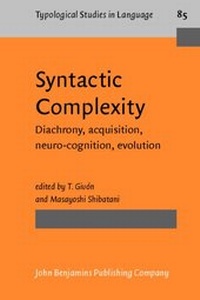
Syntactic Complexity
Diachrony, acquisition, neuro-cognition, evolution
1st Edition
Published on 22. April 2009
VI, 553 pages
978-90-272-9014-4 (ISBN)
Description

Complex hierarchic syntax is considered one of the hallmarks of human language. The highest level of syntactic complexity, recursive-embedded clauses, has been singled out by some for a special status as the apex of the uniquely-human language faculty - evolutionary but somehow immune to adaptive selection. This volume, coming out of a symposium held at Rice University in March 2008, tackles syntactic complexity from multiple developmental perspectives. We take it for granted that grammar is an adaptive instrument of communication, assembled upon the pre-existing platform of pre-linguistic cognition. Most of the papers in the volume deal with the two grand developmental trends of human language: diachrony, the communal enterprise directly responsible for fashioning synchronic morpho-syntax; and ontogeny, the individual endeavor directly responsible for the acquisition of competent grammatical performance. The genesis of syntactic complexity along these two developmental trends is considered alongside with the cognition and neurology of grammar and of syntactic complexity, and the evolutionary relevance of diachrony, ontogeny and pidginization is argued on general bio-evolutionary grounds. Lastly, several of the contributions to the volume suggest that recursive embedding is not in itself an adaptive target, but rather the by-product of two distinct adaptive gambits: the recruitment of conjoined clauses as modal operators on other clauses and the subsequent condensation of paratactic into syntactic structures.
More details
Other editions
Additional editions
T. Givon | Masayoshi Shibatani
Syntactic Complexity
Diachrony, acquisition, neuro-cognition, evolution
Book
04/2009
John Benjamins Publishing Co
€116.60
Shipment within 10-15 days
Persons
Content
Introduction
T. Givón
Part I. Diachrony
From nominal to clausal morphosyntax: Complexity via expansion
Bernd Heine
Re(e)volving complexity: Adding intonation
Marianne Mithun
Multiple routes to clause union: The diachrony of complex verb phrases
T. Givón
On the origins of serial verb constructions in Kalam
Andrew Pawley
A quantitative approach to the development of complex predicates: The case of Swedish Pseudo-Coordination with sitta "sit"
Martin Hilpert and Christian Koops
Elements of complex structures, where recursion isn't: The case of relativization
Masayoshi Shibatani
Nominalization and the origin of subordination
Guy Deutscher
The co-evolution of syntactic and pragmatic complexity: Diachronic and cross-linguistic aspects of pseudoclefts
Christian Koops and Martin Hilpert
Two pathways of grammatical evolution
Östen Dahl
Part II. Child language
On the role of frequency and similarity in the acquisition of subject and non-subject relative clauses
Holger Diessel
'Starting small' effects in the acquisition of early relative constructions in Spanish
Cecilia Rojas-Nieto
The ontogeny of complex verb phrases: How children learn to negotiate fact and desire
T. Givón
Part III. Cognition and neurology
Syntactic complexity versus concatenation in a verbal production task
Marjorie Barker and Eric Pederson
The emergence of linguistic complexity
Brian MacWhinney
Cognitive and neural underpinnings of syntactic complexity
Diego Fernandez-Duque
Neural mechanisms of recursive processing in cognitive and linguistic complexity
Don M. Tucker, Phan Luu and Catherine Poulsen
Syntactic complexity in the brain
Angela D. Friederici and Jens Brauer
Part IV. Biology and evolution
Neural plasticity: The driving force underlying the complexity of the brain
Nathan Tublitz
Recursion: Core of complexity or artifact of analysis?
Derek Bickerton
Index
T. Givón
Part I. Diachrony
From nominal to clausal morphosyntax: Complexity via expansion
Bernd Heine
Re(e)volving complexity: Adding intonation
Marianne Mithun
Multiple routes to clause union: The diachrony of complex verb phrases
T. Givón
On the origins of serial verb constructions in Kalam
Andrew Pawley
A quantitative approach to the development of complex predicates: The case of Swedish Pseudo-Coordination with sitta "sit"
Martin Hilpert and Christian Koops
Elements of complex structures, where recursion isn't: The case of relativization
Masayoshi Shibatani
Nominalization and the origin of subordination
Guy Deutscher
The co-evolution of syntactic and pragmatic complexity: Diachronic and cross-linguistic aspects of pseudoclefts
Christian Koops and Martin Hilpert
Two pathways of grammatical evolution
Östen Dahl
Part II. Child language
On the role of frequency and similarity in the acquisition of subject and non-subject relative clauses
Holger Diessel
'Starting small' effects in the acquisition of early relative constructions in Spanish
Cecilia Rojas-Nieto
The ontogeny of complex verb phrases: How children learn to negotiate fact and desire
T. Givón
Part III. Cognition and neurology
Syntactic complexity versus concatenation in a verbal production task
Marjorie Barker and Eric Pederson
The emergence of linguistic complexity
Brian MacWhinney
Cognitive and neural underpinnings of syntactic complexity
Diego Fernandez-Duque
Neural mechanisms of recursive processing in cognitive and linguistic complexity
Don M. Tucker, Phan Luu and Catherine Poulsen
Syntactic complexity in the brain
Angela D. Friederici and Jens Brauer
Part IV. Biology and evolution
Neural plasticity: The driving force underlying the complexity of the brain
Nathan Tublitz
Recursion: Core of complexity or artifact of analysis?
Derek Bickerton
Index
