

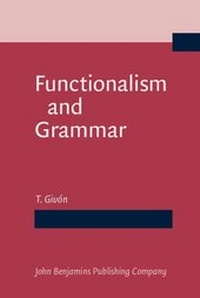
Functionalism and Grammar
1st Edition
Published on 1. June 1995
XVII, 486 pages
978-90-272-7399-4 (ISBN)
Description

This book is Prof. Givón's long-awaited critical examination of the fundamental theoretical and methodological underpinnings of the functionalist approach to grammar. It challenges functionalists to take their own medicine and establish non-circular empirical definitions of both 'function' and 'structure'. Ideological hand-waving, however fervent and right-thinking, is seldom an adequate substitute for analytic rigor and empirical responsibility. If the reductionist extremism of the various structuralist schools is to be challenged on solid intellectual grounds, the challenge cannot itself be equally extreme in its reductionism.
The book is divided into nine chapters: 1. Prospectus, somewhat jaundiced (overview)
2. Markedness as meta-iconicity: Distributional and cognitive correlates of syntactic structure
3. The functional basis of grammatical typology
4. Modal prototypes of truth and action
5. Taking structure seriously: Constituency and the VP node
6. Taking structure seriously II: Grammatical relations and clause union
7. The distribution of grammar in text: On interpreting conditional associations
8. Coming to terms with cognition: Coherence in text vs. coherence in mind
9. On the co-evolution of language, mind and brain.
The book is divided into nine chapters: 1. Prospectus, somewhat jaundiced (overview)
2. Markedness as meta-iconicity: Distributional and cognitive correlates of syntactic structure
3. The functional basis of grammatical typology
4. Modal prototypes of truth and action
5. Taking structure seriously: Constituency and the VP node
6. Taking structure seriously II: Grammatical relations and clause union
7. The distribution of grammar in text: On interpreting conditional associations
8. Coming to terms with cognition: Coherence in text vs. coherence in mind
9. On the co-evolution of language, mind and brain.
More details
Other editions
Additional editions
T. Givon
Functionalism and Grammar
Book
06/1995
John Benjamins Publishing Co
€137.80
Shipment within 10-15 days
Person
Content
- FUNCTIONALISM AND GRAMMAR
- Dedication
- Title page
- Copyright page
- Table of contents
- Preface
- 1. Prospectus,Somewhat Jaundiced
- 1.1. Historical notes
- 1.1.1. Antecedence and antecedents
- 1.1.2. The legacy of structuralism
- 1.1.3. Direct descent
- 1.2. From faith to theory
- 1.3. Naive iconism and the reality of formal structure
- 1.4. The mess inbetween discreteness and graduality
- 1.5. Clear distinctions and partial overlaps
- 1.6. Taking cognition and neurology seriously
- 1.7. Typological diversity and language universals
- 1.8. Methodology
- 1.8.1. Intuition and its limits
- 1.8.2. Induction and quantification
- 1.8.3. Deductive reasoning
- 1.8.4. Community
- Notes
- 2. Markedness as Meta-Iconicity:Distributional and Cognitive Correlatesof Syntactic Structure
- 2.1. Introduction
- 2.1.1. Markedness and explanation
- 2.1.2. Brief historical note
- 2.1.3. The context-dependence of markedness
- 2.1.4. Criteria for markedness
- 2.2. Markedness of discourse types
- 2.2.1. Oral-informal vs. written-formal discourse
- 2.2.1.1. Structural complexity
- 2.2.1.2. Frequency distribution
- 2.2.1.3. Cognitive complexity
- 2.2.2. Human-affairs vs. abstract-academic discourse
- 2.2.3. Conversation vs. narrative/procedural discourse
- 2.3. Markedness of clause types
- 2.3.1. Preamble
- 2.3.2. Main vs. subordinate clauses
- 2.3.2.1. Complexity and finiteness
- 2.3.2.1.1. Finiteness in subordinate clauses
- 2.3.2.1.2. Finiteness in conjoined main clauses
- 2.3.2.2. Frequency distribution
- 2.3.2.3. Cognitive complexity
- 2.3.2.4. Other substantive considerations
- 2.3.3. The markedness of speech-act types
- 2.3.3.1. Structural complexity
- 2.3.3.2. Frequency distribution
- 2.3.3.3. Cognitive complexity
- 2.3.3.4. Other substantive considerations
- 2.3.4. Markedness of affirmative and negative clauses
- 2.3.4.1. Structural complexity
- 2.3.4.2. Frequency distribution
- 2.3.4.3. Cognitive complexity
- 2.3.5. Markedness of active and passive voice
- 2.3.5.1. Structural complexity
- 2.3.5.2. Text frequency
- 2.3.5.3. Cognitive complexity
- 2.3.5.4. Other substantive considerations
- 2.4. Markedness of nominal modalities
- 2.4.1. Preamble
- 2.4.2. Case-role and markedness
- 2.4.2.1. The topic hierarchies
- 2.4.2.2. Structural complexity
- 2.4.2.3. Frequency distribution
- 2.4.2.4. Cognitive complexity
- 2.4.3. Referentiality and individuation
- 2.4.4. Definiteness
- 2.4.4.1. Structural complexity
- 2.4.4.2. Frequency distribution
- 2.4.4.3. Cognitive complexity
- 2.4.5. Anaphoric status
- 2.4.5.1. Structural complexity
- 2.4.5.2. Frequency distribution
- 2.4.5.3. Cognitive complexity
- 2.4.6. Topicality and referential continuity
- 2.4.6.1. Continuous vs. discontinuous topics
- 2.4.6.2. Structural complexity
- 2.4.6.3. Frequency distribution
- 2.4.6.4. Cognitive complexity
- 2.5. Markedness of verbal modalities
- 2.5.1. Suggested markedness values
- 2.5.2. Structural complexity
- 2.5.3. Frequency distribution
- 2.5.4. Substantive considerations
- 2.5.4.1. Modality
- 2.5.4.2. Perfectivity
- 2.5.4.3. The perfect
- 2.5.4.3.1. Counter-sequentiality
- 2.5.4.3.2. Relevance
- 2.6. Markedness as meta-iconicity
- 2.6.1. Meta-iconicity and naive iconism
- 2.6.2. Diachronic change and markedness reversal
- 2.6.2.1. Ritualized structure
- 2.6.2.2. Cyclic fluctuations of markedness
- 2.7. Naive functionalism and excess structure
- 2.8. Markedness, cognition and communication
- 2.8.1. Saliency and frequency
- 2.8.2. Cognitive vs. cultural saliency
- Notes
- 3. The Functional Basis of Grammatical Typology
- 3.1. Introduction
- 3.2. The functional basis of grammatical typology
- 3.3. The semantics of transitivity
- 3.4. The pragmatics of de-transitive voice
- 3.5. Definition and measurement of topicality
- 3.5.1. Anaphoric and cataphoric dimensions
- 3.5.2. Quantitative identification of voice constructions
- 3.5.2.1. Topicality measures
- 3.5.2.2. Frequency distribution in text
- 3.5.2.3. Frequency of non-anaphoric agent or patient deletion
- 3.6. Syntactic-typological correlates of de-transitive voice
- 3.6.1. Subjecthood and voice
- 3.6.2. Grammatical relations in the de-transitive clause
- 3.6.2.1. Syntactic demotion
- 3.6.2.2. Syntactic promotion
- 3.6.3. Toward a cross-linguistic typology of inverse constructions
- 3.6.3.1. Syntactic-typological dimensions
- 3.6.3.2. Pronominal (morphological) vs. word-order inverse
- 3.6.3.2.1. Pronominal inverses
- 3.6.3.2.2. Word-order inverses
- 3.6.3.3. Full-NP case marking in the inverse clause
- 3.6.3.4. Obligatory semantic inversion
- 3.6.3.5. Promotional vs. non-promotional inverse
- 3.7. Diachronic change and the typology of inverse
- 3.7.1. The diachronic underpinnings of synchronic typology
- 3.7.2. From word-order inverse to pronominal inverse
- 3.7.3. From pragmatic to semantic inversion
- 3.7.4. From inverse to ergative
- 3.7.5. Diachronic connections between inverse and passive
- 3.7.5.1. From promotional passive to promotional inverse
- 3.7.5.2. From agent-of-inverse to agent-of-passive
- 3.8. Conclusion
- Notes
- 4. Modal Prototypes of Truth and Action
- 4.1. Introduction
- 4.1.1. Perspective
- 4.1.2. Goals
- 4.2. Propositional modalities
- 4.2.1. Traditional view of modality
- 4.2.2. The communicative definition of modality
- 4.3. The distribution of irrealis over grammatical contexts
- 4.3.1. Tense-aspect and irrealis
- 4.3.2. Irrealis-inducing adverbs
- 4.3.3. Irrealis in verb complements
- 4.3.4. Non-declarative speech-acts and irrealis
- 4.3.5. Irrealis in adverbial clauses
- 4.3.6. Modal auxiliaries and the markedness status of the irrealis sub-modes
- 4.4. The distribution of the subjunctive across irrealis subordinate clauses
- 4.4.1. Preamble
- 4.4.2. The subjunctive in verb complements
- 4.4.2.1. The complementation scale
- 4.4.2.2. The subjunctive of weak manipulation
- 4.4.2.3. The subjunctive of low certainty
- 4.4.2.3.1. From deontic to epistemic modality
- 4.4.2.3.2. Unified subjunctive
- 4.4.2.3.3. Split subjunctive
- 4.4.3. The subjunctive in adverbial clauses
- 4.4.3.1. Preamble
- 4.4.3.2. English
- 4.4.3.3. Bemba
- 4.4.3.4. Swahili
- 4.4.3.5. Spanish
- 4.5. The subjunctive in main clauses
- 4.5.1. Preamble
- 4.5.2. The subjunctive of weak manipulation
- 4.5.2.1. English
- 4.5.2.2. Spanish
- 4.5.2.3. Bemba
- 4.5.3. The subjunctive of low certainty
- 4.5.3.1. English
- 4.5.3.2. Spanish
- 4.5.3.3. Bemba
- 4.6. Three subjunctive puzzles
- 4.6.1. Subjunctives in Spanish relative clauses
- 4.6.2. Subjunctive in Spanish factive complements
- 4.6.3. The use of past or perfect as subjunctive forms
- 4.6.3.1. Realis-marked subjunctives
- 4.6.3.2. Past or perfect marked counter-fact clauses
- 4.6.3.3. Explanations
- 4.7. Functional universals and typological variation
- 4.7.1. The reality of irrealis
- 4.7.2. The functional coherence of irrealis
- 4.7.3. The grammatical marking of irrealis and the functional basis of grammatical typology
- 4.7.4. Typological diversity as diachronic source diversity
- 4.8. Conclusion
- Notes
- 5. Taking Structure Seriously, I: Constituency and the VP Node
- 5.1. The grammar denial syndrome
- 5.2. Constituency and hierarchic structure
- 5.3. The VP node
- 5.3.1. Preliminaries
- 5.3.2. Criteria
- 5.4. Joint extraction and joint anaphoric reference
- 5.5. The noun-incorporation argument
- 5.6. Intermezzo: Configurational case-marking
- 5.7. The VSO-language argument
- 5.8. The VP node in multi-verb clauses
- 5.8.1. Preamble
- 5.8.2. Complementation and grammaticalized auxiliaries in embedding languages
- 5.8.3. Complementation and grammaticalized auxiliaries in verb-serializing languages
- 5.8.4. The verb phrase in serial-verb languages
- 5.8.4.1. Configurational accounts of serial clauses
- 5.8.4.2. Verb serialization and the distribution of finite verbal morphology
- 5.8.4.3. The typological chasm
- 5.9. Discussion
- 5.9.1. The generative paradigm as problem generator
- 5.9.2. Constituency and the VP node
- 5.9.3. Alternative means of signalling constituency: Adjacency and morphological binding
- 5.9.4. The reality of grammar
- Notes
- 6. Taking Structure Seriously, II: Grammatical Relations
- 6.1. Introduction
- 6.2. Semantic vs. grammatical case: The dissociation test
- 6.3. Empirical criteria for grammatical relations
- 6.3.1. The prototype clustering approach to categories
- 6.3.2. The clustering approach to grammatical relations
- 6.4. Formal properties of subjects and objects
- 6.4.1. Preamble
- 6.4.2. Overt coding properties
- 6.4.3. Verb-coding of grammatical roles
- 6.4.4. Behavior-and-control properties
- 6.4.4.1. The problem of applicability
- 6.4.4.2. Conflicts with overt coding properties
- 6.4.4.3. Relativization and grammatical relations
- 6.4.4.4. Passivization and grammatical relations
- 6.4.4.5. Equi-NP deletion and grammatical relations
- 6.4.4.6. Reflexives and grammatical relations
- 6.5. Gradations and indeterminacy of grammatical relations
- 6.5.1. Preamble
- 6.5.2. Gradation of direct objecthood
- 6.5.3. Gradation of subjecthood
- 6.5.4. A functional account of cross-language variability: The ranking of formal subject and object properties
- 6.6. Grammatical relations in ergative languages
- 6.6.1. Overt coding properties in ergative languages
- 6.6.1.1. Nominal morphology: Split subject marking
- 6.6.1.2. Control of verb agreement
- 6.6.1.3. Word order in ergative languages
- 6.6.2. Behavior-and-control properties in ergative languages
- 6.6.2.1. Preamble
- 6.6.2.2. Control of equi
- 6.6.2.3. Control of reflexivization
- 6.6.2.4. Control of zero anaphora in chained clauses
- 6.6.2.5. Control of relativization
- 6.6.2.6. Raising to object
- 6.6.2.7. Overview: Mixed control of syntactic processes and gradation in grammatical relations
- 6.7. Grammatical relations in serial-verb languages
- 6.7.1. Preamble
- 6.7.2. Multiple objects in serial clauses
- 6.7.3. The grammatical subject in serial clauses
- 6.8. Grammatical relations and clause union
- 6.8.1. Preamble
- 6.8.2. Syntactic constraints on clause union
- 6.8.2.1. Clause union in equi-subject (SS) configurations
- 6.8.2.1.1. Embedding languages
- 6.8.2.1.2. Serializing languages
- 6.8.2.2. Clause union in switch-subject (DS) configurations
- 6.8.2.2.1. Embedding languages
- 6.8.3. Degree of grammaticalization and re-analysis of grammatical relations
- 6.8.4. Clause union, reflexivization and grammatical relations
- 6.9. Recapitulation
- 6.9.1. The clustering approach to grammatical relations
- 6.9.2. Ergativity and grammatical relations
- 6.9.3. Serial verbs and grammatical relations
- 6.9.4. Clause union and grammatical relations
- Notes
- 7. The Distribution of Grammar in Text: On Interpreting Conditional Associations
- 7.1. Introduction
- 7.2. The problem of access
- 7.2.1. The limits of conscious reflection
- 7.2.2. Definitions and observations
- 7.2.3. Discourse context as a heuristic
- 7.3. Methodological perspective
- 7.4. Conditional associations
- 7.5. Case studies
- 7.5.1. Word-order in Mandarin Chinese
- 7.5.1.1. Background
- 7.5.1.2. The Mandarin facts
- 7.5.1.3. Interim explanation
- 7.5.1.4. Falsificatory testing
- 7.5.1.5. A broader theoretical context
- 7.5.1.5.1. The cognitive basis of word-order pragmatics
- 7.5.1.5.2. The inherent bias in form:function correlations
- 7.5.1.5.3. Searching for structures vs. searching for functions
- 7.5.1.5.4. The cross-language validity of "same function
- 7.5.2. Word-order in Tagalog
- 7.5.3. Scalarity vs. discreteness of "topic
- 7.6. Hypotheses about the text vs. hypotheses about the mind
- 7.6.1. The perils of distributional reductionism
- 7.6.2. The perils of cognitive reductionism
- 7.7. Closure
- Notes
- 8. Coming to Terms with Cognition: Coherence in Text vs. Coherence in Mind
- 8.1. Introduction
- 8.2. Coherence and grounding
- 8.2.1. Coherence strands in the external text
- 8.2.2. Coherence as a mental entity
- 8.2.2.1. The working memory buffer
- 8.2.2.2. Episodic memory
- 8.2.3. Coherence as grounding
- 8.2.3.1. Preamble
- 8.2.3.2. Cataphoric ('anticipatory') grounding
- 8.2.3.3. Anaphoric grounding
- 8.2.3.3.1. Preamble: Definite reference
- 8.2.3.3.2. Grounding to the speech situation
- 8.2.3.3.3. Grounding to generic-lexical knowledge
- 8.2.3.3.4. Grounding into the current text
- 8.2.4. The extreme bounds of coherence
- 8.3. Knowledge-driven vs. grammar-cued coherence
- 8.3.1. Preamble
- 8.3.2. Grammar as an automated discourse-processing mode
- 8.4. Local vs. global coherence
- 8.5. Mechanisms of coherence
- 8.5.1. Preamble
- 8.5.2. Spatial coherence
- 8.5.2.1. Vocabulary-guided spatial coherence
- 8.5.2.2. Grammar-cued spatial coherence
- 8.5.3. Temporal coherence
- 8.5.3.1. Vocabulary-guided temporal coherence
- 8.5.3.2. Grammar-cued temporal coherence
- 8.5.3.2.1. Tense-aspect and temporal coherence
- 8.5.3.2.2. Temporal adverbial connectors
- 8.5.3.2.3. Temporal adverbial clauses
- 8.5.4. Thematic coherence
- 8.5.4.1. Vocabulary-guided action coherence
- 8.5.4.2. Grammar-cued thematic coherence
- 8.5.5. Referential Coherence
- 8.5.5.1. grammar vs. Lexicon, local vs. Global
- 8.5.6. Text frequency, markedness and cognitive default
- 8.6. The grammar of referential coherence as mental processing cues
- 8.6.1. Preliminaries
- 8.6.2. Cognitive model
- 8.6.3. Some general principles
- 8.7. Discussion
- 8.7.1. Local vs. global coherence
- 8.7.2. Vocabulary-guided vs. grammar-cued coherence
- 8.7.3. Why is anaphoric grounding necessary?
- 8.7.4. Grammar, episodic storage and working memory: The thematic flexibility of episodic representation
- 8.7.5. Closure
- Notes
- 9. On the Co-evolution of Language, Mind and Brain
- 9.1. Introduction
- 9.2. The functional components of human communication
- 9.2.1. The cognitive representation system
- 9.2.1.1. The conceptual lexicon
- 9.2.1.2. Propositional information and clauses
- 9.2.1.3. Multi-propositional discourse
- 9.2.2. The coding systems
- 9.2.2.1. Peripheral sensory-motor coding system
- 9.2.2.2. The grammar coding system
- 9.2.2.2.1. Preamble
- 9.2.2.2.2. Grammar as a code
- 9.2.2.2.3. Pre-grammatical vs. grammaticalized communication
- 9.2.3. Summary of mapping between codes and functions
- 9.3. Pre-grammar as proto-grammar
- 9.4. Visual information processing in the primate cortex
- 9.4.1. Directionality and hierarchy
- 9.4.2. Retinotopic spatial maps
- 9.4.3. The two streams of visual information processing
- 9.4.4. Correspondences between visual and linguistic information
- 9.5. Language-specific neurology in the left hemisphere
- 9.5.1. Modularity and interaction
- 9.5.2. The semantic lexicon
- 9.5.2.1. Localization
- 9.5.2.2. Unified vs. bi-modal lexicon
- 9.5.3. Episodic memory
- 9.5.3.1. Localization
- 9.5.3.2. Modality of input
- 9.5.4. The peripheral coders and de-coders
- 9.5.4.1. Peripheral word-recognition modules
- 9.5.4.2. The peripheral motor codes
- 9.5.5. The grammar module and Broca's area
- 9.5.6. Neuro-evolutionary considerations
- 9.5.6.1. Sub-differentiation and adjacency
- 9.5.6.2. Input adjustment
- 9.5.6.3. Re-training by adjacency
- 9.6. The co-evolution scenario
- 9.6.1. Cognitive pre-adaptations
- 9.6.1.1. The conceptual lexicon
- 9.6.1.2. Propositional information
- 9.6.2. The rise of a well-coded lexicon
- 9.6.2.1. Preamble: Well-coded signals
- 9.6.2.2. From pre-lexical to lexicalized coding: Attention-getting and referent-pointing
- 9.6.2.3. From 'secular' to communicative behavior
- 9.6.2.4. Early co-existence of auditory-vocal and visual-gestural codes
- 9.6.3. The shift to audio-oral coding
- 9.6.3.1. Adaptive advantages
- 9.6.3.2. Neurological adjustment
- 9.6.3.3. Expansion and abstraction of the vocabulary
- 9.6.4. The shift in speech-act value
- 9.6.5. The evolution of grammar
- 9.6.5.1. Preamble
- 9.6.5.2. The pre-grammar mono-propositional stage
- 9.6.5.3. Proto-grammar and multi-propositional discourse
- 9.6.5.4. Grammaticalization
- 9.6.5.4.1. Episodic trace of the current text
- 9.6.5.4.2. The retention of proto-grammar: Combining iconic and symbolic elements in the grammaticalized code
- 9.7. Discussion
- 9.7.1. Convergence
- 9.7.2. Why the change to auditory coding?
- 9.7.3. Modularity, gapped evolution and pre-adaptation
- 9.7.4. Closure: Co-evolution and multiple causality
- Notes
- Bibliography
- Index
