

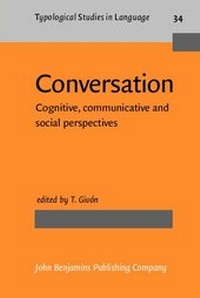
Conversation
Cognitive, communicative and social perspectives
1st Edition
Published on 7. May 1997
VIII, 302 pages
978-90-272-7579-0 (ISBN)
Description

The papers in this volume were originally presented at the Symposium on Conversation, held at the University of New Mexico in July 1995. The symposium brought together scholars who work on face-to-face communication from a variety of perspectives: social, cultural, cognitive and communicative. Our aim for both the symposium and this volume has been to challenge some of the prevailing dichotomies in discourse studies: First, the cleavage between the study of information flow and the study of social interaction. Second, the theoretical division between speech-situation models and cognitive models. Third, the methodological split between the study of spontaneous conversation in natural context and the study of speech production and comprehension under controlled experimental conditions. And fourth, the rigid genre distinction between narrative and conversational discourse.
All four dichotomies have been useful either methodologically or historically. But important as they may have been in the past, the time has perhaps come to work toward an integrated approach to the study of human communication, one that will be less dependent on narrow reductions.
Both the ontological primacy and the methodological challenge of natural face-to-face communication are self evident. Human language has evolved, is acquired, and is practiced most commonly in the context of face-to-face communication. Most past theory-building in either linguistics or psychology has not benefited from the study of face-to-face communication, a fact that is regrettable and demands rectification. We hope that this volume tilts in the right direction.
All four dichotomies have been useful either methodologically or historically. But important as they may have been in the past, the time has perhaps come to work toward an integrated approach to the study of human communication, one that will be less dependent on narrow reductions.
Both the ontological primacy and the methodological challenge of natural face-to-face communication are self evident. Human language has evolved, is acquired, and is practiced most commonly in the context of face-to-face communication. Most past theory-building in either linguistics or psychology has not benefited from the study of face-to-face communication, a fact that is regrettable and demands rectification. We hope that this volume tilts in the right direction.
More details
Other editions
Additional editions
Book
05/1997
John Benjamins Publishing Co
€132.50
Shipment within 10-15 days
Person
Content
- CONVERSATION COGNITIVE, COMMUNICATIVE AND SOCIAL PERSPECTIVES
- Editorial page
- Title page
- Copyright page
- Table of contents
- Editor's Preface
- Dialoguedespite Difficulties A Study of Communication between Aphasic and Unimpaired Speakers
- 1. Background
- 1.1. Introduction
- 1.2. Studies of the communicative abilities of aphasic speakers
- 1.3. Studies of non-verbal communication in aphasia
- 2. Method
- 2.1. Subjects
- 2.2. The Communicative Task
- 3. Results
- 3.1. Communicative performance
- 3.2. Dialogue Analysis
- 3.3. Coding and Reliability
- 3.4. Results of dialogue analyses
- 4. Gesture
- 4.1. Analysis of Gesture
- 4.2. Gesture Coding Results
- 5. Discussion
- Acknowledgments
- References
- Polyphonic Topic Development
- What is a Text?
- Transcription conventions
- References
- The Construction of a Collaborative Floor in Women's Friendly Talk
- 1. Women and jam sessions
- 2. Jointly constructed utterances
- 2.1. Joint construction involving simultaneous speech
- 2.2. Incomplete utterances
- 2.3. Finding the right word
- 3. Overlapping speech
- 4. The collaborative floor
- 4.1. Two examples
- 4.2. The test of acceptance
- 4.3. Minimal responses
- 4.4. Laughter
- 4.5. Talk as play
- Transcription Conventions
- Acknowledgments
- Notes
- References
- Memory and Conversation Toward an Experimental Paradigm
- 1. Background
- 2. Relevant cognitive systems
- 2.1. Shared information as mental models
- 2.2. Episodic memory
- 2.3. Working memory
- 3. Mental representation of the current speech situation
- 3.1. Spatial-temporal deixis
- 3.2. Mental representation of the hearer's current be lief-and-intention states
- 3.3. Other mental models relevant to the use of grammar
- 4. Methodology
- 4.1. Overall design
- 4.2. Text elicitation
- 4.3. Subjects
- 4.4. Computing a base-line control for recalled information
- 4.5. Semantic considerations
- 4.6. General experimental procedures
- 4.7. Control conditions I, II, III
- 5. Conditions I, II, III
- 5.1. Procedures
- 5.1.1. Condition I
- 5.1.2. Conditions II, III
- 5.2. Results
- 5.3. Further analysis
- 5.4. Interim discussion: Conditions I, II, III
- 6.Condition IV
- 6.1. General considerations
- 6.2. Procedures
- 6.3. Results
- 6.4. Cross-subject individual variation
- 6.5. Interim discussion of condition IV
- 7.Condition V
- 7.1. General considerations
- 7.2. Procedures
- 7.3. Results
- 7.4. Analysis of individual variation
- 7.5. Interim discussion
- 8. Discussion
- 8.1. Conversational cooperation and episodic recall
- 8.2. Integration of episodic and situational memory
- Appendix: Baseline clauses and number of subjects contributing each*)
- References
- The Occasioning and Structure of Conversational Stories
- 1. Orientation
- 2. Narrative genre vs. narrative production
- 3. Standard narrative
- 4. A boundary case
- 4.1. Databases for study
- 4.2. Locating narratives in transcripts
- 5. Observed features and contexts of conversational narratives
- 5.1. Elicited/prefaced narratives
- 5.2. Rounds of stories
- 5.3. Environmentally cued narratives
- 5.4. Narratives presenting problems
- 5.5. Narratives as performances
- 5.6. Tactical narratives
- 6. Conclusions
- Notes
- References
- Coherence in Multi-Party Conversation Episodes and Contexts in Interaction
- 1. Introduction: Coherence-building in conversation
- 2. Local and global coherence
- 3. Episodes and the dynamics of topic progression in conversation
- 4. Contextual resources in conversation
- 5. Topical Episode Analysis
- 6. Categories of episodes in conversation
- 7. Topical episodes as islands of temporarily shared understanding
- 8. Fragmentation in multi-party conversation
- 9. Concluding remarks: Coherence inside, between and across episodes
- Notes
- References
- Choosing the Right Quantifier Usage in the Context of Communication
- 1. Introduction
- 2. Laboratory studies of quantifier function
- 2.1. Quantity
- 2.2. Perspectives: Monotonicity and focus
- 2.3. Levels of interpretation
- 2.4. Conclusion
- 3. A substitution task using naturally occurring sentences
- 3.1. Corpus
- 3.2. Experiment
- 4. Vignette studies of quantifier selection
- 4.1. When refset patterns should be best
- 4.2. Compset focus and the requirement to disengage the listener
- 4.3. Requirement to engage the listener
- 6. General discussion
- 7. The broader perspective
- Acknowledgements
- Notes
- References
- Conflict Talk Understanding and Resolving Arguments
- 1. Background
- 1.1. Understanding an argument and choosing sides
- 1.2. Individual differences in prior knowledge about an argument
- 1.3. Review of past research on conflict
- 2. Method
- 2.1. Subjects
- 2.2. Materials
- 2.3. Design
- 2.4. Procedure
- 2.4.1. Screening interview
- 2.4.2. Pre-negotiation interview
- 2.4.3. Negotiation session
- 3. Results
- 3.1. Beginning the negotiation: The status of initial knowledge
- 3.1.1. The number of supporting and opposing reason for both positions
- 3.1.2. The content of supporting and opposing reasons
- 3.2. The relationship between commitment, desired strategy and initial knowledge
- 3.3. Predicting the outcomes of negotiation
- 3.3.1. The effect of instructions to compromise on negotiated outcomes
- 3.3.2. The effect of gender on negotiated outcomes
- 3.3.3. The relationship between initial knowledge and negotiated outcome
- 3.3.4. The relationships between initial knowledge, desired strategy, commitmentand negotiated outcome
- 3.4. Biases in position selection as a function of outcome
- 3.5. Explanations for ending the negotiation in a compromise or a win-loss
- 3.6. Conflict talk among compromisers versus winners and losers
- 4. Discussion
- 4.1. Initial knowledge
- 4.1.1. Amount and type of argument knowledge
- 4.1.2. The content of supporting and opposing reasons
- 4.2. The effects of instructions on the outcomes of negotiation
- 4.3. Relationships among initial knowledge, desired strategy, commitment and outcome
- 4.4. The relationship between the conversational focus and the outcome
- 5. General conclusions
- Acknowledgements
- Notes
- References
- Appendix: Borrowing money scenario
- Friendship scenario
- Communicating Evaluation in Narrative Understanding
- 1.1. Example narrative episode and structure
- 1.2. Verbal protocols
- 2. "Thinking aloud": A study of communicating one's understanding during reading
- 2.1. Example Protocol
- 2.2. Linguistic Devices
- 3. Evaluations of episodic constituents
- 3.1. Initiating events
- 3.2. Reader appraisals of initiating events
- 3.3. Character preferences for/against initiating even
- 3.4. Emotions as reactions to initiating events
- 3.5. Goals as evaluations of initiating events
- 3.6. Evaluations of goals
- 3.7. Character preference for/against goals
- 3.8. Reader appraisal of goals
- 3.9. Character emotion
- 3.10. Character outcome
- 3.11. Evaluation of attempts
- 3.12. Appropriate means to achieve goals
- 3.13. Appropriate outcomes (ends)
- 3.14. Evaluation of outcomes
- 3.15. Goal success or failure
- 3.16. Emotions
- 3.17. Evaluations of emotion
- 3.18. Positive emotions
- 3.19. Negative emotions
- 3.20. Preference and emotion explanations
- 4. Discussion
- Acknowledgment
- References
