

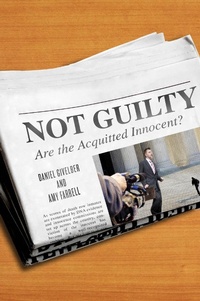
Not Guilty
Are the Acquitted Innocent?
Published on 11. June 2012
277 pages
978-0-8147-4440-6 (ISBN)
Description

As scores of death row inmates are exonerated by DNA evidence and innocence commissions are set up across the country, conviction of the innocent has become a well-recognized problem. But our justice system makes both kinds of errors-we acquit the guilty and convict the innocent-and exploring the reasons why people are acquitted can help us to evaluate the efficiency and fairness of our criminal justice system. Not Guilty provides a sustained examination and analysis of the factors that lead juries to find defendants "not guilty," as well as the connection between those factors and the possibility of factual innocence, examining why some criminal trials result in not guilty verdicts and what those verdicts suggest about the accuracy of our criminal process.
Reviews / Votes
Excellent acquisition for criminal justice, law, and crime collections. Summing up: highly recommended. All readership levels. - D. Schultz, Hamline University (Choice) In their terrific if misleadingly titled new book, Not Guilty: Are the Acquitted Innocent?, Daniel Givelber and Amy Farrell ask a practically unanswerable question: how many defendants who are acquitted at trial are actually innocent?... it is immensely valuable for the close look it provides at what we know, and can know, about the correctness of jury verdicts. - Darryl K. Brown (Criminal Law and Criminal Justice Books) This interdisciplinary scholarship between law and a social science is sorely needed in the United States and I hope Givelber and Farrell have begun a trend that is so well established in other countries such as Germany and England. The authors are to be commended for writing a book that is thought provoking and vitally important in understand an ignored area of our justice system. - Robert Costello (Social and Legal Studies) An acquittal is the most powerful and final of legal judgments. It may not be reviewed let alone reversed. It is also, perhaps, the least respected. After a criminal defendant has been convicted, prosecutors and judges often resist efforts to reconsider the verdict, even in the face of strong new evidence of innocence, because & the jury has spoken. When a defendant is acquitted they are as likely say & that doesnt mean hes innocent.In Not Guilty Daniel Givelber and Amy Farrell explore this anomaly.Givelber and Farrell make a persuasive case that most jury acquittals are based on evidence not emotion, and that acquittals should be taken to mean what they say: that the defendant is Not Guilty. - Samuel Gross,co-author of A Modern Approach to Evidence: Text, Problems, Transcripts, and Cases Daniel Givelber and Amy Farrell have written a brilliant book that masterfully debunks the conventional wisdom that those who are charged with crimes in our criminal justice system, even when they are acquitted at trial, are almost certainly guilty. Drawing on extensive empirical research, this book systematically analyzes the sources of judge-jury disagreement about leniency and acquittals. This book challenges us to rethink our assumptions about the meaning of an acquittal in a system that asymmetrically treats & guilty verdicts as factual but & not guilty verdicts are merely procedural. It also exposes how false assumptions about the probable guilt of the acquitted contribute to miscarriages of justice. This is a book that anyone interested in the accuracy and fairness of the criminal justice system should read. It is a data-driven tour de force. - Richard A. Leo,author of Police Interrogation and American Justice This book is powerful, strong, and convincing. It is written at a level that undergraduates can understand and it avoids arcane academic language so that the book can be read and understood by practitioners, academics, and the general public...The book is quite informative, but it is also succinct and can be read quickly and easily. This book is likely to inform our understanding of jury behavior and of the nature of acquittals for years to come. (Crime Law and Social Change)More details
Language
English
Place of publication
New York
United States
Target group
Professional and scholarly
Product notice
Reflowable
ISBN-13
978-0-8147-4440-6 (9780814744406)
Copyright in bibliographic data and cover images is held by Nielsen Book Services Limited or by the publishers or by their respective licensors: all rights reserved.
Schweitzer Classification
Other editions
Additional editions
Book
06/2012
New York University Press
€49.00
Shipment within 15-20 days
Persons
Daniel Givelber is Professor of Law and former Dean at Northeastern Law School of Law. A founding member of the New England Innocence Project, he has also been involved in death penalty litigation both through directing Northeastern's Certiorari Clinic and by the successful decade long representation of a death row inmate.
Amy Farrell is Associate Professor of Criminology and Criminal Justice at Northeastern University.
Amy Farrell is Associate Professor of Criminology and Criminal Justice at Northeastern University.
Content
Introduction: Invisible Innocence
2 Judge and Jury Decisions to Acquit: What We
Know from Social Science Research
3 Screening for Innocence
4 Understanding Why Judges and Juries Disagree
about Criminal Case Outcomes: Are Jury
Verdicts an Expression of Sentiment?
5 Th e Defense Case
6 Th e Impact of Race on Judge and Jury
Decision Making
7 Conclusion
Appendix A
Appendix B
Appendix C
Notes
Bibliography
Index
About the Author
