

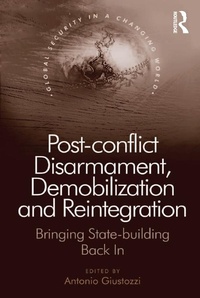
Post-conflict Disarmament, Demobilization and Reintegration
Bringing State-building Back In
Published on 8. April 2016
160 pages
978-1-317-07738-1 (ISBN)
Description

This book revisits post-Cold War Disarmament Disintegration and Reintegration (DDR) programmes in the light of previous experiences of disarmament, demobilisation and reintegration. In the history of North America and Europe, in particular, such programmes had a major impact on state-building, contributing to the development of the welfare state, shaping political settlements and directing government policy to maintain social peace. The authors in this important book ask what is left of these state-building dimensions in contemporary DDR programmes and whether the constraints imposed by international organisations on DDR programmes have more negative effects than positive ones. The role of political leadership in DDR processes is highlighted: can bureaucratically-driven processes deliver success? Only if political elites take full control and manage DDR programmes can there be a lasting impact on state-building. Even then, most political elites avoid deep changes in their relationship with the veterans. Is there a chance of reshaping international intervention in such a way as to favour the development of a 'social contract' between political elites and veterans? In taking a historical perspective, this book is unique in the existing literature on DDR and will be essential reading for policy makers, students and scholars of conflict studies, and those working in NGOs, particularly donor agencies. This volume was produced with the contribution of the Crisis States Research Centre (LSE).
Reviews / Votes
'This new edited volume calls attention to the limits of security promotion in war-torn states. In their meticulously researched study, Giustozzi and colleagues underline the mixed record of international efforts to disarm, demobilize and reintegrate former fighters. They show how demobilization and reintegration processes are often connected to the state-building project. In the process, the authors successfully push the boundaries of conventional discourse and practice. They also signal hopeful avenues to sustainably reintegrate soldiers at wars end. Taken together, the volume is an important addition to the critical security studies literature and should be read by scholars and practitioners alike.' Robert Muggah, International Relations Institute, IRI-PUC and Small Arms Survey 'Among the dominant assumptions underlying theory and practice in the field of post-conflict reconstruction is the indispensability of DDR early in the post-conflict period. Indeed the rather rigid model of DDR that has evolved over the past decade has become part of the orthodoxy of UN peace building, part of a sequencing of programs and activities that UN missions rarely deviate from. In recent years, we have seen this orthodoxy increasingly questioned, both in terms of the content of the DDR model and the very utility of the concept to broader processes of peace-building and state-building. This collection of essays edited by Antonio Giustozzi, featuring rich empirical analysis of key DDR case studies, will make an important contribution to that debate and emerging literature. In helping the reader to see DDR not as a discreet standalone reconstruction program, but part of a wider process of state formation, the book should help to catalyze a much needed change of mindset and approach among practitioners and policy-makers alike.' Mark Sedra, Centre for International Governance Innovation (CIGI), CanadaMore details
Series
Language
English
Place of publication
London
United Kingdom
Publishing group
Taylor & Francis Ltd
Target group
College/higher education
File size
3,09 MB
ISBN-13
978-1-317-07738-1 (9781317077381)
Copyright in bibliographic data and cover images is held by Nielsen Book Services Limited or by the publishers or by their respective licensors: all rights reserved.
Schweitzer Classification
Other editions
Additional editions
Antonio Giustozzi
Post-conflict Disarmament, Demobilization and Reintegration
Bringing State-building Back In
Book
05/2017
1st Edition
Routledge
€77.60
Shipment within 10-20 days
Antonio Giustozzi
Post-conflict Disarmament, Demobilization and Reintegration
Bringing State-building Back In
Book
04/2012
1st Edition
Routledge
€231.10
Shipment within 10-20 days
Person
Dr. Antonio Giustozzi is an Associate Research Fellow at the Development Studies Institute at the London School of Economics, UK and a freelance consultant who has worked for the Afghan Analysts Network, the European Union Special Representative's Office in Kabul and the Afghan Research and Evaluation Unit.
Content
Introduction; Chapter 1 Tajikistan: DDR in a Context of Authoritarian Peace, Anna Matveeva; Chapter 2 DDR in Mozambique: A Success Without the First 'D', Lorenzo Striuli; Chapter 3 Afghanistan: 'Chaotic' Peacekeeping and DDR, Antonio Giustozzi; Chapter 4 The Case of the FDLR in DR Congo: A Technical Drift?, Ben J. Shepherd; Chapter 5 The Case of the FDLR in DR Congo: A Facade of Collaboration?, Zoe Marriage; Chapter 6 1My thanks to Dr Antonio Giustozzi for his helpful comments, to Prof. Miriam Coronel Ferrer, Department of Political Science, University of the Philippines, and Atty Soliman Santos Jr. of the South-South Network (SSN) for Non-State Armed Group Engagement who gave access to their data and their studies of the process of MNLF integration to the Armed Forces of the Philippines., Francisco J. LaraJr; Chapter 7 Colombia's Paramilitary DDR and its Limits, Francisco Gutierrez Sanin, Andrea Gonzalez Pena; Chapter 8 Conclusions;
