

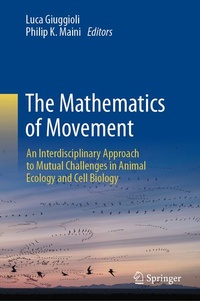
The Mathematics of Movement
Description

This volume presents insights into the mathematics of movement with a focus on applications to animal ecology and cell biology. With the advances over the past decades in sensor technologies, from Global Positioning Systems (GPS) and radio-telemetry for the observation of moving animals to imaging technologies for tracking cells in live tissues, vast datasets on the movement and interactions of biological entities are providing exciting opportunities to answer many open questions. At the same time, the data revolution has brought novel challenges in the analysis of observational data with unprecedented resolution in space and time. To overcome these challenges, researchers have largely focused their efforts on specific systems or species, increasing the level of sophistication of the models in particular areas at the expense of the transferability of the know-how to the other disciplines. Commonalities between processes and models of the movement and interactions in animals in ecology, and cells in biology, do exist, but such inter-relations have rarely been considered, let alone exploited. This book explores these commonalities and identifies the fundamental differences that underlie a variety of phenomena in the two disciplines. By presenting the state-of-the-art quantitative methodologies and their application to the different types of processes, experiments and data that the applied disciplines bring, this book aims to catalyze the conceptual and technical integration of diverse movement models, and facilitate the emergence of radically new ways of mathematical thinking on complex challenges in animal ecology and cell biology.
More details
Other editions
Additional editions
Persons
Luca Giuggioli is Professor of Complexity Sciences at the School of Engineering Mathematics and Technology at the University of Bristol.
Philip K, Maini is Statutory Professor of Mathematical Biology and Director of the Wolfson Centre for Mathematical Biology, Mathematical Institute, University of Oxford.
Content
Chapter 1: A cross-disciplinary way forward in the study of movement.- Chapter 2: Hybrid Methods in Reaction-Diffusion Equations.- Chapter 3: Classification of Similarities and Differences in Movement between two Sympatric Raven Species across Multiple Spatiotemporal Scales.- Chapter 4: Probabilistic Formulations of Diffusive Search Processes with Stochastic Resetting.- Chapter 5: Scalable non-Markovian State Switching Models for Animal Movement.- Chapter 6: A Method for Reconstructing and Modeling Social Interactions in Moving Animal Groups from Trajectory Data.- Chapter 7: Spatial Distributions for Animal Movement Processes.- Chapter 8: An Information Theory Treatment of Animal Movement Tracks.- Chapter 9: Some Statistical Mechanics Techniques for Ecology: Random Walks for Epidemics Spread and Kinetic Equations for Patchiness.- Chapter 10: Modelling the Movements of Organisms: From Cell Migration to Bumblebee Flights to Foraging Sea Turtles.- Chapter 11: Spatial Competition and Repulsion: Pattern Formation and the Role of Movement.- Chapter 12: Number of Distinct and Common Sites Visited by ?? Independent Random Walkers.- Chapter 13: Collective Foraging and Behavioural Syndromes in Ants: First-Passage Statistics with Heterogeneous Walkers on a Honeycomb Lattice.- Chapter 14: Prospection and Dispersal in Metapopulations: a Perspective from Opinion Dynamics Models.- Chapter 15: Starving Random Walks.- Chapter 16: Methods for Quantifying Self-Organization in Biology: a Forward-Looking Survey and Tutorial.
