

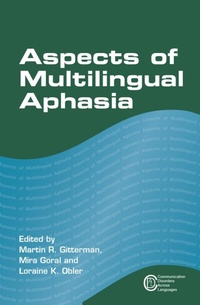
Aspects of Multilingual Aphasia
Published on 20. June 2012
336 pages
978-1-84769-756-1 (ISBN)
Description

This volume provides a broad overview of current work in aphasia in individuals who speak more than one language. With contributions from many of the leading researchers in the field, the material included, both experimental work and theoretical overviews, should prove useful to both researchers and clinicians. The book should also appeal to a broader audience, including all who have an interest in the study of language disorders in an increasingly multicultural/multilingual world (e.g. students of speech-language pathology and linguistics). The areas of multilingual aphasia addressed in this collection include assessment and treatment, language phenomena (e.g. code-switching), particular language pairs (including a bidialectal study), and the role of cultural context.
Reviews / Votes
This book is an impressive and essential guide to the bewildering and urgent clinical and theoretical problems posed by bilingual/multilingual aphasia. It presents puzzling and challenging case studies, discussion of resources for testing and therapy, useful small-group studies and insightful overviews, with psycholinguistically and therapeutically sophisticated attention paid to cognitive, social and linguistic factors. -- Lise Menn, University of Colorado, USA In the past decade, there has been a dramatic increase of research on the science of bilingualism, recognizing that in much of the world, bilingualism is a common rather than exceptional circumstance. The present volume provides an exciting synthesis of the latest findings on bilingual aphasia, drawing implications for clinical assessment and treatment, and also for theoretical claims about language, the mind, and the brain. -- Judith Kroll, Pennsylvania State University, USAMore details
Series
Language
English
Place of publication
Bristol
United Kingdom
Publishing group
Channel View Publications Ltd
Target group
Professional and scholarly
ISBN-13
978-1-84769-756-1 (9781847697561)
Copyright in bibliographic data and cover images is held by Nielsen Book Services Limited or by the publishers or by their respective licensors: all rights reserved.
Schweitzer Classification
Other editions
Additional editions
Martin R. Gitterman | Mira Goral | Loraine K. Obler
Aspects of Multilingual Aphasia
Book
06/2012
Multilingual Matters
€133.90
Shipment within 10-20 days
Persons
Martin R. Gitterman, Ph.D. is Professor Emeritus of Speech-Language-Hearing Sciences at Lehman College and The Graduate Center, The City University of New York. He has published in the areas of neurolinguistics, aphasia, second language acquisition, bilingualism, and applied linguistics. http://www.lehman.edu//academics/arts-humanities/speech-language-hearing-sciences/gitterman-faculty-page.php
Mira Goral, Ph.D. CCC-SLP is a Professor of Speech-Language-Hearing Sciences at Lehman College and The Graduate Center of The City University of New York. She also holds an appointment at the Harold Goodglass Aphasia Research Center of the Boston University School of Medicine. She has published in the areas of multilingualism, aphasia, language attrition, and language and cognition in aging. Http://www.lehman.edu/academics/arts-humanities/speech-language-hearing-sciences/mira.php
Loraine K. Obler, Ph.D. is a Distinguished Professor at the CUNY Graduate Center, with appointments in both Speech-Language-Hearing Sciences and Linguistics, as well as at the Harold Goodglass Aphasia Research Center of the Boston University School of Medicine. She has co-authored articles and books on her areas of interest: neurolinguistics, bilingualism and the brain, cross-language study of aphasia, and language in aging. http://web.gc.cuny.edu/speechandhearing/faculty/lobler.asp
Mira Goral, Ph.D. CCC-SLP is a Professor of Speech-Language-Hearing Sciences at Lehman College and The Graduate Center of The City University of New York. She also holds an appointment at the Harold Goodglass Aphasia Research Center of the Boston University School of Medicine. She has published in the areas of multilingualism, aphasia, language attrition, and language and cognition in aging. Http://www.lehman.edu/academics/arts-humanities/speech-language-hearing-sciences/mira.php
Loraine K. Obler, Ph.D. is a Distinguished Professor at the CUNY Graduate Center, with appointments in both Speech-Language-Hearing Sciences and Linguistics, as well as at the Harold Goodglass Aphasia Research Center of the Boston University School of Medicine. She has co-authored articles and books on her areas of interest: neurolinguistics, bilingualism and the brain, cross-language study of aphasia, and language in aging. http://web.gc.cuny.edu/speechandhearing/faculty/lobler.asp
Content
Introduction - Martin R. Gitterman, Mira Goral, and Loraine K. Obler
Part 1 - Broad Considerations
1. The Study of Bilingual Aphasia: The Questions Addressed - Loraine K. Obler and Youngmi Park
2. Bilingual Aphasia: Neural Plasticity and Considerations for Recovery - Daniel Adrover-Roig, Karine Marcotte, Lilian C. Scherer, and Ana Ansaldo
Part 2 - Assessment and Treatment
3. What Do We Know About Assessing Language Impairment in Bilingual Aphasia? - Swathi Kiran and Particia M. Roberts
4. Morphological Assessment in Bilingual Aphasia: Compounding and the Language Nexus - Gary Libben
5. The Clinical Management of Anomia in Bilingual Speakers of Spanish and English - Maria L. Munoz
6. Generalization in Bilingual Aphasia Treatment - Kathryn Kohnert and Michael Peterson
7. Cross-Language Treatment Effects in Multilingual Aphasia - Mira Goral
8. Language Deficits, Recovery Patterns and Effective Intervention in a Multilingual 16 Years Post-TBI - Daly Sebastian, Usha Dalvi, and Loraine K. Obler
Part 3 - Bilingual Language Phenomena
9. Bilingual Aphasia and Code-Switching: Representation and Control - Alessandra Riccardi
10. Grammatical Category Deficits in Bilingual Aphasia - Yasmeen Faroqi-Shah
11. Language Choice in Bilingual Aphasia: Memory and Emotions - Carmit Altman, Mali Gil, and Joel Walters
12. Acquired Dyslexia and Dysgraphia in Bilinguals Across Alphabetical and Non-Alphabetical Scripts - Maximiliano A. Wilson, Karima Kahlaoui, and Brendan S. Weekes
Part 4 - Language Pairs
13. Morphosyntactic Features in the Spoken Language of Spanish-English Bilinguals with Aphasia - Jose G. Centeno
14. Nonword Jargon Produced by a French-English Bilingual - Nicole Mueller and Zaneta Mok
15. Number-Processing Deficit in a Bilingual (Chinese-English) Speaker - Nancy Eng
16. A Case Study of a Bidialectal (African-American Vernacular English/Standard American English) Speaker with Agrammatism - Jean E. Jones, Martin R. Gitterman, and Loraine K. Obler
Part 5 - Cultural Context
17. Aphasia, Language, and Culture: Arabs in the U.S. - Reem Khamis-Dakwar and Karen Froud
18. Towards Cultural Aphasiology: Contextual Models of Service Delivery in Aphasia - Claire Penn
Part 1 - Broad Considerations
1. The Study of Bilingual Aphasia: The Questions Addressed - Loraine K. Obler and Youngmi Park
2. Bilingual Aphasia: Neural Plasticity and Considerations for Recovery - Daniel Adrover-Roig, Karine Marcotte, Lilian C. Scherer, and Ana Ansaldo
Part 2 - Assessment and Treatment
3. What Do We Know About Assessing Language Impairment in Bilingual Aphasia? - Swathi Kiran and Particia M. Roberts
4. Morphological Assessment in Bilingual Aphasia: Compounding and the Language Nexus - Gary Libben
5. The Clinical Management of Anomia in Bilingual Speakers of Spanish and English - Maria L. Munoz
6. Generalization in Bilingual Aphasia Treatment - Kathryn Kohnert and Michael Peterson
7. Cross-Language Treatment Effects in Multilingual Aphasia - Mira Goral
8. Language Deficits, Recovery Patterns and Effective Intervention in a Multilingual 16 Years Post-TBI - Daly Sebastian, Usha Dalvi, and Loraine K. Obler
Part 3 - Bilingual Language Phenomena
9. Bilingual Aphasia and Code-Switching: Representation and Control - Alessandra Riccardi
10. Grammatical Category Deficits in Bilingual Aphasia - Yasmeen Faroqi-Shah
11. Language Choice in Bilingual Aphasia: Memory and Emotions - Carmit Altman, Mali Gil, and Joel Walters
12. Acquired Dyslexia and Dysgraphia in Bilinguals Across Alphabetical and Non-Alphabetical Scripts - Maximiliano A. Wilson, Karima Kahlaoui, and Brendan S. Weekes
Part 4 - Language Pairs
13. Morphosyntactic Features in the Spoken Language of Spanish-English Bilinguals with Aphasia - Jose G. Centeno
14. Nonword Jargon Produced by a French-English Bilingual - Nicole Mueller and Zaneta Mok
15. Number-Processing Deficit in a Bilingual (Chinese-English) Speaker - Nancy Eng
16. A Case Study of a Bidialectal (African-American Vernacular English/Standard American English) Speaker with Agrammatism - Jean E. Jones, Martin R. Gitterman, and Loraine K. Obler
Part 5 - Cultural Context
17. Aphasia, Language, and Culture: Arabs in the U.S. - Reem Khamis-Dakwar and Karen Froud
18. Towards Cultural Aphasiology: Contextual Models of Service Delivery in Aphasia - Claire Penn
