

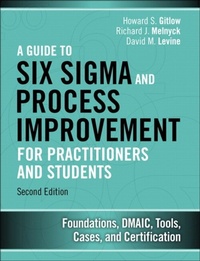
Guide to Six Sigma and Process Improvement for Practitioners and Students, A
Foundations, DMAIC, Tools, Cases, and Certification
2nd Edition
Published on 8. April 2015
480 pages
978-0-13-392545-6 (ISBN)
Description

Master modern Six Sigma implementation with the most complete, up-to-date guide for Green Belts, Black Belts, Champions and students! Now fully updated with the latest lean and process control applications, A Guide to Lean Six Sigma and Process Improvement for Practitioners and Students, Second Edition gives you a complete executive framework for understanding quality and implementing Lean Six Sigma. Whether you're a green belt, black belt, champion, or student, Howard Gitlow and Richard Melnyck cover all you need to know. Step by step, they systematically walk you through the five-step DMAIC implementation process, with detailed examples and many real-world case studies. You'll find practical coverage of Six Sigma statistics and management techniques, from dashboards and control charts to hypothesis testing and experiment design. Drawing on their extensive experience consulting on Six Sigma and leading major Lean and quality initiatives, Gitlow and Melnyck offer up-to-date coverage of:
What Six Sigma can do, and how to manage it effectively
Six Sigma roles, responsibilities, and terminology
Running Six Sigma programs with Dashboards and Control Charts
Mastering each DMAIC phase: Define, Measure, Analyze, Improve, Control
Understanding foundational Six Sigma statistics: probability, probability distributions, sampling distributions, and interval estimation
Pursuing Six Sigma Champion or Green Belt Certification, and more
This guide will be an invaluable resource for everyone who is currently involved in Six Sigma implementation, or plans to be. It's ideal for students in quality programs; "Green Belts" who project manage Six Sigma implementations, "Black Belts" who lead Six Sigma teams; "Champions" who promote and coordinate Six Sigma at the executive level; and anyone seeking Six Sigma certification.
What Six Sigma can do, and how to manage it effectively
Six Sigma roles, responsibilities, and terminology
Running Six Sigma programs with Dashboards and Control Charts
Mastering each DMAIC phase: Define, Measure, Analyze, Improve, Control
Understanding foundational Six Sigma statistics: probability, probability distributions, sampling distributions, and interval estimation
Pursuing Six Sigma Champion or Green Belt Certification, and more
This guide will be an invaluable resource for everyone who is currently involved in Six Sigma implementation, or plans to be. It's ideal for students in quality programs; "Green Belts" who project manage Six Sigma implementations, "Black Belts" who lead Six Sigma teams; "Champions" who promote and coordinate Six Sigma at the executive level; and anyone seeking Six Sigma certification.
All prices
More details
Edition
2nd edition
Language
English
Place of publication
NJ
United States
Publishing group
Pearson Education (US)
Target group
College/higher education
File size
22,53 MB
ISBN-13
978-0-13-392545-6 (9780133925456)
Copyright in bibliographic data and cover images is held by Nielsen Book Services Limited or by the publishers or by their respective licensors: all rights reserved.
Schweitzer Classification
Other editions
Additional editions
Howard Gitlow | Richard Melnyck | David Levine
Guide to Six Sigma and Process Improvement for Practitioners and Students, A
Foundations, DMAIC, Tools, Cases, and Certification
Book
05/2015
2nd Edition
Pearson FT Press
€64.36
Article not available at the moment
Persons
Dr. Howard S. Gitlow is Executive Director of the Institute for the Study of Quality, Director of the Master of Science degree in Management Science, and a Professor of Management Science, School of Business Administration, University of Miami, Coral Gables, Florida. He was a visiting professor at the Stern School of Business at New York University from 2007 through 2013, and a visiting professor at the Science University of Tokyo in 1990 where he studied with Dr. Noriaki Kano. He received his PhD in Statistics (1974), MBA (1972), and BS in Statistics (1969) from New York University. His areas of specialization are Six Sigma Management, Dr. Deming's theory of management, Japanese Total Quality Control, and statistical quality control.
Dr. Gitlow is a Six Sigma Master Black Belt, a fellow of the American Society for Quality, and a member of the American Statistical Association. He has consulted on quality, productivity, and related matters with many organizations, including several Fortune 500 companies.
Dr. Gitlow has authored or coauthored 16 books, including America's Research Universities: The Challenges Ahead, University Press of America (2011); A Guide to Lean Six Sigma, CRC Press (2009); Design for Six Sigma for Green Belts and Champions, Prentice-Hall, (2006); Six Sigma for Green Belts and Champions, Prentice-Hall, (2004); Quality Management: Tools and Methods for Improvement, 3rd edition, Richard. D. Irwin (2004); Quality Management Systems, CRC Press (2000), Total Quality Management in Action, Prentice-Hall, (1994); The Deming Guide to Quality and Competitive Position, Prentice-Hall (1987); Planning for Quality, Productivity, and Competitive Position, Dow Jones-Irwin (1990); and Stat City: Understanding Statistics Through Realistic Applications, 2nd edition, Richard D. Irwin (1987). He has published more than 60 academic articles in the areas of quality, statistics, management, and marketing.
While at the University of Miami, Dr. Gitlow has received awards for outstanding teaching, outstanding writing, and outstanding published research articles.
Richard J. Melnyck is Assistant Vice President for Medical Affairs and Executive Director of Process Improvement at the University of Miami Miller School of Medicine and Health System. He is a Six Sigma Master Black Belt, the University of Miami faculty advisor for the American Society for Quality, the University of Miami Miller School of Medicine faculty advisor for the Institute for Healthcare Improvement, and a member of the Beta Gamma Sigma International Honor Society. Melnyck has taught process improvement in both the School of Business and the Miller School of Medicine at the University of Miami. He has consulted on quality, productivity, and related matters with many organizations. He received his MS in Management Science (2008), MBA (2002), and MS in Computer Information Systems (2002) from the University of Miami.
David M. Levine is Professor Emeritus of Statistics and Computer Information Systems at Baruch College (City University of New York). He received B.B.A. and M.B.A. degrees in Statistics from City College of New York and a PhD from New York University in industrial engineering and operations research. He is nationally recognized as a leading innovator in statistics education and is the coauthor of 14 books, including such bestselling statistics textbooks as Statistics for Managers Using Microsoft Excel, Basic Business Statistics: Concepts and Applications, Business Statistics: A First Course, and Applied Statistics for Engineers and Scientists Using Microsoft Excel and Minitab. He also is the coauthor of Even You Can Learn Statistics & Analytics: A Guide for Everyone Who Has Ever Been Afraid of Statistics, currently in its third edition, and Design for Six Sigma for Green Belts and Champions, and the author of Statistics for Six Sigma Green Belts, all published by Pearson, and Quality Management, third edition, McGraw-Hill/Irwin. He is also the author of Video Review of Statistics and Video Review of Probability, both published by Video Aided Instruction, and the statistics module of the MBA primer published by Cengage Learning. He has published articles in various journals, including Psychometrika, The American Statistician, Communications in Statistics, Decision Sciences Journal of Innovative Education, Multivariate Behavioral Research, Journal of Systems Management, Quality Progress, and The American Anthropologist, and he has given numerous talks at the Decision Sciences Institute (DSI), American Statistical Association (ASA), and Making Statistics More Effective in Schools and Business (MSMESB) conferences. Levine has also received several awards for outstanding teaching and curriculum development from Baruch College.
Dr. Gitlow is a Six Sigma Master Black Belt, a fellow of the American Society for Quality, and a member of the American Statistical Association. He has consulted on quality, productivity, and related matters with many organizations, including several Fortune 500 companies.
Dr. Gitlow has authored or coauthored 16 books, including America's Research Universities: The Challenges Ahead, University Press of America (2011); A Guide to Lean Six Sigma, CRC Press (2009); Design for Six Sigma for Green Belts and Champions, Prentice-Hall, (2006); Six Sigma for Green Belts and Champions, Prentice-Hall, (2004); Quality Management: Tools and Methods for Improvement, 3rd edition, Richard. D. Irwin (2004); Quality Management Systems, CRC Press (2000), Total Quality Management in Action, Prentice-Hall, (1994); The Deming Guide to Quality and Competitive Position, Prentice-Hall (1987); Planning for Quality, Productivity, and Competitive Position, Dow Jones-Irwin (1990); and Stat City: Understanding Statistics Through Realistic Applications, 2nd edition, Richard D. Irwin (1987). He has published more than 60 academic articles in the areas of quality, statistics, management, and marketing.
While at the University of Miami, Dr. Gitlow has received awards for outstanding teaching, outstanding writing, and outstanding published research articles.
Richard J. Melnyck is Assistant Vice President for Medical Affairs and Executive Director of Process Improvement at the University of Miami Miller School of Medicine and Health System. He is a Six Sigma Master Black Belt, the University of Miami faculty advisor for the American Society for Quality, the University of Miami Miller School of Medicine faculty advisor for the Institute for Healthcare Improvement, and a member of the Beta Gamma Sigma International Honor Society. Melnyck has taught process improvement in both the School of Business and the Miller School of Medicine at the University of Miami. He has consulted on quality, productivity, and related matters with many organizations. He received his MS in Management Science (2008), MBA (2002), and MS in Computer Information Systems (2002) from the University of Miami.
David M. Levine is Professor Emeritus of Statistics and Computer Information Systems at Baruch College (City University of New York). He received B.B.A. and M.B.A. degrees in Statistics from City College of New York and a PhD from New York University in industrial engineering and operations research. He is nationally recognized as a leading innovator in statistics education and is the coauthor of 14 books, including such bestselling statistics textbooks as Statistics for Managers Using Microsoft Excel, Basic Business Statistics: Concepts and Applications, Business Statistics: A First Course, and Applied Statistics for Engineers and Scientists Using Microsoft Excel and Minitab. He also is the coauthor of Even You Can Learn Statistics & Analytics: A Guide for Everyone Who Has Ever Been Afraid of Statistics, currently in its third edition, and Design for Six Sigma for Green Belts and Champions, and the author of Statistics for Six Sigma Green Belts, all published by Pearson, and Quality Management, third edition, McGraw-Hill/Irwin. He is also the author of Video Review of Statistics and Video Review of Probability, both published by Video Aided Instruction, and the statistics module of the MBA primer published by Cengage Learning. He has published articles in various journals, including Psychometrika, The American Statistician, Communications in Statistics, Decision Sciences Journal of Innovative Education, Multivariate Behavioral Research, Journal of Systems Management, Quality Progress, and The American Anthropologist, and he has given numerous talks at the Decision Sciences Institute (DSI), American Statistical Association (ASA), and Making Statistics More Effective in Schools and Business (MSMESB) conferences. Levine has also received several awards for outstanding teaching and curriculum development from Baruch College.
Content
Section I: Building a Foundation of Process Improvement Fundamentals
Chapter 1: You Don't Have to Suffer from the Sunday Night Blues!
Chapter 2: Process and Quality Fundamentals
Chapter 3: Defining and Documenting a Process
Section II: Creating Your Toolbox for Process Improvement
Chapter 4: Understanding Data: Tools and Methods
Chapter 5: Understanding Variation: Tools and Methods
Chapter 6: Non-Quantitative Techniques: Tools and Methods
Chapter 7: Overview of Process Improvement Methodologies
Chapter 8: Project Identification and Prioritization: Building a Project Pipeline
Section III: Putting It All Together--Six Sigma Projects
Chapter 9: Overview of Six Sigma Management
Chapter 10: DMAIC Model: "D" Is for Define
Chapter 11: DMAIC Model: "M" Is for Measure
Chapter 12: DMAIC Model: "A" Is for Analyze
Chapter 13: DMAIC Model: "I" Is for Improve
Chapter 14: DMAIC Model: "C" Is for Control
Chapter 15: Maintaining Improvements in Processes, Products-Services, Policies, and Management Style
Section IV: The Culture Required for Six Sigma Management
Chapter 16: W. Edwards Deming's Theory of Management: A Model for Cultural Transformation of an Organization
Index
Chapter 1: You Don't Have to Suffer from the Sunday Night Blues!
Chapter 2: Process and Quality Fundamentals
Chapter 3: Defining and Documenting a Process
Section II: Creating Your Toolbox for Process Improvement
Chapter 4: Understanding Data: Tools and Methods
Chapter 5: Understanding Variation: Tools and Methods
Chapter 6: Non-Quantitative Techniques: Tools and Methods
Chapter 7: Overview of Process Improvement Methodologies
Chapter 8: Project Identification and Prioritization: Building a Project Pipeline
Section III: Putting It All Together--Six Sigma Projects
Chapter 9: Overview of Six Sigma Management
Chapter 10: DMAIC Model: "D" Is for Define
Chapter 11: DMAIC Model: "M" Is for Measure
Chapter 12: DMAIC Model: "A" Is for Analyze
Chapter 13: DMAIC Model: "I" Is for Improve
Chapter 14: DMAIC Model: "C" Is for Control
Chapter 15: Maintaining Improvements in Processes, Products-Services, Policies, and Management Style
Section IV: The Culture Required for Six Sigma Management
Chapter 16: W. Edwards Deming's Theory of Management: A Model for Cultural Transformation of an Organization
Index
