

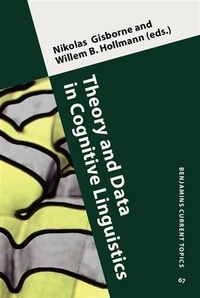
Theory and Data in Cognitive Linguistics
1st Edition
Published on 24. September 2014
V, 262 pages
978-90-272-6960-7 (ISBN)
Description

Cognitive linguistics has an honourable tradition of paying respect to naturally occurring language data and there have been fruitful interactions between corpus data and aspects of linguistic structure and meaning. More recently, dialect data and sociolinguistic data collection methods/theoretical concepts have started to generate interest. There has also been an increase in several kinds of experimental work. However, not all linguistic data is simply naturally occurring or derived from experiments with statistically robust samples of speakers. Other traditions, especially the generative tradition, have fruitfully used introspection and questions about the grammaticality of different strings to uncover patterns which might otherwise have gone unnoticed. The divide between generative and cognitive approaches to language is intimately connected to the kinds of data drawn on, and the way in which generalisations are derived from these data. The papers in this volume explore these issues through the lens of synchronic linguistic analysis, the study of language change, typological investigation and experimental study. Originally published in Studies in Language Vol. 36:3 (2012).
More details
Other editions
Additional editions
Nikolas Gisborne | Willem B. Hollmann
Theory and Data in Cognitive Linguistics
Book
09/2014
John Benjamins Publishing Co
€100.70
Shipment within 10-15 days
Persons
Content
- Theory and Data in Cognitive Linguistics
- Editorial page
- Title page
- LCC data
- Table of contents
- Theory and data in cognitive linguistics
- Gries
- Barðdal et al.
- Patten
- Trousdale
- Gisborne
- Cristofaro
- Hollmann
- Matlock et al.
- References
- Index
- Frequencies, probabilities, and association measures in usage-/exemplar-based linguistics
- 1. Introduction
- 2. Collostructional analysis: A brief overview
- 2.1 Perspective 1: CA and its goals
- 2.2 Perspective 2: CA and its mathematics/computation
- 2.3 Perspective 3: CA and its results, interpretation, and motivation
- 3. Bybee's points of critique
- 3.1 Perspective 1: CA and its goals
- 3.2 Perspective 2: CA and its mathematics/computation
- 3.3 Perspective 3: CA and its results, interpretation, and motivation
- 3.3.1 The perceived lack of semantics
- 3.3.2 The perceived lacks of semantics and discriminatory power
- 3.3.3 The absence of cognitive mechanisms underlying CA
- 4. Clarifications, repudiations, and responses
- 4.1 Perspective 1: CA and its goals
- 4.2 Perspective 2: CA and its mathematics/computation
- 4.2.1 The issue of the corpus size
- 4.2.2 The distribution of pFYE
- 4.3 Perspective 3: CA and its results, interpretation, and motivation
- 4.3.1 The perceived lacks of semantics
- 4.3.2 The perceived lacks of semantics and discriminatory power
- 4.3.3 The absence of cognitive mechanisms underlying CA
- 5. Towards a new empirical perspective and its theoretical implications
- 5.1 A cline of co-occurrence complexity and its motivations/implications
- 5.1.1 Approach 1: Raw frequencies/percentages
- 5.1.2 Approach 2: Association measures
- 5.1.3 Approach 3: Full cross-tabulation
- 5.1.4 Approach 4: Dispersion of (co-)occurrence
- 5.2 Why CA works at all and a brief excursus on Zipf
- 5.3 Towards a refined usage-/exemplar-based definition of construction
- 5.4 Conclusion
- References
- Reconstructing constructional semantics
- 1. Introduction
- 2. The Dative Subject Construction
- 3. Reconstructing semantics
- 4. Comparison of the semantics of the Dative Subject Construction in Old Norse-Icelandic, Archaic/Classical Latin, Ancient Greek, Old Russian, and Old Lithuanian
- 5. A reconstruction of the semantics of the Dative Subject Construction in Indo-European
- 6. Special characteristics of the Indo-European Dative Subject Construction in the typological landscape
- 7. Summary
- References
- Appendix: Narrowly-circumscribed lexical semantic verb classes
- The historical development of the it-cleft
- 1. Introduction1
- 2. Theoretical assumptions
- 2.1 Language structure
- 2.2 Language change
- 2.3 Interim summary
- 3. The object of study
- 3.1 An expletive account of it-clefts
- 3.2 An extraposition account of it-clefts
- 4. Sorting the data
- 4.1 Ball's (1991)it-cleft origin story
- 4.2 Patten's (forthcoming) it-cleft origin story
- 4.3 Handling the OE hit-cleft
- 5. Interpreting the data
- 5.1 The diachronic development of the English it-cleft
- 5.2 Ball (1994) and the mergers of the English it-cleft
- 5.3 Patten (2010) and the constructionalization of the English it-cleft
- 6. Conclusion
- References
- Theory and data in diachronic Construction Grammar
- 1. Introduction
- 2 Free adjuncts, absolutes and the what withpattern in contemporary English
- 2.1 A minimalist analysis
- 2.2 A constructional analysis
- 3. Data on the historical evolution of the what with construction
- 3.1 Up to Modern English
- 3.2 Late Modern English
- 3.2.1 Method
- 3.2.2 Results
- 3.3 Twentieth-century American English (COCA corpus)
- 3.3.1 Method
- 3.3.2 Results
- 4 Grammatical constructionalization: A cognitive approach to language change
- 4.1 Summary of the principal changes
- 4.2 Grammatical constructionalization
- 5. Conclusions
- Corpus data
- References
- The semantics of definite expressions and the grammaticalization of THE
- 1. Introduction
- 2. Two approaches to definiteness.
- 3. Reference
- 4. The familiarity theory of definites
- 5. An alternative theory of definites
- 6. Modelling the quantifier theory in a cognitive theory of language structure
- 7. Comparing the familiarity theory with the quantifier theory
- 7.1 Case study 1: Scope effects
- 7.2 Case study 2: The definiteness effect
- 7.3 Case study 3: Specificational sentences
- 8. The theories and grammaticalization
- 9. Conclusion
- References
- Cognitive explanations, distributional evidence, and diachrony
- 1. Introduction
- 2. The development of alignment systems
- 3. The origin of prototype effects
- 4. Concluding remarks
- List of Abbreviations
- References
- Word classes
- 1. Introduction
- 2. Previous scholarship on word classes
- 2.1 The structuralist-generative approach
- 2.2 The cognitive linguistic approach
- 2.2.1 Langacker
- 2.2.2 Croft
- 2.3 Psycholinguistics
- 3. Questionnaire study design
- 3.1 The questionnaire
- 3.2 Participants
- 3.3 Phonological and distributional properties and scoring schemes
- 3.3.1 Phonology
- 3.3.2 Distribution
- 4. Phonological properties
- 4.1 Results
- 4.1.1 Word length
- 4.1.2 Mean syllable length
- 4.1.3 Final obstruent voicing
- 4.1.4 Nasal consonants
- 4.1.5 Stressed vowel advancement
- 4.1.6 Stressed vowel height
- 4.1.7 Presence vs. absence of a final obstruent
- 4.2 Discussion
- 5. Distributional properties
- 5.1 Results
- 5.1.1 Nouns
- 5.1.2 Verbs
- 5.2 Discussion
- 6. Conclusion
- References
- Smashing new results on aspectual framing
- 1. Introduction
- 1.1 Aspect
- 2. Experiment
- 2.1 Participants, materials, and methods
- 3. Results
- 3.1 Speech
- 3.2 Gesture
- 4. General discussion
- References
