

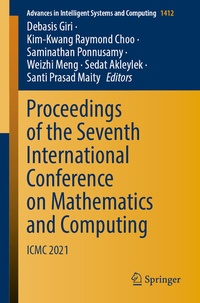
Proceedings of the Seventh International Conference on Mathematics and Computing
ICMC 2021
1st Edition
Published on 5. March 2022
XXVII, 1117 pages
978-981-16-6890-6 (ISBN)
Description

This book features selected papers from the 7th International Conference on Mathematics and Computing (ICMC 2021), organized by Indian Institute of Engineering Science and Technology (IIEST), Shibpur, India, during March 2021. It covers recent advances in the field of mathematics, statistics, and scientific computing. The book presents innovative work by leading academics, researchers, and experts from industry.
More details
Series
Language
English
Place of publication
Singapore
Singapore
Publishing group
Springer Singapore
Target group
Professional and scholarly
Product notice
Reflowable
Illustrations
XXVII, 1117 p. 302 illus., 211 illus. in color.
File size
23,95 MB
ISBN-13
978-981-16-6890-6 (9789811668906)
DOI
10.1007/978-981-16-6890-6
Schweitzer Classification
Other editions
Additional editions
Debasis Giri | Kim-Kwang Raymond Choo | Saminathan Ponnusamy
Proceedings of the Seventh International Conference on Mathematics and Computing
ICMC 2021
Book
03/2022
Springer
€246.09
Shipment within 3-4 weeks
Persons
Debasis Giri received the M.Sc., M.Tech, and Ph.D. degrees from the Indian Institute of Technology, Kharagpur, India, in 1998, 2001, and 2009, respectively. He is ten-th all India rank holder in Graduate Aptitude Test in Engineering (GATE) in 1999. He received a certificate from All India Science Teachers' Association in Science Aptitude & Talent Search Test in 1988. He is currently an Associate Professor with the Department of Information Technology, Maulana Abul Kalam Azad University of Technology (formerly known as the West Bengal University of Technology), Haringhata, India. His research interests include cryptography, network security, Security based on Machine Learning, data hiding and security in WSN. He has authored more than 80 research papers in reputed international journals, conference proceedings and book chapters. He is an associate Editor of Associate Editor of the international Journals: i) Information Security and Applications (Elsevier), ii) the Security and Privacy Journal (Wiley), iii) Journal of Communication Systems (Wiley), and iv) Security and Communication Networks. He is also a Reviewer for many reputed international journals. He is a member of IEEE, and a life member of Cryptology Research Society of India (CRSI), the International Society for Analysis, its Applications and Computation (ISAAC) and Computer Society of India (CSI).
Kim-Kwang Raymond Choo received the Ph.D. in Information Security in 2006 from Queensland University of Technology, Australia. He currently holds the Cloud Technology Endowed Professorship at The University of Texas at San Antonio. He is the founding co-editor-in-chief of ACM Distributed Ledger Technologies: Research & Practice, founding chair of IEEE Technology and Engineering Management Society's Technical Committee on Blockchain and Distributed Ledger Technologies, and serves as Department Editor of IEEE Transactions on Engineering Management and the Associate Editor of IEEE Transactions on Dependable and Secure Computing and IEEE Transactions on Big Data. He is an ACM Distinguished Speaker and IEEE Computer Society Distinguished Visitor (2021 - 2023), included in Web of Science's Highly Cited Researcher in the field of Cross-Field - 2020, and is the recipient of the 2019 IEEE Technical Committee on Scalable Computing Award for Excellence in Scalable Computing (Middle Career Researcher).
Saminathan Ponnusamy (PhD, 1989, IIT Kanpur, India) is currently the Institute Chair Professor at IIT Madras, India, and the President of the Ramanujan Mathematical Society (RMS), India; He has earned his B.Sc. (1980) and M.Sc. (1992) from the University of Madras. His current research interest includes complex analysis, quasiconformal and harmonic mappings, special functions, and functions spaces. Dr. S Ponnusamy is the founding ``Fellow of the Forum de Analystes, Chennai, India", 1992. He was elected as a ``Fellow of The National Academy of Sciences, India" in the year2002 and has been a ``Senior Associate" of The Abdus Salam International Centre for Theoretical Physics". He served five years as Head of the Indian Statistical Institute, Chennai Centre (2012--2017). Dr. S Ponnusamy has been associated with a number of organizations for popularization of science and serves on the editorial boards of several peer-reviewed international journals. He has been a referee for more than 100 journals. He is often invited to give plenary talks at international conferences and to give lectures in universities all over the world. He took part as a researcher in many funded projects in India and Abroad. Dr. Ponnusamy has written four text books and another text book with Herb Sivlerman. One of his books won the Best Selling Author Award in 2002. He has edited several volumes, and international conference proceedings. He has published more than 250 technical articles in reputed international journals and has solved several long standing open problems and conjectures. Dr. Ponnusamy has been a Visiting Professor of number of universities in abroad (e.g. Hengyang Normal University and Hunan Normal University, China; Kazan Federal University and Petrozavodsk State University, Russia; University Sains Malaysia, Malaysia; University of Aalto, University of Turku, and University of Helsinki, Finland; University of South Australia, Adelaide; Texas Tech University, Lubbock, USA). Weizhi Meng is currently an Associate Professor in the Department of Applied Mathematics and Computer Science, Technical University of Denmark (DTU), Kongens Lyngby, Denmark. He obtained his Ph.D. degree in Computer Science from the City University of Hong Kong (CityU), China. He won the Outstanding Academic Performance Award during his doctoral study, and is a recipient of the Hong Kong Institution of Engineers (HKIE) Outstanding Paper Award for Young Engineers/Researchers in both 2014 and 2017. His primary researchinterests are cyber security and intelligent technology in security, including intrusion detection, IoT security, biometric authentication, trust management, and blockchain in security. He served as associate editors / editorial board members for several reputed journals, as well as PC chair for many international conferences. Sedat Akleylek received the B.Sc. degree in Mathematics majored in Computer Science from Ege University in 2004 in Izmir, Turkey, M.Sc. and Ph.D. degrees in Cryptography from Middle East Technical University in 2008 and 2010, in Ankara, Turkey, respectively. He was a post-doctoral researcher at Cryptography and Computer Algebra Group, TU Darmstadt, Germany between 2014-2015. He is currently employed as an associate professor at the Department of Computer Engineering, Ondokuz Mayis University, Samsun, Turkey since 2016. He is a member of the editorial board of IEEE Access, Turkish Journal of Electrical Engineering and Computer Sciences, Peerj Computer Science, and International Journal of Information Security Science. His research interests include the areas of post-quantum cryptography, algorithms and complexity, architectures for computations in finite fields, applied cryptography for cyber security, IoT and fog computing. He has published more than 100 research papers in international journals, conference proceedings, book chapters and has solved several real-world security and data analytics problems for the industry. Santi P. Maity has been working as Professor in the Dept. of Information Technology, Indian Institute of Engineering Science and Technology, Shibpur, since September 2012. He received B.E. degree in Electronics and Communication Engineering from National Institute of Technology Durgapur and M.Tech. in Microwaves from the University of Burdwan, India in 1993 and 1997, respectively. He received his Ph.D. degree in Engineering from IIEST, Shibpur, India in 2008. He did Post Doctoral work from January 2009 to July 2009 and February 2011 to July 2011 at the Laboratoire des Signaux et Systems, Supelec, France. His research interests include Cognitive Radio network, Compressive Sensing, Digital Watermarking, Secret Sharing and Machine Learning. He has published more than 280 research papers in International Journals, Conference Proceedings and Book Chapters. He has delivered more than 60 invited talks in various academic programs. He has guided 17 Ph. D thesis and 5 are in progress.
Saminathan Ponnusamy (PhD, 1989, IIT Kanpur, India) is currently the Institute Chair Professor at IIT Madras, India, and the President of the Ramanujan Mathematical Society (RMS), India; He has earned his B.Sc. (1980) and M.Sc. (1992) from the University of Madras. His current research interest includes complex analysis, quasiconformal and harmonic mappings, special functions, and functions spaces. Dr. S Ponnusamy is the founding ``Fellow of the Forum de Analystes, Chennai, India", 1992. He was elected as a ``Fellow of The National Academy of Sciences, India" in the year2002 and has been a ``Senior Associate" of The Abdus Salam International Centre for Theoretical Physics". He served five years as Head of the Indian Statistical Institute, Chennai Centre (2012--2017). Dr. S Ponnusamy has been associated with a number of organizations for popularization of science and serves on the editorial boards of several peer-reviewed international journals. He has been a referee for more than 100 journals. He is often invited to give plenary talks at international conferences and to give lectures in universities all over the world. He took part as a researcher in many funded projects in India and Abroad. Dr. Ponnusamy has written four text books and another text book with Herb Sivlerman. One of his books won the Best Selling Author Award in 2002. He has edited several volumes, and international conference proceedings. He has published more than 250 technical articles in reputed international journals and has solved several long standing open problems and conjectures. Dr. Ponnusamy has been a Visiting Professor of number of universities in abroad (e.g. Hengyang Normal University and Hunan Normal University, China; Kazan Federal University and Petrozavodsk State University, Russia; University Sains Malaysia, Malaysia; University of Aalto, University of Turku, and University of Helsinki, Finland; University of South Australia, Adelaide; Texas Tech University, Lubbock, USA). Weizhi Meng is currently an Associate Professor in the Department of Applied Mathematics and Computer Science, Technical University of Denmark (DTU), Kongens Lyngby, Denmark. He obtained his Ph.D. degree in Computer Science from the City University of Hong Kong (CityU), China. He won the Outstanding Academic Performance Award during his doctoral study, and is a recipient of the Hong Kong Institution of Engineers (HKIE) Outstanding Paper Award for Young Engineers/Researchers in both 2014 and 2017. His primary researchinterests are cyber security and intelligent technology in security, including intrusion detection, IoT security, biometric authentication, trust management, and blockchain in security. He served as associate editors / editorial board members for several reputed journals, as well as PC chair for many international conferences. Sedat Akleylek received the B.Sc. degree in Mathematics majored in Computer Science from Ege University in 2004 in Izmir, Turkey, M.Sc. and Ph.D. degrees in Cryptography from Middle East Technical University in 2008 and 2010, in Ankara, Turkey, respectively. He was a post-doctoral researcher at Cryptography and Computer Algebra Group, TU Darmstadt, Germany between 2014-2015. He is currently employed as an associate professor at the Department of Computer Engineering, Ondokuz Mayis University, Samsun, Turkey since 2016. He is a member of the editorial board of IEEE Access, Turkish Journal of Electrical Engineering and Computer Sciences, Peerj Computer Science, and International Journal of Information Security Science. His research interests include the areas of post-quantum cryptography, algorithms and complexity, architectures for computations in finite fields, applied cryptography for cyber security, IoT and fog computing. He has published more than 100 research papers in international journals, conference proceedings, book chapters and has solved several real-world security and data analytics problems for the industry. Santi P. Maity has been working as Professor in the Dept. of Information Technology, Indian Institute of Engineering Science and Technology, Shibpur, since September 2012. He received B.E. degree in Electronics and Communication Engineering from National Institute of Technology Durgapur and M.Tech. in Microwaves from the University of Burdwan, India in 1993 and 1997, respectively. He received his Ph.D. degree in Engineering from IIEST, Shibpur, India in 2008. He did Post Doctoral work from January 2009 to July 2009 and February 2011 to July 2011 at the Laboratoire des Signaux et Systems, Supelec, France. His research interests include Cognitive Radio network, Compressive Sensing, Digital Watermarking, Secret Sharing and Machine Learning. He has published more than 280 research papers in International Journals, Conference Proceedings and Book Chapters. He has delivered more than 60 invited talks in various academic programs. He has guided 17 Ph. D thesis and 5 are in progress.
Content
A Blind Signature Scheme based on Bilinear Pairings.- Security Analysis via Algebraic Attack Against A New Encryption Scheme for Multivariate Quadratic System'.- Currency An Energy-Efficient Proof-of-Work Scheme for Crypto-Currencies.- A study on randomness used in signature generation of UOV.- On The Inadequacy of Multimodal Maps for Cryptographic Hash Applications with Phase-Space Modulation.
