

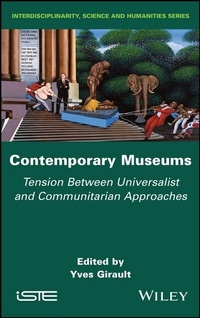
Contemporary Museums
Description

At the heart of these current events and international issues, this collective work studies, in an international context, the values, actions and discourses advocated for participating in processes such as collection, selection, conservation and interpretation of heritage elements linked to the territories, resources, knowledge and know-how of various communities. The analysis of the tensions and asymmetries of power between various groups of actors - politicians, managers, scientists, visitors, representatives of local or diasporic populations, among others - particularly in the context of decolonization policies of museums, is also a major part of this book.
More details
Other editions
Additional editions
Person
Content
Introduction xi
Yves GIRAULT
Part 1 From Local Participation to the Social Role of the Museum 1
Chapter 1 Reflections on Social Participation and the Museum in Latin America 3
Isabel ORELLANA RIVERA
1.1 Introduction 3
1.2 The Round Table of Santiago de Chile, 1972: a new beginning for Latin American museological praxis 4
1.3 Museums and social participation: toward a Latin American museology 11
1.4 The museum in the time of the pandemic: the fragile equilibriums of social participation 19
1.4.1 Contextual elements: the erosion of the museum community and the global nature of culture 19
1.4.2 The Chilean context in Covid mode: the digital gap and its impact on social participation in the museum 21
1.5 References 25
Chapter 2 Analysis of Different Modalities of the Museological Promotion of Participatory Archaeological Research 29
Francisco VALDEZ
2.1 Introduction 29
2.2 The values and epistemological presuppositions of participatory archaeology 30
2.3 The importance of the contemporary sociocultural contexts of archaeological sites 35
2.3.1 La Tolita Pampa de Oro: tensions between archaeologists and treasure seekers 36
2.3.2 La Tolita, a collaborative artisanal museum 39
2.3.3 Salango: an example of salvage archaeology leading to the creation of a regional museum 43
2.3.4 Agua Blanca: an example of social archaeology leading to the creation of a community museum 45
2.3.5 The Marquesas Islands: an example of community-based archaeology 50
2.4 Conclusion 55
2.5 Acknowledgments 56
2.6 References 57
Chapter 3 The Paradox of Participation in the Chinese Ecomuseum 61
Yi DU
3.1 Introduction 61
3.2 Historical and contextual markers of the origins of the ecomuseum in China 62
3.2.1 The introduction of the concept of the ecomuseum to China 62
3.2.2 The ecomuseum: from concept to project 64
3.3 Participation in the Chinese-Norwegian ecomuseum program 66
3.3.1 The construction of the documentation center 68
3.3.2 The Qing Miao Memory Project and the training of youths 70
3.3.3 The difficult transition of governance 72
3.4 From the ecomuseum to the economuseum: the evolution of the paradigm of the Chinese ecomuseum 74
3.5 Conclusion: participation beyond economic reasoning? 78
3.6 Acknowledgments 80
3.7 References 80
Chapter 4 The Integration of Digital Technologies into the Museum 85
François MAIRESSE
4.1 Introduction 85
4.2 The emergence of new technologies 86
4.2.1 The transformations of the 1990s 87
4.2.2 Digital participation and social participation 89
4.3 Digital technologies and museum functions 90
4.3.1 New digital displays 91
4.3.2 New consequences for the museum 94
4.4 Digital technologies and the social dimension of the museum 95
4.4.1 The logic of the spectacle 97
4.4.2 The place of the museum in the world 99
4.5 Conclusion 100
4.6 References 102
Chapter 5 Redefining the Museum or the Distant Echo of Santiago: A North American View 107
Yves BERGERON and Anna-Lou GALASSINI
5.1 Prologue: the Nouvelle Muséologie movement in Canada 107
5.2 1987: "The Spirit Sings" 108
5.3 Kyoto 2019: a progressive definition 109
5.4 ICH: The Trojan horse 111
5.5 Redefining the museum in 2019, half a century after Santiago 113
5.6 The "spirit of the Nouvelle Muséologie" 114
5.7 The concerns of the new definition 117
5.8 Toward a new world for the museum 119
5.9 References 121
Part 2 From Political Engagement to the Decolonization of the Museum 125
Chapter 6 Problems and Challenges of the Involvement of Diasporas within the Museum 127
Yves GIRAULT
6.1 Diaspora museums dealing with genocide 129
6.1.1 The first-generation diaspora museum as cultural testament 130
6.1.2 Second-generation museums against the merciless repetition of trauma 132
6.1.3 Small museums as mediators of diasporic identities 134
6.2 Analyzing the obstacles encountered in the context of a partnership with a diaspora, a case study: the renovation of the RMCA 137
6.2.1 History of the institution 138
6.2.2 Primary obstacles 140
6.3 References 150
Chapter 7 Indigenous and Museum-Based Curation: In Partnership with the Kaingang, Guarani Nhandewa and Terena Peoples (São Paulo, Brazil) 155
Marília XAVIER CURY
7.1 Introduction 155
7.2 Intermuseologies: the museum and the Kaingang, Guarani Nhandewa and Terena peoples (São Paulo, Brazil) 157
7.3 Curation: methodological approaches 161
7.4 Collection management policies 166
7.5 Final considerations 169
7.6 Acknowledgments 171
7.7 References 172
Chapter 8 "Collaborative Conservation" in the Museum: Is Decolonized Conservation Possible in France? 175
Amandine PÉQUIGNOT
8.1 Conservation-restoration, between standardization and materiality 177
8.1.1 Conservation-restoration, a standardized definition 177
8.1.2 To conserve the object is to conserve more than its materiality 179
8.2 From participatory conservation to the decolonization of conservation 180
8.2.1 The museum, an "engagement zone" for indigenous curation 180
8.2.2 Decolonized conservation and the hybridization of knowledge 182
8.2.3 Integrating indigenous curation: participation in the conservation of intangible cultural heritage 184
8.3 The French situation: limits and roadblocks to overcome 187
8.3.1 The conservator-restorer: standardized practices and academic knowledge 187
8.3.2 Existing tensions in the dialogue between conservation-restoration specialists 189
8.3.3 French heritage legislation, a blessing in disguise 190
8.3.4 Conservation-restoration as subject to standardization 191
8.3.5 Possible breaches 192
8.4 Conclusion 194
8.5 References 196
Chapter 9 Restitution and Repatriation Procedures: New Perspectives, New Practices 205
Simon JEAN-NEBBACHE
9.1 Introduction 205
9.2 The relationship between museums and local populations: toward the legislation of restitution 206
9.3 The repatriation of human remains 212
9.3.1 A case study: the request for the repatriation of Maori heads 214
9.4 Conclusion 217
9.5 References 219
Conclusion 223
Yves GIRAULT
List of Authors 227
Index 229
