

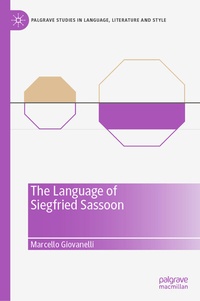
The Language of Siegfried Sassoon
Description

This book presents a cognitive stylistic analysis of the writing of Siegfried Sassoon, a First World War poet who has typically been perceived as a poet of protest and irony, but whose work is in fact multi-faceted and complex in theme and shifted in style considerably throughout his lifetime. The author starts from the premise that a more systematic account of Sassoon's style is possible using the methodology of contemporary stylistics, in particular Cognitive Grammar. Using this as a starting point, he revisits common ideas from Sassoon scholarship and reconfigures them through the lens of cognitive stylistics to provide a fresh perspective on Sassoon's style. This book will be of interest to students and scholars of stylistics, war poetry, twentieth-century literature, and cognitive linguistics.
Reviews / Votes
"This is a rich and fascinating study of Sassoon's language in his poetry and prose, from his familiar and oft-quoted war poems and memoirs as well as his later, lesser-known verse. Employing the methodologies of cognitive stylistics, and in particular cognitive grammar, Giovanelli calls our attention to the lexical and linguistic effects that continue to invite readers into Sassoon's imaginative world. Giovanelli's intricate and clearly articulated analyses combine with biographical detail to provide fresh and unique insights into how the First World War forever shaped and scarred the literary creations of the most iconic writers of the twentieth century."Jane Potter, Reader (Arts), Oxford Brookes, University, UK
"Giovanelli's book takes us on a fascinating deep dive into the language of Siegfried Sassoon, using Cognitive Grammar as a toolkit for revealing the linguistic mechanics of his poetry and his autobiographical prose. The meticulous, coherent, andscientifically grounded stylistic analyses show how Sassoon's language guides readers' cognitive processes toward specific experiential effects and interpretations. Giovanelli also provides clear and insightful explanations of concepts from Cognitive Grammar and cognitive stylistics more generally, as well as a thorough contextualization of Sassoon's work. This book represents a landmark study of Sassoon's language and an important development in the application of Cognitive Grammar to literary analysis."Eric Rundquist, Assistant Professor in English Linguistics, Pontifical Catholic University of Chile
More details
Other editions
Additional editions
Person
Marcello Giovanelli is Reader in Literary Linguistics and Head of English, Languages and Applied Linguistics at Aston University, UK. He teaches on undergraduate modules in stylistics, cognitive poetics and English literature and supervises doctoral students working on topics in cognitive stylistics. He has previously published on both the work of Siegfried Sassoon and on stylistic applications of Cognitive Grammar.
