

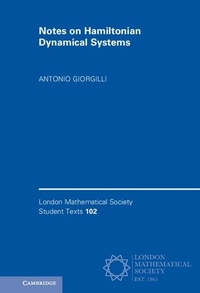
Notes on Hamiltonian Dynamical Systems
Published on 27. April 2022
978-1-009-17486-2 (ISBN)
Description

Starting with the basics of Hamiltonian dynamics and canonical transformations, this text follows the historical development of the theory culminating in recent results: the Kolmogorov-Arnold-Moser theorem, Nekhoroshev's theorem and superexponential stability. Its analytic approach allows students to learn about perturbation methods leading to advanced results. Key topics covered include Liouville's theorem, the proof of Poincare?'s non-integrability theorem and the nonlinear dynamics in the neighbourhood of equilibria. The theorem of Kolmogorov on persistence of invariant tori and the theory of exponential stability of Nekhoroshev are proved via constructive algorithms based on the Lie series method. A final chapter is devoted to the discovery of chaos by Poincare? and its relations with integrability, also including recent results on superexponential stability. Written in an accessible, self-contained way with few prerequisites, this book can serve as an introductory text for senior undergraduate and graduate students.
Reviews / Votes
'The classical mechanics of systems of finitely many point particles belongs to the bedrock of theoretical physics every physicist has to be familiar with. Giorgilli's book on Hamiltonian mechanics is a treasure chest. It conveys the author's profound knowledge of the history of the subject and provides a pedagogical exposition of the basic mathematical techniques. Very many important examples of systems are discussed, and the reader is guided towards fairly recent and new developments in this important subject. This book will become a classic.' Juerg Froehlich, ETH Zuerich 'This is an impressive book by one of the protagonists of the modern theory of dynamical systems. It contains the basic steps of the Hamiltonian theory, but it emphasizes the modern developments of the theory that started with Poincare and Birkhoff, reaching the study of chaos. The book has two important advantages: it gives the successive steps needed by a beginner who enters this field, up to its most recent developments, and it provides a remarkable historical account of the developments of the theory. Giorgilli introduced many new ideas in the theory of dynamical systems, but he presents the new developments in a systematic way without emphasizing his own contributions. This book will be of great value for anyone interested in dynamics, and it is absolutely necessary for any library in Physics, Astronomy and related fields.' George Contopoulos, Academy of Athens 'This is a book that the reader will refer to over and over again: it provides a theoretical and practical framework for understanding Hamiltonian formalism and classical perturbation theory. It contains a readable complete proof of the most important results in the field (Kolmogorov-Arnold-Moser theorem and Nekhoroshev's theorem) as well as their applications to the fundamental problems of celestial mechanics. It also explains how small divisors are at the origin of the divergence of perturbation series and Poincare's discovery of homoclinic intersections and of chaotic behavior in near-to-integrable systems. What a remarkably useful and exciting book!' Stefano Marmi, Scuola Normale Superiore, Pisa 'This amazing book, written by a prominent master of the theory of Hamiltonian systems, is a wonderful gift for anyone interested in Classical Dynamics, from a novice student to a sophisticated expert. The author, together with the reader, goes from the definition of canonical equations to such shining peaks as the Kolmogorov theorem on invariant tori and the Nekhoroshev theorem on exponential stability (with complete proofs, and for each of these fundamental theorems two entirely different proofs are presented!). Carefully selected examples and exercises and historical digressions greatly facilitate learning the material and turn reading the book into an intellectual festivity.' Mikhail Sevryuk, Semenov Federal Research Center of Chemical Physics, Moscow 'Giorgilli builds up the whole architecture of Hamiltonian Dynamics chapter by chapter in a delightful succession of ideas with many examples. This book will certainly become an essential reference for basic and for advanced courses and it will also be a source of inspiration for experts in the field.' Angel Jorba, University of Barcelona 'This book is an excellent and exhaustive treatise on Hamiltonian systems aimed at both students and researchers, which collects in great detail the classical results and contains a very accurate description of the theory of perturbations. It is a reference book on constructive methods, which are successfully applied throughout the book in many examples, most notably those of Celestial Mechanics.' Amadeu Delshams, BarcelonaTech 'The author provides a treatment that is accessible to newcomers, complete, and attentive to the complexities of the subject's historical development. One of the appeals of the book is the way it mixes the technical details of formal statements and proofs with numerical experiments and historical digression ... The book covers a great deal of material, but it does so gracefully and thoroughly.' Bill Satzer, MAA ReviewsMore details
Series
Language
English
Place of publication
Cambridge
United Kingdom
Illustrations
Worked examples or Exercises
File size
183,16 MB
ISBN-13
978-1-009-17486-2 (9781009174862)
Copyright in bibliographic data and cover images is held by Nielsen Book Services Limited or by the publishers or by their respective licensors: all rights reserved.
Schweitzer Classification
Other editions
Additional editions
Antonio Giorgilli
Notes on Hamiltonian Dynamical Systems
Book
05/2022
Cambridge University Press
€176.80
Shipment within 15-20 days
Antonio Giorgilli
Notes on Hamiltonian Dynamical Systems
Book
05/2022
Cambridge University Press
€108.60
Shipment within 15-20 days
Person
Content
1. Hamiltonian formalism; 2. Canonical transformations; 3. Integrable systems; 4. First integrals; 5. Nonlinear oscillations; 6. The method of Lie series and of Lie transform; 7. The normal form of Poincare and Birkhoff; 8. Persistence of invariant tori; 9. Long time stability; 10. Stability and chaos; A. The geometry of resonances; B. A quick introduction to symplectic geometry; References; Index.
