

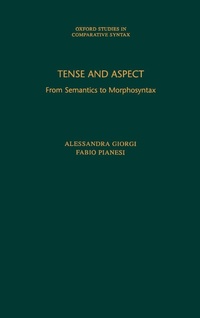
Tense and Aspect
From Semantics to Morphosyntax
1st Edition
Published on 11. December 1997
336 pages
978-0-19-535788-2 (ISBN)
Description

The authors bridge the gap between the semantic and syntactic properties of verb tense and aspect, and suggest a unified account of tense and aspect using Chomsky's Principles and Parameters Framework. They compare tense and aspect systems in Romance languages with Germanic ones.
More details
Other editions
Additional editions
Book
04/1998
Oxford University Press Inc
€291.80
Shipment within 15-20 days
Book
01/1998
Oxford University Press Inc
€139.50
Shipment within 15-20 days
Persons
Alessandra Giorgi is Associate Professor in the Department of Linguistics, University of Bergamo, Italy.
Fabio Pianesi is a Research Scientist at the Institute for Technology and Scientific Research (IRST) in Trento, Italy.
Content
- Intro
- Contents
- Symbols
- Introduction
- 1. The Syntactic and Semantic Background
- 1.1. The syntactic framework
- 1.1.1. The Split-Infl hypothesis
- 1.1.2. Chomsky's minimalist approach
- 1.1.3. A few words on phrase structure
- 1.1.4. Syncretic categories and the Feature Scattering Principle
- 1.2. The semantic representation
- 1.2.1. Tenses as sentential operators
- 1.2.2. Temporal entities
- 1.2.3. Events
- 2. On the Italian, Latin, and Portuguese Temporal Systems
- 2.1. The temporal projection
- 2.2. The Italian system
- 2.3. The Latin system
- 2.4. The Portuguese system
- 2.5. On nominative case assignment
- Appendix: On the etymology of the Latin pluperfect and future perfect
- 3. The Present Perfect in Germanic and Romance
- 3.1. The morphosyntactic properties of the Germanic verbal systems
- 3.1.1. The morphosyntax of the English verbal system
- 3.1.2. Other Germanic languages
- 3.1.3. The position of negation
- 3.1.4. English modals again
- 3.1.5. On the present perfect puzzle
- 3.1.6. The simple past and the present perfect in Italian
- 3.2. The semantics of the present perfect
- 3.2.1. On the notion of consequent state
- 3.2.2. Some tentative speculations on the semantics of the present perfect and the simple past
- 3.2.3. A revision of the notion of consequent state
- 3.2.4. A compositional semantics for synthetic and analytic perfects
- 3.2.5. On the argumental status of temporal adverbials
- 3.2.6. The present perfect in English and MSc and temporal localizations
- 3.2.7. Toward an account of the present perfect puzzle
- 3.3. More on the present perfect in Italian-like languages
- 3.3.1. A note on Icelandic
- 3.3.2. The interpretation of the present perfect in Spanish and Catalon
- 3.3.3. The analysis of the Portuguese periphrastic present perfect
- 3.4. Some observations on the temporal and aspectual properties of the Italian present perfect
- Appendix: The present perfect in Catanese and Vicentino
- 4. The Present and Imperfect in Germanic and Romance
- 4.1. The present tense
- 4.1.1. Crosslinguistic evidence
- 4.1.2. The structure of events
- 4.1.3. Punctuality and the properties of the speech event
- 4.1.4. A revised notion of punctuality
- 4.1.5. The present tense and perfectivity
- 4.2. On the present-in-the-past interpretation of embedded events in Germanic and Romance
- 4.2.1. The Italian imperfect: a characterisation
- 4.2.2. Comparative evidence
- 5. On the Semantics and Morphosyntax of the Italian Subjunctive
- 5.1 Toward a semantics of the subjunctive
- 5.1.1. The data
- 5.1.2. Previous accounts
- 5.1.3. Mood and modality
- 5.1.4. Mood in subordinate clauses
- 5.1.5. Factive predicates
- 5.1.6. Dream and its companions
- 5.1.7. Intralinguistic variations in mood choice
- 5.1.8. Other factors affecting mood choice
- 5.1.9. Concluding remarks
- 5.2. The morphosyntax of the Italian subjunctive
- 5.2.1. Syncretic categories and the Feature Scattering Principle
- 5.2.2. Subject-Verb inversion phenomena in Italian
- 5.2.3. The V-to-C solution
- 5.2.4. The syncretic category solution
- 5.2.5. Extraction from subjunctive clauses
- 5.2.6. Conclusions
- Appendix: Conditionals and counterfactuals
- 6. The Double Accessibility Reading in Italian and English
- 6.1. The Double Accessibility Reading
- 6.2. The Italian data
- 6.3. The English data
- 6.4. Conclusions
- References
- Author Index
- A
- B
- C
- D
- E
- F
- G
- H
- I
- J
- K
- L
- M
- O
- P
- R
- S
- T
- U
- V
- W
- Z
- Subject Index
- A
- B
- C
- D
- E
- F
- G
- H
- I
- J
- L
- M
- N
- O
- P
- R
- S
- T
- U
- V
- W
