

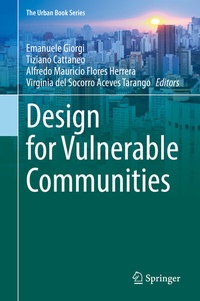
Design for Vulnerable Communities
Description

For this reason, this contributed volume collects contributions and considerations from experts in various fields of knowledge working in different parts of the world, such as the Americas, Europe and Asia. The goal is precisely to provide the reader with multidisciplinary knowledge and methodologies in order to better reflect and analyze the challenges that designing for vulnerable communities will face in the next few years. These multidisciplinary studies are organized into five sections:
- Sustainability and Vulnerabilities in Time of the Anthropocene
- Approaches, Principles and Paradigms to Contemporary Research and Practice for Vulnerable Communities
- Designing for Vulnerabilities: Applications and Actions
- Social Engagement in Vulnerable Communities Between Digital and Humanist Visions
- Vulnerabilities in Context: Analysis and Projects in the U.S.-Mexico Border Region
More details
Other editions
Additional editions
Persons
Tiziano Cattaneo
, Architect, PhD, Associate Professor in Architectural Design at the Department of Civil Engineering and Architecture, University of Pavia. In China he holds a qualification as Professor in design at the College of Design and Innovation, Tongji University, Shanghai. His research focuses on architectural design as a process to create and regenerate environments addressing contemporary conditions such as climate change, globalization, technology and urbanization. Tiziano is leading research, exhibitions, workshops and scientific meetings and is collaborating on a number of research projects with institutions and organizations in Europe, Mexico and China in the field of shared landscape, urban resilience and sustainable communities. He was visiting professor and has lectured in international universities and institutions in Europe, Brazil, Chile, Mexico, Russia, USA and China, and is author of numerous scientific publications.
Mauricio Flores
graduated in Architectural Engineering from the National Polytechnic Institute in 2000 and has a master's degree in Construction Administration from the Technological Institute of Construction. He worked in the construction area since 2002, developing projects, multimedia products and site supervision. In 2011 he began his career as a professor at the Tec de Monterrey campus Chihuahua in the colleges of Architecture, Industrial Design and Civil Engineering. In 2012 he held the position of Academic Director and since 2015 he is a full-time professor until today.
Virginia Aceves
graduated from the career from Facultad de Filosofía y Letras by the Universidad Autónoma de Chihuahua in 2000 and has a master degree in Humanity Studies from Universidad Virtual del Tecnológico de Monterrey. In 2000 she became professor in Tecnológico de Monterrey campus Chihuahua of language, grammar, literature and philosophy. Since 2010 was part of Escuela de Negocios y Humanidades. She held the position of Academic Director of Humanities from 2012 to 2016. Since 2017 she is a full time professor until today. She is creator and leader of social project
Accionetica.
