

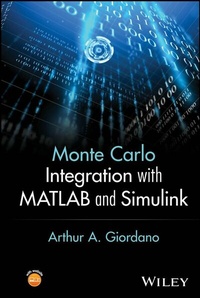
Monte Carlo Integration with MATLAB and Simulink
Description

Presents detailed guidance on Monte Carlo integration methods for complex applications
Monte Carlo integration has become an indispensable computational tool across science, engineering, mathematics, and economics, offering effective solutions where traditional numerical integration methods fall short. Monte Carlo Integration with MATLAB and Simulink provides both a structured introduction to advanced integration techniques and a practical guide to applying them in real-world contexts. Author Arthur A. Giordano emphasizes the natural progression from traditional methods such as the use of MATLAB integral to Monte Carlo simulation-based approaches, highlighting the growing importance of random variable-driven computations in modern research and engineering applications.
Covering topics from accept-rejection sampling and importance sampling to advanced algorithms such as Metropolis-Hastings, Gibbs Sampling, Slice, Hamiltonian Monte Carlo, and Sequential Monte Carlo (Particle Filtering), the book equips readers with the knowledge to handle both tractable and intractable integration problems. Extensive MATLAB examples are paired with detailed explanations, while dedicated Simulink models extend the scope of applications to robotics, control systems, neural networks, cosmology, and more. By integrating step-by-step examples, code snippets, and exploratory exercises, the book fosters an interactive learning process that encourages readers to replicate, modify, and expand on the provided material.
Combining theoretical background with extensive computational demonstrations, Monte Carlo Integration with MATLAB and Simulink:
- Covers both deterministic and simulation-based integration methods with increasing depth and complexity
- Introduces advanced Monte Carlo sampling algorithms, including Gibbs Sampling and Sequential Monte Carlo (Particle Filtering)
- Features over a dozen fully developed MATLAB examples with accompanying program code
- Provides detailed Simulink models for robotics, control systems, and scientific applications
- Includes problem sets with solutions available on a companion website
- Highlights the transition from classical integration to simulation methods for random processes
Incorporating classical integration techniques and cutting-edge simulation methods, Monte Carlo Integration with MATLAB and Simulink is a valuable resource for advanced undergraduate and graduate students in applied mathematics, engineering, and computational sciences, as well as scientists, engineers, and researchers applying Monte Carlo integration in fields ranging from signal processing to robotics.
More details
Other editions
Additional editions
Person
Arthur A. Giordano, PhD, earned his BS and MS in Electrical Engineering from Northeastern University and his doctorate from the University of Pennsylvania. With decades of experience in military and commercial communications, he has held leadership roles at GTE, Verizon Laboratories, and CNR, and was a founder of AG Consulting, LLC. He has published numerous technical articles, holds multiple patents, and co-authored two widely referenced texts: Modeling of Digital Communications Using Simulink and Detection and Estimation Theory. Dr. Giordano is a Life Senior Member of IEEE.
Content
Preface xiii
Acknowledgments xxi
About the Software xxiii
Abbreviations and Acronyms xxv
List of MATLAB® and Simulink® Programs xxvii
About the Companion Website xxxi
1 Monte Carlo and Numerical Integration Methods 1
2 Numerical Integration 3
3 MATLAB® Integral Programs 11
4 Monte Carlo Integration 21
5 Monte Carlo Integration: A Binary Choice 39
6 Monte Carlo Integration of a Normal Probability Density Function 57
7 Integration Using Importance Sampling 81
8 Further Methods of Monte Carlo Sampling 97
9 Metropolis-Hastings (MH) and Markov Chain Monte Carlo (MCMC) 125
10 Gibbs Sampling 179
11 Slice Sampling 207
12 Hamiltonian Monte Carlo Sampling 219
13 Sequential Monte Carlo or Particle Filtering 237
14 Numerical Integration via Simulink® 257
15 Summary of Monte Carlo Integration Methods 309
Appendix A Summary of Legendre-Gauss Quadrature Integration Method 313
Appendix B Computation of Posteriori pdf for Gibbs Sampling 321
Appendix C Hamiltonian Equations of Motion 331
Appendix D MATLAB Notes 337
Index 343
Preface
Monte Carlo integration is an innovative tool used in wide-ranging applications in science, mathematics, engineering, medicine, and economics. On a deeper level, it has become the go-to tool in physics, chemistry, biology, astronomy, digital signal processing, machine learning, control systems, robotics, medical, and economic applications. The MathWorks® has provided MATLAB® and Simulink® software proven to be invaluable in this pursuit. MATLAB® and Simulink® provide the necessary computational and simulation capability to address the plethora of applications. Numerous Monte Carlo integration and numerical integration examples based on this software are intended to be complementary allowing further insight into complex computations.
Preceding Monte Carlo integration numerical integration accomplished numerical analysis involving multiple methods to evaluate a definite integral. Both computational methods with known, exact expressions and simulation methods for unknown or unavailable expressions are used. MATLAB® and Simulink® tools are invoked to obtain accurate results of the integration. The extension to Monte Carlo integration is a natural step to where the underlying computations are based on random variables.
In this book, the reader may choose to follow the traditional approach that proceeds from introductory material to increasingly more complicated explanations. Alternatively, the presentation often allows the reader to scan the available examples and proceed directly to an example of interest while diminishing the use of prior information. By having the MATLAB® and Simulink® programs adjoining the computations, a close-coupling permits quick back-and-forth study of the program code and the computations. Where necessary, mathematical explanations are included for clarification.
This book focuses on Monte Carlo integration methods where an introductory aspect is pursued in terms of traditional, i.e., deterministic methods. Use of Monte Carlo integration via simulation provides an estimate of the actual integral based on random sampling. The latter case is a tribute to the recent advances in computational techniques via computer simulation involving random processes. The principal attention of the presented examples focuses on MATLAB® where extensive Simulink® examples are provided subsequently.
An important goal in providing the detailed examples presented here is to expand the reader's knowledge and ability to develop their own programs. As a consequence, an interactive approach in use of the provided examples is recommended. The reader can realize maximum benefit by adopting the suggested actions listed below:
- Replicate specific examples to ensure an understanding of the computations.
- Modify the inputs of the selected example for exploring the consequences of the ensuing changes.
- Replace the function in the integration routine with a user-defined alternative and execute the modified example.
Scope
This book introduces the reader to a wide selection of Monte Carlo-based numerical integration techniques. The selection of the method to use is dependent on the users' application likely involving random number generation and expectations of functions of random variables. MATLAB® is the naturally chosen computational technique for providing accurate, efficient solutions of often complicated, intractable problems. As a complementary tool, Simulink® examples, involving Monte Carlo-based numerical integration, is included to explore unlimited topics in diverse technologies.
It is noted that the MATLAB® and Simulink® programs presented here assumes that the reader has rudimentary knowledge of MATLAB® and Simulink®. The MathWorks® has excellent tutorials on both of these topics; see https://www.MathWorks.com
Organization of the Book
Chapters 1-13 encompass numerical integration methods where MathWorks® programs in MATLAB® can perform integration of any well-defined function. In Chapters 4-13, Monte Carlo integration via MATLAB® encompasses many computational and simulation-based methods whose function is intractable, complicated, or undefined. These methods include accept-rejection sampling, importance sampling, Metropolis-Hastings, Gibbs sampling, slice sampling, Hamiltonian Monte Carlo sampling, and sequential Monte Carlo, also known as particle filtering. This last subject delves into nonlinear, non-Gaussian models and is more indicative of realistic cases.
In Chapter 14, Monte Carlo Integration via Simulink® addresses numerous examples focusing on science, engineering, astronomy/cosmology, neural networks, robotics, Kalman filtering, and sequential Monte Carlo or particle filtering.
Chapters 2-13 contain detailed MATLAB® examples and the accompanying code. Chapter 14 contains multiple Simulink® models concluding in particle filtering.
Chapters 2-14 contain suggested problems where solutions appear on a website.
Chapter 1
This chapter outlines the framework for performing numerical integration using Monte Carlo methods. Integration using computer-based discrete methods replaces continuous integration where convergence is assured via the Law of Large Numbers (LLN). Following a historical introduction to numerical integration, the focus quickly advances to modern Monte Carlo integration methods where intractable integrals can be evaluated using pseudo-random sampling. In the subsequent chapters, numerous Monte Carlo integration methods are presented concluding with sequential Monte Carlo or particle filters where the general application involves nonlinear, non-Gaussian computations.
Chapter 2
Numerical integration methods for deterministic or nonrandom applications have been a mainstay for the evaluation of definite integrals prior to the availability of laptop computers possessing extensive memory and fast computational capability. Prior advances in computational techniques involving Legendre-Gauss quadrature methods that remove the restriction of equally spaced intervals in the integrand have been successful in evaluating a myriad of complicated integrals. Currently modern laptop computers with extensive software capability propelled the advance of numerical integration methods where MATLAB®'s program integral is a premier tool in this regard. A comparison of MATLAB®'s integral program with standard techniques such as rectangular, trapezoidal, and Simpson's method establishes a baseline for the study of Monte Carlo integration methods.
Chapter 3
This chapter represents a compendium of examples using MATLAB® integral as well as MATLAB® programs trapz and quad. Program trapz computes the integral of a vector via the trapezoidal method where for matrices the computation produces a row vector with the integral over each column. Program quad uses recursive adaptive Simpson quadrature to determine the integral of scalar-valued function with an absolute error tolerance. Examples include power spectrum estimation of a linear system, blackbody radiation emittance and integration of the probability density for Cauchy and standard normal distributions. This preliminary background establishes the starting point where Monte Carlo integration can be recognized as the pinnacle of computational methods.
Chapter 4
Random number generation is the backbone of Monte Carlo integration where multiple samples of the integrand are needed. Chebyshev's inequality bounds the integration error. For a sufficiently large sample size, the estimate of the integral is normally distributed. Using discrete samples of the integrand, the sample mean provides an estimate of the integral with a sample variance that decreases with the number of samples. When the integration involves a random variable with a known probability density, the Monte Carlo sample mean provides an estimate of the integral using randomly generated samples.
Chapter 5
Monte Carlo integration is instrumental in integrating complicated or undefined functions. Using computer-based computations with random sampling, two principal binary methods applied for arbitrary functions are hit-or-miss and accept-reject, also referred to as rejection sampling. The function to be integrated is assumed to have a maximum value within the integration interval. In the Monte Carlo algorithm, randomly generated samples are dropped into the area of interest and the probability that the samples lie inside the region of interest are estimated thereby allowing an estimate of the integral to be obtained. This method is applicable to multiple integrals involving three-dimensional objects such as a sphere.
Chapter 6
Monte Carlo methods are frequently used in the integration of normal distributions. In this chapter, MATLAB® program integral, a sampled version of the integral and normally distributed samples generated from MATLAB® routine randn are used in conjunction with a MATLAB® program ksdensity for estimating the probability density function. An important computation with normal distributions involves the estimation of the tail of the distribution. Investigating multiple methods leads to a comparison of the various techniques in terms of the sample size and variance of the estimate.
Chapter 7
This chapter presents...
