

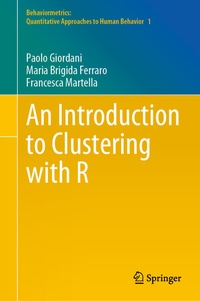
An Introduction to Clustering with R
Description

The purpose of this book is to thoroughly prepare the reader for applied research in clustering. Cluster analysis comprises a class of statistical techniques for classifying multivariate data into groups or clusters based on their similar features. Clustering is nowadays widely used in several domains of research, such as social sciences, psychology, and marketing, highlighting its multidisciplinary nature. This book provides an accessible and comprehensive introduction to clustering and offers practical guidelines for applying clustering tools by carefully chosen real-life datasets and extensive data analyses. The procedures addressed in this book include traditional hard clustering methods and up-to-date developments in soft clustering. Attention is paid to practical examples and applications through the open source statistical software R. Commented R code and output for conducting, step by step, complete cluster analyses are available. The book is intended for researchers interested in applying clustering methods. Basic notions on theoretical issues and on R are provided so that professionals as well as novices with little or no background in the subject will benefit from the book.
Reviews / Votes
"This book is written for anybody who would like to start clustering using R . and considers both practical and theoretical aspects. . this is an in-depth introduction to clustering analysis considering both the theory and applications in R, with various examples in different fields. . More than just an introduction, this would be a very good companion book for researchers to help them understand clustering with R, and to compare the various methods and their applications." (Sébastien Bailly, ISCB News, iscb.info, Issue 71, June, 2021)
More details
Other editions
Additional editions
Persons
Maria Brigida Ferraro, Department of Statistical Sciences, Sapienza University of Rome
Francesca Martella, Department of Statistical Sciences, Sapienza University of Rome
