

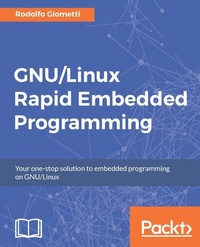
GNU/Linux Rapid Embedded Programming
Your one-stop solution to embedded programming on GNU/Linux
Published on 7. October 2025
732 pages
978-1-78646-328-9 (ISBN)
Description

An annotated guide to program and develop GNU/Linux Embedded systems quickly
Key Features
Rapidly design and build powerful prototypes for GNU/Linux Embedded systems
Become familiar with the workings of GNU/Linux Embedded systems and how to manage its peripherals
Write, monitor, and configure applications quickly and effectively, manage an external micro-controller, and use it as co-processor for real-time tasks
Book DescriptionEmbedded computers have become very complex in the last few years and developers need to easily manage them by focusing on how to solve a problem without wasting time in finding supported peripherals or learning how to manage them. The main challenge with experienced embedded programmers and engineers is really how long it takes to turn an idea into reality, and we show you exactly how to do it. This book shows how to interact with external environments through specific peripherals used in the industry. We will use the latest Linux kernel release 4.4.x and Debian/Ubuntu distributions (with embedded distributions like OpenWrt and Yocto). The book will present popular boards in the industry that are user-friendly to base the rest of the projects on - BeagleBone Black, SAMA5D3 Xplained, Wandboard and system-on-chip manufacturers. Readers will be able to take their first steps in programming the embedded platforms, using C, Bash, and Python/PHP languages in order to get access to the external peripherals. More about using and programming device driver and accessing the peripherals will be covered to lay a strong foundation. The readers will learn how to read/write data from/to the external environment by using both C programs or a scripting language (Bash/PHP/Python) and how to configure a device driver for a specific hardware. After finishing this book, the readers will be able to gain a good knowledge level and understanding of writing, configuring, and managing drivers, controlling and monitoring applications with the help of efficient/quick programming and will be able to apply these skills into real-world projects. What you will learn
Use embedded systems to implement your projects
Access and manage peripherals for embedded systems
Program embedded systems using languages such as C, Python, Bash, and PHP
Use a complete distribution, such as Debian or Ubuntu, or an embedded one, such as OpenWrt or Yocto
Harness device driver capabilities to optimize device communications
Access data through several kinds of devices such as GPIO's, serial ports, PWM, ADC, Ethernet, WiFi, audio, video, I2C, SPI, One Wire, USB and CAN
Who this book is forThis book targets Embedded System developers and GNU/Linux programmers who would like to program Embedded Systems and perform Embedded development. The book focuses on quick and efficient prototype building. Some experience with hardware and Embedded Systems is assumed, as is having done some previous work on GNU/Linux systems. Knowledge of scripting on GNU/Linux is expected as well.
Key Features
Rapidly design and build powerful prototypes for GNU/Linux Embedded systems
Become familiar with the workings of GNU/Linux Embedded systems and how to manage its peripherals
Write, monitor, and configure applications quickly and effectively, manage an external micro-controller, and use it as co-processor for real-time tasks
Book DescriptionEmbedded computers have become very complex in the last few years and developers need to easily manage them by focusing on how to solve a problem without wasting time in finding supported peripherals or learning how to manage them. The main challenge with experienced embedded programmers and engineers is really how long it takes to turn an idea into reality, and we show you exactly how to do it. This book shows how to interact with external environments through specific peripherals used in the industry. We will use the latest Linux kernel release 4.4.x and Debian/Ubuntu distributions (with embedded distributions like OpenWrt and Yocto). The book will present popular boards in the industry that are user-friendly to base the rest of the projects on - BeagleBone Black, SAMA5D3 Xplained, Wandboard and system-on-chip manufacturers. Readers will be able to take their first steps in programming the embedded platforms, using C, Bash, and Python/PHP languages in order to get access to the external peripherals. More about using and programming device driver and accessing the peripherals will be covered to lay a strong foundation. The readers will learn how to read/write data from/to the external environment by using both C programs or a scripting language (Bash/PHP/Python) and how to configure a device driver for a specific hardware. After finishing this book, the readers will be able to gain a good knowledge level and understanding of writing, configuring, and managing drivers, controlling and monitoring applications with the help of efficient/quick programming and will be able to apply these skills into real-world projects. What you will learn
Use embedded systems to implement your projects
Access and manage peripherals for embedded systems
Program embedded systems using languages such as C, Python, Bash, and PHP
Use a complete distribution, such as Debian or Ubuntu, or an embedded one, such as OpenWrt or Yocto
Harness device driver capabilities to optimize device communications
Access data through several kinds of devices such as GPIO's, serial ports, PWM, ADC, Ethernet, WiFi, audio, video, I2C, SPI, One Wire, USB and CAN
Who this book is forThis book targets Embedded System developers and GNU/Linux programmers who would like to program Embedded Systems and perform Embedded development. The book focuses on quick and efficient prototype building. Some experience with hardware and Embedded Systems is assumed, as is having done some previous work on GNU/Linux systems. Knowledge of scripting on GNU/Linux is expected as well.
All prices
More details
Edition
Digital original
Language
English
Place of publication
Birmingham
United Kingdom
Target group
Professional and scholarly
US School Grade: College Graduate Student
Edition type
Digital original
File size
39,66 MB
ISBN-13
978-1-78646-328-9 (9781786463289)
Copyright in bibliographic data and cover images is held by Nielsen Book Services Limited or by the publishers or by their respective licensors: all rights reserved.
Schweitzer Classification
Other editions
Additional editions
Rodolfo Giometti
GNU/Linux Rapid Embedded Programming
Your one-stop solution to embedded programming on GNU/Linux
Book
03/2017
Packt Publishing
€60.40
Shipment within 3-4 weeks
Person
Giometti Rodolfo :
Rodolfo Giometti is an engineer, IT specialist, GNU/Linux expert and software libre evangelist. He is the author of the books BeagleBone Essentials, BeagleBone Home Automation Blueprints and GNU/Linux Rapid Embedded Programming by Packt Publishing and maintainer of the LinuxPPS projects. He still actively contributes to the Linux source code with several patches and new device drivers for industrial applications devices. During his 20+ years of experience, he has worked on the x86, ARM, MIPS, and PowerPC-based platforms. Now, he is the co-chief at HCE Engineering S.r.l., where he designs new hardware and software systems for the quick prototyping in industry environment, control automation, and remote monitoring.
Rodolfo Giometti is an engineer, IT specialist, GNU/Linux expert and software libre evangelist. He is the author of the books BeagleBone Essentials, BeagleBone Home Automation Blueprints and GNU/Linux Rapid Embedded Programming by Packt Publishing and maintainer of the LinuxPPS projects. He still actively contributes to the Linux source code with several patches and new device drivers for industrial applications devices. During his 20+ years of experience, he has worked on the x86, ARM, MIPS, and PowerPC-based platforms. Now, he is the co-chief at HCE Engineering S.r.l., where he designs new hardware and software systems for the quick prototyping in industry environment, control automation, and remote monitoring.
Content
Table of Contents
Installing the Development System
Managing the System Console
C Compiler, Device Drivers & Useful Developing Techniques
Quick Programming with scripts & system daemons
Setting up an embedded OS
General Purposes Input Output signals - GPIO
Serial Ports and TTY Devices - TTY
Universal Serial Bus
Inter-integrated Circuit
Serial Peripheral Interface
Wire Bus
Ethernet network device
Wireless Network Device
Controller Area Network
Multimedia Devices
Analog Devices
Analog-to-Digital Converters
Pulse-Width Modulation
Miscellaneous devices
Installing the Development System
Managing the System Console
C Compiler, Device Drivers & Useful Developing Techniques
Quick Programming with scripts & system daemons
Setting up an embedded OS
General Purposes Input Output signals - GPIO
Serial Ports and TTY Devices - TTY
Universal Serial Bus
Inter-integrated Circuit
Serial Peripheral Interface
Wire Bus
Ethernet network device
Wireless Network Device
Controller Area Network
Multimedia Devices
Analog Devices
Analog-to-Digital Converters
Pulse-Width Modulation
Miscellaneous devices

