

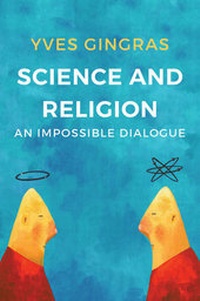
Science and Religion
Description

Reviews / Votes
'In this forceful and fascinating polemic, a leading historian and sociologist of the sciences takes up arms against recent calls for dialogue between science and religion. In a survey of past centuries of conflict, censorship and apologetics, and a telling analysis of modern initiatives to establish new kinds of relations between science and religion, Gingras argues that the sciences have achieved autonomous status by building social organizations not to be reconciled with the claims of faith. This book represents an important and provocative intervention in a debate of great contemporary significance.' Simon Schaffer, Professor of History of Science, University of Cambridge 'Yves Gingras' gripping account of four centuries of conflict between religion and science provides a wonderful antidote to the insistent calls for "dialogue".' Alan Sokal, Professor of Physics, New York University ?In this forceful and fascinating polemic, a leading historian and sociologist of the sciences takes up arms against recent calls for dialogue between science and religion. In a survey of past centuries of conflict, censorship and apologetics, and a telling analysis of modern initiatives to establish new kinds of relation between science and religion, Gingras argues that the sciences have achieved autonomous status by building social organisations not to be reconciled with the claims of faith. This book represents an important and provocative intervention in a debate of great contemporary significance.? Simon Schaffer, University of Cambridge "Yves Gingras' gripping account of four centuries of conflict between religion and science provides a wonderful antidote to the insistent calls for 'dialogue.'" Alan Sokal, Professor of Physics, New York UniveristyMore details
Other editions
Additional editions
Person
Content
1
THE THEOLOGICAL LIMITS OF THE AUTONOMY OF SCIENCE
Lost in an immense forest at night, I have only a small light to find my way; come a stranger who tells me: 'my friend, blow your candle to better find your way'. This stranger is a theologian.
Diderot1
Modern science, institutionalized in the seventeenth century, gradually emancipated itself from philosophy - the original source of all reflection on the physical, psychological and social worlds - and gave birth, in the course of the nineteenth century, to an increasingly fragmented domain populated with specialized and technical scientific disciplines. During this process, 'philosophers of nature', generalists who were often self-taught and who cultivated several areas of knowledge at the same time, gave way to more specialized 'scientists' often dedicated to full-time research on a particular subject matter. The invention of the term scientist to replace natural philosopher by mathematician, philosopher, and Anglican clergyman William Whewell at the beginning of the 1830s, stands as a linguistic signpost of this social transformation.
This chapter describes the progressive autonomization of science in relation to other spheres of society and the extension of its specific mode of thought to the whole of the natural and social world. This process also generated conflicts with theologians, specialists in rational discourse on the gods, as the Greek word Theologos, first found in Plato, indicates. The Christian Church took up this tradition of Greek philosophy and applied it to the interpretation of a single God. Spokespersons for the monotheistic religions (Christian, Muslim and Jewish) are thus the guardians of a long-dominant interpretation of nature, wherein profane knowledge was subjugated to a divine knowledge revealed in texts considered sacred (the Christian and Jewish Bibles, and the Koran). Of course, only scientists working in areas likely to contradict a religious view of the world struggled with these authorities. For it is never science in general that enters into conflict with a given religion, but only particular sciences when they raise an issue that is already the subject of a particular theological interpretation. It is therefore not surprising that physics and astronomy were the first sciences to become problematic within the Christian context since these disciplines deal with questions that confront Christian cosmology head-on.
The confrontation between faith and reason goes back to the roots of Christianity, the first debates having drawn philosophers from the Greek polytheistic tradition into opposition with theologians and the fathers of the Christian Church. The latter were obliged to justify the tenets of their 'cult' to the cultivated followers of the Ancients and argue that their religion was indeed a true 'philosophy' in the Greek sense of the word and that the proponents of this new philosophy had rational arguments that would demonstrate the existence of a single God as opposed to the polytheism maintained by the hitherto dominant elites.2 It was not, however, until the rediscovery of Aristotle's works on nature in the Middle Ages that these conflicts took on a clear institutional form. The question of the relationship between faith and reason also arose in the Muslim world in the famous (posthumous) confrontation between al-Ghazali (1058-1111) - for whom philosophy must submit to theology - and the great jurist and Aristotle commentator, Ibn Rushd, latinized as Averroes (1126-1198) - who defended the autonomy of philosophy.3 In the Christian world, the teaching of Aristotle's natural philosophy in the university Faculties of Arts at the beginning of the thirteenth century also generated a jurisdictional dispute with the Faculties of Theology, who saw philosophy as a propaedeutic discipline subject to their control.4 Public confrontations between philosophy, the rational discourse on nature, and theology, the rational discourse on a revealed God, gained importance only after theology had become a social institution that sought to control and sanction any and all discourse calling into question the dogmas and the teachings of the Church.
These multiple and recurrent struggles between science and religion are not simple confrontations between individuals of varying degrees of stubbornness, as is too often suggested, but an expression of institutional power relations. At issue is the autonomy and freedom of science vis-à-vis the pretensions of the churches to rule over science through its theologians.
Aristotle: the first conflict of the faculties
In 1798, the German protestant philosopher, Immanuel Kant (1724-1804), then seventy-five years old, published his last book: The Conflict of the Faculties. Coming from the author of the famous three 'Critiques' (of pure reason, of practical reason and of the faculty of judgment), one might assume that the book dealt with the intellectual faculties, but it did not. The topic was the freedom of thought within university faculties. Kant called for nothing less than the absolute independence and complete freedom of thought and public speech for professors in the faculty of philosophy and, especially, the end of the guardianship of theology over philosophy. The Faculty of Philosophy, he says, 'must be free to examine in public and to evaluate with cold reason the source and content of this alleged basis of doctrine, unintimidated by the sacredness of the object which has supposedly been experienced and determined to bring this alleged feeling to concepts'.5 Moreover, when 'the source of a sanctioned teaching is historical, then - no matter how highly it may be recommended as sacred to the unhesitating obedience of faith - the philosophy faculty is entitled and indeed obligated to investigate its origins with critical scrupulosity'.6 Since philosophy sought truth, it must be free and 'subject only to laws given by reason, not by the government'.7 Notice that, in Kant's time, philosophy included natural philosophy and therefore the sciences.
As a philosopher, Kant had himself suffered from the limits imposed on the freedom of expression when he had, four years earlier, published an essay on Religion within the Bounds of Mere Reason. He had then received an admonishing letter from the King of Prussia, Frederic William II, who accused him of misusing his 'philosophy to distort and disparage many of the cardinal and basic teachings of the Holy Scriptures and of Christianity'.8 Kant had accepted his monarch's censorship and promised to no longer speak publicly about natural or revealed religion during the King's reign. Kant did not write again until after the King's death in 1797. As the new king, Frederic William III, had disposed of the theologian who dictated the religious policy of his father, Kant felt free to publicly expose the foundation of the problem: the guardianship of theology over philosophy within the universities. Kant remained the bugbear of Catholic theologians. As if to remind him posthumously of the limits of his critical discourse, his famous Critique of Pure Reason, even though published in 1781, was placed on the Index by the Catholic Church in 1827.
Eighty years later, with the Church in full anti-modernist crisis, Cardinal Mercier would even declare that Kant and Darwin were the sources of the 'modernism' that Catholics must resist.9 Again in 2006, Pope Benedict XVI launched a similar charge describing the German philosopher as the theorist of the 'self-limitation of reason', a thesis that had subsequently been 'radicalized by the impact of the natural sciences' and should now be called into question.10
Theology's guardianship of philosophy in the Christian world, publicly denounced by Kant, dates back to the very origins of the medieval university. Indeed, Aristotle's writings on nature began to circulate at the beginning of the thirteenth century, and increasingly became a subject taught within the arts faculties of universities, particularly at the University of Paris.11 Written four centuries before the birth of Jesus, the works of the Greek philosopher are of course 'pagan' and present an uncreated and eternal nature, in other words, a nature that is obviously incompatible with biblical and koranic stories of creation. The 'heretical' nature of the affirmation of the eternity of the world had already been noted in the Middle Ages by al-Ghazali in his denunciation of Aristotle's philosophy.12
As early as 1210, a provincial council of bishops in Paris had prohibited the public reading of Aristotle's works dealing with natural philosophy under penalty of excommunication. Reminders were issued in 1215 and in 1231 by Pope Gregory IX who demanded that the prohibited works be examined in order to expunge them 'of any suspicion of error', in order to retain only the useful parts.13 According to the Pope, the secular sciences must serve 'the science of Holy Scriptures'. Accordingly, Christ's faithful were to study them only 'to the extent that it is proven that they condescend to the will of the sovereign master'. It was therefore legitimate, he said, to retain only the useful parts and to 'scrupulously' remove 'all errors liable to...
