

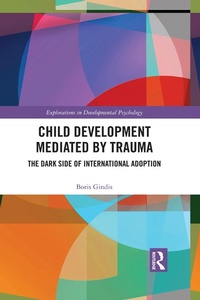
Child Development Mediated by Trauma
The Dark Side of International Adoption
1st Edition
Published on 4. June 2019
222 pages
978-1-351-33327-6 (ISBN)
Description

Drawing on clinical data obtained through the study of children adopted from overseas orphanages, the author of this cutting-edge text applies the Developmental Trauma Disorder (DTD) conceptual framework to the analysis of psychological, educational and mental health impact of the early childhood trauma on development.
A massive scale of international adoption of children, victims of profound neglect and deprivation, combined with the fundamental change in a child's social situation of development after adoption, offers a valuable opportunity to explore the concept of Developmental Trauma Disorder, in particular, developmental delays, emotional vulnerability, "mixed maturity", cumulative cognitive deficit, and post-orphanage behavior patterns, being presented by many adoptees long after the adoption. By focusing on the neurological and psychological nature of childhood trauma, Dr. Gindis offers a unique approach to understanding the ongoing impacts of DTD and the ways in which any subsequent neuropsychological, educational, and mental health issues might be assessed.
Offering an evidence-based exploration of DTD, and a critique of "conventional" approaches to rehabilitation and remediation of international adoptees, this book will be of great interest to researchers in the fields of psychology, mental health, education and child development; as well as clinicians involved in trauma treatment and international adoption.
A massive scale of international adoption of children, victims of profound neglect and deprivation, combined with the fundamental change in a child's social situation of development after adoption, offers a valuable opportunity to explore the concept of Developmental Trauma Disorder, in particular, developmental delays, emotional vulnerability, "mixed maturity", cumulative cognitive deficit, and post-orphanage behavior patterns, being presented by many adoptees long after the adoption. By focusing on the neurological and psychological nature of childhood trauma, Dr. Gindis offers a unique approach to understanding the ongoing impacts of DTD and the ways in which any subsequent neuropsychological, educational, and mental health issues might be assessed.
Offering an evidence-based exploration of DTD, and a critique of "conventional" approaches to rehabilitation and remediation of international adoptees, this book will be of great interest to researchers in the fields of psychology, mental health, education and child development; as well as clinicians involved in trauma treatment and international adoption.
Reviews / Votes
"Dr. Boris Gindis has written a remarkably readable book on a highly complex subject. If you work with traumatized youngsters, you need to read Child Development Mediated by Trauma: The Dark Side of International Adoption.[...] For those working with internationally adopted children, Dr. Gindis brings together a set of new ideas as well as fresh perspectives on old concepts. Although familiar with the subject, I learned a great deal. [...] The book seamlessly weaves together developmental brain-science, trauma research and pertinent clinical examples to create an articulate and compelling narrative. Dr. Gindis takes the reader on a "tour" of the proposed medical diagnosis, Developmental Trauma Disorder (DTD) suggested by Dr. Bessel van der Kolk and his associates. Dr. Gindis offers succinct examples from his own practice (all carefully disguised) to explain this new, integrative clinical framework. [...] Dr. Gindis discussion of DTD as the root of Reactive Attachment Disorder (RAD) is powerful. Every mental health training program-from psychiatry to occupational therapy- should have Child Development Mediated by Trauma as part of their core curriculum. I keep it close at hand on my "go to" shelf"."Dr. Patty Cogen, is the author of the international best-selling adoption book, Parenting Your Internationally Adopted Child. She currently works as a Child Development Specialist and Family Therapist with expertise in international adoptions, USA. "Dr. Boris Gindis has written a remarkably readable book on a highly complex subject. If you work with traumatized youngsters, you need to read Child Development Mediated by Trauma: The Dark Side of International Adoption.[...] For those working with internationally adopted children, Dr. Gindis brings together a set of new ideas as well as fresh perspectives on old concepts. Although familiar with the subject, I learned a great deal. [...] The book seamlessly weaves together developmental brain-science, trauma research and pertinent clinical examples to create an articulate and compelling narrative. Dr. Gindis takes the reader on a "tour" of the proposed medical diagnosis, Developmental Trauma Disorder (DTD) suggested by Dr. Bessel van der Kolk and his associates. Dr. Gindis offers succinct examples from his own practice (all carefully disguised) to explain this new, integrative clinical framework. [...] Dr. Gindis discussion of DTD as the root of Reactive Attachment Disorder (RAD) is powerful. Every mental health training program-from psychiatry to occupational therapy- should have Child Development Mediated by Trauma as part of their core curriculum. I keep it close at hand on my "go to" shelf"."
Dr. Patty Cogen, is the author of the international best-selling adoption book, Parenting Your Internationally Adopted Child. She currently works as a Child Development Specialist and Family Therapist with expertise in international adoptions, USA.
"As a parent and an adoption lawyer who is well familiar with the 'classical' editions on the attachment disorder and other psychological issues of the adoptive children, I can very much appreciate the quality of the research provided in the Dr. Gindis' book. Both the depth of the research and the literary style of this book are of equally high quality. The narrative is very logical and well-structured, meaning that the highly academic work is easy to follow even for a non-psychologist or psychiatrist. The academic concepts are smartly illustrated with captivating real-life stories which bring a great human touch to this scientific edition."
Olga Mitireva, adoption lawyer, Geneva.
"Gindis' book can be recommended not only to psychologists and educators working with internationally adopted post-institutionalized (IAPI) children but to all professionals interested in vicissitudes of traumatic child development and its uncertain outcomes."
Alex Kozulin, Achva College and the Feuerstein Institute, Jerusalem, Israel
More details
Series
Edition
1. Auflage
Language
English
Place of publication
London
United Kingdom
Publishing group
Taylor & Francis Ltd
Target group
College/higher education
Illustrations
6 Tables, black and white
ISBN-13
978-1-351-33327-6 (9781351333276)
Copyright in bibliographic data and cover images is held by Nielsen Book Services Limited or by the publishers or by their respective licensors: all rights reserved.
Schweitzer Classification
Other editions
Additional editions
Book
12/2020
1st Edition
Routledge
€52.07
Shipment within 15-20 days
Book
06/2019
1st Edition
Routledge
€206.20
Shipment within 10-20 days
Person
Boris Gindis, PhD, is a licensed psychologist, USA.
Content
Introduction
Chapter One: Contemporary International Adoption - a Unique Social/Cultural Phenomenon
Chapter Two: Developmental Trauma Disorder and Internationally Adopted Post-Institutionalized Children
Chapter Three: Development Interceded by Trauma in Internationally Adopted Post-Institutionalized Children
Chapter Four: "Language Lost - Language Found" experience: Distinct Pattern of Language Development in Internationally Adopted Post-Institutionalized Children
Chapter Five: Cognitive Functioning of Internationally Adopted Post-Institutionalized Children
Chapter Six: Social/Emotional and Behavioral Functioning of Internationally Adopted Post-Institutionalized Children
Chapter Seven: Academic performance and educational remediation of Internationally Adopted Post-Institutionalized Children
Conclusion
Appendix 1: Developmental Trauma Disorder Questionnaire for the Parents of Internationally Adopted Post-Institutionalized Children.
Appendix 2: Sample of referral questions and psychological tools used in bilingual screening of newly arrived Internationally Adopted Post-Institutionalized Children
Appendix 3: Sample of referral questions and psychoeducational tests/clinical procedures used for a comprehensive combined neuropsychological, developmental, and educational assessment of Internationally Adopted Post-Institutionalized Children.
Chapter One: Contemporary International Adoption - a Unique Social/Cultural Phenomenon
Chapter Two: Developmental Trauma Disorder and Internationally Adopted Post-Institutionalized Children
Chapter Three: Development Interceded by Trauma in Internationally Adopted Post-Institutionalized Children
Chapter Four: "Language Lost - Language Found" experience: Distinct Pattern of Language Development in Internationally Adopted Post-Institutionalized Children
Chapter Five: Cognitive Functioning of Internationally Adopted Post-Institutionalized Children
Chapter Six: Social/Emotional and Behavioral Functioning of Internationally Adopted Post-Institutionalized Children
Chapter Seven: Academic performance and educational remediation of Internationally Adopted Post-Institutionalized Children
Conclusion
Appendix 1: Developmental Trauma Disorder Questionnaire for the Parents of Internationally Adopted Post-Institutionalized Children.
Appendix 2: Sample of referral questions and psychological tools used in bilingual screening of newly arrived Internationally Adopted Post-Institutionalized Children
Appendix 3: Sample of referral questions and psychoeducational tests/clinical procedures used for a comprehensive combined neuropsychological, developmental, and educational assessment of Internationally Adopted Post-Institutionalized Children.
