
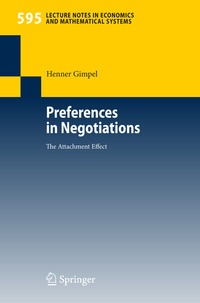
Preferences in Negotiations
Description
Alles über E-Books | Antworten auf Fragen rund um E-Books, Kopierschutz und Dateiformate finden Sie in unserem Info- & Hilfebereich.
Negotiations are ubiquitous in business, politics, and private life. In many cases their outcome is of great importance. Yet, negotiators frequently act irrationally and fail to reach mutually beneficial agreements. Cognitive biases like overconfidence, egocentrism, and the mythical fixed pie illusion oftentimes foreclose profitable results. A further cognitive bias is the attachment effect: Parties are influenced by their subjective expectations formed on account of the exchange of offers, they form reference points, and loss aversion potentially leads to a change of preferences when expectations change.
This book presents a motivation, formalization, and substantiation of the attachment effect. Thereby, preferences and behavior are approached from a microeconomic and a psychological perspective. Two experiments show clear evidence for a systematic bias. The results can be used for prescriptive advice to negotiators: either for debiasing or to systematically affect the counterparty.
More details
Other editions
Additional editions

Content
System requirements
File format: PDF
Copy protection: Watermark-DRM (Digital Rights Management)
System requirements:
- Computer (Windows; MacOS X; Linux): Use the free software Adobe Reader, Adobe Digital Editions, or any other PDF viewer of your choice (see eBook Help).
- Tablet/Smartphone (Android; iOS): Install the free app Adobe Digital Editions or another reading app for eBooks, e.g., PocketBook (see eBook Help).
- E-reader: Bookeen, Kobo, Pocketbook, Sony, Tolino and many more (only limited: Kindle).
The file format PDF always displays a book page identically on any hardware. This makes PDF suitable for complex layouts such as those used in textbooks and reference books (images, tables, columns, footnotes). Unfortunately, on the small screens of e-readers or smartphones, PDFs are rather annoying, requiring too much scrolling.
This eBook uses Watermark-DRM, a „soft” copy protection. This means that there are no technical restrictions to prevent illegal distribution. However, there is a personalised watermark embedded in the eBook that can be used to identify the purchaser of the eBook in the event of misuse and to provide evidence for legal purposes.
For more information, see our eBook Help page.