

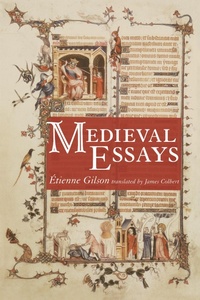
Medieval Essays
Published on 15. September 2011
234 pages
978-1-62189-096-6 (ISBN)
Description

This book is a collection of nine articles by the twentieth century's leading medievalist, Etienne Gilson. A major participant in the revival of Thomistic philosophy, Gilson was a member of the French Academy and, after a university career culminating at the Sorbonne and the College de France, he turned down an invitation from Harvard University to become the guiding spirit of the Pontifical Institute of Medieval Studies at the University of Toronto for several decades.
Several of the articles stand on their own as making a significant contribution to topics like St. Anselm's ontological argument for the existence of God. Likewise, "The Middle Ages and Naturalism" contrasts Renaissance Humanists and Reformers with the medievals on the defining issue of their attitude toward nature in order to understand who actually stands closer to the ancient Greeks.
All of the articles give an insight into the great synthetic visions articulated by the better-known works of Gilson like The Spirit of Medieval Philosophy. We see Gilson's meticulous spadework for the broader theme of Christian philosophy in his examination of the Latin Averroist Boethius of Dacia's book on the eternity of the world. Gilson finds that Boethius never expresses the view attributed to Latin Averroism that there are contradictory truths in religion and philosophy, although he does think that Boethius is unsuccessful in his account of the relations between philosophy and theology.
The opening piece revisits a battle now won (and won in great measure by Gilson's efforts), namely the fight to acknowledge the very existence of medieval philosophy and win its place in the academic world. But the article also makes the effort--which becomes a connecting thread throughout the nine articles-to pinpoint the uniqueness of what Gilson calls Christian philosophy. The closing article studies the profound influence of the great Muslim thinker Avicenna on Latin Europe drawing a parallel between Avicenna's work and that of the great Christian medievals like Thomas Aquinas and Duns Scotus.
When Gilson died in 1978, a great deal of his work on the history of philosophy, and specifically God, the primacy of existence or esse over essence, and the impact of Christianity on philosophy had been translated. A significant amount of material, however, has not yet appeared in English. The publication of Medieval Studies represents a vital step in bringing these important works into the English-speaking world.
More details
Other editions
Additional editions
Persons
James G. Colbert is a philosophy professor at Fitchburg State College in Massachusetts. He is the author or co-author of books on symbolic logic, Marxism, and the family. Colbert has translated six books, including Gilson's Greco-Arabic Sources of Avicennist Augustinianism.
Content
- Intro
- Medieval Essays
- Foreword to the French Edition
- Chapter 1: Critical Historical Research and the Future of Scholasticism
- Chapter 2: The Middle Ages and Ancient Naturalism
- Chapter 3: The Meaning and Nature of St. Anselm's Argument
- Chapter 4: Peter Lombard and the Theologies of Essence
- Chapter 5: The Concept of Existence in William of Auvergne
- Chapter 6: Maimonides and the Philosophy of Exodus
- Chapter 7: Boethius of Dacia and Double Truth
- Chapter 8: Notes for the History of Efficient Causality
- Chapter 9: Avicenna in the West during the Middle Ages
- Bibliography
