

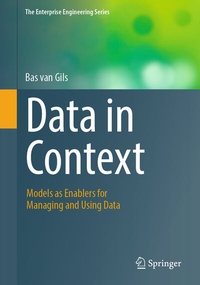
Data in Context
Models as Enablers for Managing and Using Data
Published on 31. July 2023
XX, 217 pages
978-3-031-35539-4 (ISBN)
Description

Data is an increasingly important asset for many organizations. This book shows how to model data in a way that allows to exploit this asset effectively and in every respect. To this end, it combines and exploits scientific (semiotics, relational model, etc.) and pragmatic theories (most prominently: the DAMA wheel) and provides a coherent overview from a business and an IT/ICT perspective.
After a brief introduction, the remaining book consists of three parts. In Part I "Data", the focus is on understanding data. It includes theories in semiotics, the relational model, and normalization, as well as related theories around understanding data/designing sound data structures. This part is complemented by an extensive chapter on how to design effective data structures and a smaller one on the topic of create versus use context. Part II "Data Management" then focuses on managing data as an asset. This part is based on the DMBOK and each of the functional areas is discussed in a separate chapter. Part III "Parting Thoughts" presents conclusions which are based on a synthesis of Part I and Part II, leading up to a summary of the main contributions of this book as well as a critical reflection on these results.
This book is written for a rather broad audience, ranging from professionals to students, both from business, computer science, and information management. The writing style is adjusted specifically for these groups. At the end of each chapter reflection questions are included that distinguish between questions for practitioners and for students and help both audiences to benefit from the book and check their comprehension.
After a brief introduction, the remaining book consists of three parts. In Part I "Data", the focus is on understanding data. It includes theories in semiotics, the relational model, and normalization, as well as related theories around understanding data/designing sound data structures. This part is complemented by an extensive chapter on how to design effective data structures and a smaller one on the topic of create versus use context. Part II "Data Management" then focuses on managing data as an asset. This part is based on the DMBOK and each of the functional areas is discussed in a separate chapter. Part III "Parting Thoughts" presents conclusions which are based on a synthesis of Part I and Part II, leading up to a summary of the main contributions of this book as well as a critical reflection on these results.
This book is written for a rather broad audience, ranging from professionals to students, both from business, computer science, and information management. The writing style is adjusted specifically for these groups. At the end of each chapter reflection questions are included that distinguish between questions for practitioners and for students and help both audiences to benefit from the book and check their comprehension.
More details
Series
Edition
1st ed. 2023
Language
English
Place of publication
Cham
Switzerland
Publishing group
Springer International Publishing
Target group
Primary & secondary/elementary & high school
Illustrations
XX, 217 p. 82 illus., 28 illus. in color.
File size
5,95 MB
ISBN-13
978-3-031-35539-4 (9783031355394)
DOI
10.1007/978-3-031-35539-4
Schweitzer Classification
Other editions
Additional editions
Book
08/2023
Springer
€80.24
Shipment within 15-20 days
Person
B
as van Gils
is a Professor at Antwerp Management School (AMS) and a driven and experienced consultant, trainer, and researcher. He is also the co-founder and a managing partner at Strategy Alliance, which is the home for his consulting activities. In his work, he attempts to balance academic work with consultancy work. Bas has worked in different industries, both in Europe and the United States, both as a teacher and consultant, and he is a frequent speaker at academic and professional conferences.
Content
- 1. Introduction. -
Part I Data.
- 2. Understanding Data. - 3. Designing Data Structures. - 4. Context. - 5. Related Approaches. -
Part II Data Management.
- 6. Managing Data as an Asset. - 7. Data Modeling and Design. - 8. Data Architecture. - 9. Data Storage and Operations. - 10. Data Security. - 11. Data Integration. - 12. Document and Content Management. - 13. Reference and Master Data Management. - 14. Data Warehousing and Business Intelligence. - 15. Data Science. - 16. Metadata. - 17. Data Quality. - 18. Data Governance. -
Part III Parting Thoughts.
- 19. Conclusion.
