

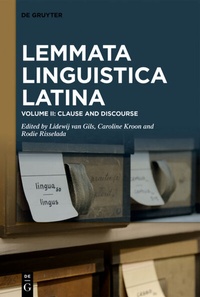
Clause and Discourse
1st Edition
Published on 20. January 2020
XI, 484 pages
978-3-11-067822-2 (ISBN)
Description

These volumes assemble contributions presented at the XIX International Colloquium on Latin Linguistics in Munich (2017). They embrace essential topics of Latin linguistics with different theoretical and methodological approaches: The volumes contain chapters on Latin lexicography, etymology, morphology, phonology, Greek-Latin language contact, Latin syntax, semantics, and discourse-pragmatics.
More details
Other editions
Additional editions
Lidewij van Gils | Caroline Kroon | Rodie Risselada
Clause and Discourse
Book
04/2025
1st Edition
De Gruyter
€174.95
Shipment within 7-9 days
Lidewij van Gils | Caroline Kroon | Rodie Risselada
Clause and Discourse
Vol. II: Clause and Discourse
E-Book
01/2020
1st Edition
De Gruyter
from
€164.95
Available for download
Persons
L. v an Gils , Vrije Universiteit Amsterdam, NL; C. Kroon and R. Risselada , Universiteit van Amsterdam, NL.
Content
- Intro
- Preface
- Contents
- Clause
- Constructions
- Linguistic theory in daily lexicographical practice: dealing with arguments and satellites in the entries of regnare and nectere in the Thesaurus Linguae Latinae
- The expression of knowledge in Latin: cognosco, nosco, scio, nescio and ignoro
- Los verbos latinos timeo y metuo: sintaxis, semántica y pragmática
- Potest + passive infinitives: auxiliary or impersonal verb?
- Ruinam dare : les complexités d'une construction latine à verbe support
- On the use of the ablative of the gerund and the nominative of the present participle in Latin technical literature
- Praedicativum and subject complement: a question revisited in light of the Latin verb sto
- Der lateinische Dativ: neue Wege in Transitivität und funktionaler Semantik
- Between syntax and magic: some peculiarities of nominal syntax in Latin curse tablets
- Les complétives en quoniam : étude à partir du latin biblique
- Semantics
- Animacy in Latin: explaining some peripheral phenomena
- Gallia est omnis divisa in partes tres: Sapir's typology and different perspectives on totality
- General extenders in Latin
- Les parcours sémantiques vers l'adversatif : une approche typologique des langues anciennes
- The diffraction of iam: contextual effects in interpretation
- Le système latin de la déixis et de l'endophore : l'évolution linguistique chez Sénèque
- Discourse
- Tense and discourse
- On the expression of relative time in Latin narrations
- Progression thématique et types de séquences chez quelques historiens romains
- Engaging the audience: an intersubjectivity approach to the historic present tense in Latin
- 'I hereby present the use of the Latin first-person perfect indicative as a performative'
- Politeness and identity
- Expressing happiness as a manifestation of positive politeness in Roman comedy
- Impoliteness in Plautus' comedies
- How to assess politeness in response to impoliteness: some examples from Latin comedy
- Cicero vs. Mark Antony: identity construction and ingroup/outgroup formation in Philippics One and Three
- Ego sum Amphitruo: Selbstidentifikation in der römischen Komödie
- Index
