

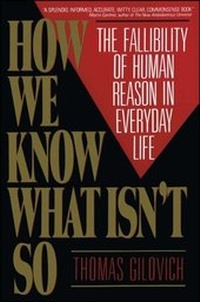
How We Know What Isn't So
1st Edition
Published on 30. June 2008
224 pages
978-1-4391-0674-7 (ISBN)
Description

Thomas Gilovich offers a wise and readable guide to the fallacy of the obvious in everyday life.
When can we trust what we believe?that "teams and players have winning streaks," that "flattery works," or that "the more people who agree, the more likely they are to be right"?and when are such beliefs suspect? Thomas Gilovich offers a guide to the fallacy of the obvious in everyday life. Illustrating his points with examples, and supporting them with the latest research findings, he documents the cognitive, social, and motivational processes that distort our thoughts, beliefs, judgments and decisions. In a rapidly changing world, the biases and stereotypes that help us process an overload of complex information inevitably distort what we would like to believe is reality. Awareness of our propensity to make these systematic errors, Gilovich argues, is the first step to more effective analysis and action.
When can we trust what we believe?that "teams and players have winning streaks," that "flattery works," or that "the more people who agree, the more likely they are to be right"?and when are such beliefs suspect? Thomas Gilovich offers a guide to the fallacy of the obvious in everyday life. Illustrating his points with examples, and supporting them with the latest research findings, he documents the cognitive, social, and motivational processes that distort our thoughts, beliefs, judgments and decisions. In a rapidly changing world, the biases and stereotypes that help us process an overload of complex information inevitably distort what we would like to believe is reality. Awareness of our propensity to make these systematic errors, Gilovich argues, is the first step to more effective analysis and action.
More details
Other editions
Additional editions
Thomas Gilovich
How We Know What Isn't So
Book
04/1993
The Free Press
€19.00
Article not available at the moment
Person
Thomas Gilovich is a professor of psychology at Cornell University and author of The Wisest One in the Room (with Lee Ross), How We Know What Isn't So, Why Smart People Make Big Money Mistakes, and Social Psychology. He lives in Ithaca, New York.
Content
- Cover Page
- Title Page
- Copyright Page
- Dedication
- Contents
- Acknowledgments
- 1 Introduction
- ONE Cognitive Determinants of Questionable Beliefs
- 2 Something Out of Nothing
- 3 Too Much from Too Little
- 4 Seeing What We Expect to See
- TWO Motivational and Social Determinants of Questionable Beliefs
- 5 Seeing What We Want to See
- 6 Believing What We Are Told
- 7 The Imagined Agreement of Others
- THREE Examples of Questionable and Erroneous Beliefs
- 8 Belief in Ineffective "Alternative" Health Practices
- 9 Belief in the Effectiveness of Questionable Interpersonal Strategies
- 10 Belief in ESP
- FOUR Where Do We Go from Here
- 11 Challenging Dubious Beliefs
- Notes
- Index
