

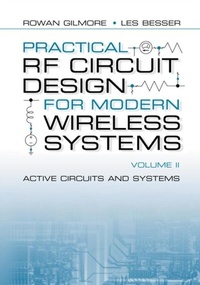
Practical RF Circuit Design for Modern Wireless Systems, Volume II
Active Circuits
1st Edition
Published on 1. January 2002
592 pages
978-1-58053-674-5 (ISBN)
Description

The second of two authoritative, highly practical volumes, this hands-on resource covers active and nonlinear circuits, and introduces advanced topics in RF circuit and system design. The book opens with an overview of active RF devices and their modeling. It explores nonlinear circuit simulation techniques such as harmonic balance, and extensively illustrates the use of CAD tools in active circuit design throughout. This is a tested and insightful book that contains answers to most of the questions practical engineers are asking. In this thoroughly practical second volume, you learn the theory behind linear and low-noise RF amplifiers, high power RF transistor amplifiers, oscillators, mixers, and frequency multipliers, so you gain an intuitive understanding of their operation. The final chapter presents the design of a radio chip set and pulls together the component aspects that are covered earlier in the book. This essential reference is lavishly illustrated with explanation of practical issues and supported with clear examples. This text is guaranteed to provide even the most experienced RF designer with fresh, intuitive insight into circuit operation, and will be as useful at universities as a course text on practical RF circuit design, as it will in industry as a training refresher.
More details
Other editions
Additional editions
Rowan Gilmore | Les Besser
Practical RF Circuit Design for Modern Wireless Systems: Active Circuits and Systems Vol II
Book
05/2003
Artech House Publishers
€137.50
Shipment within 10-20 days
Content
- Intro
- Contents
- Preface
- Acknowledgements
- 1. Linear RF amplifier design-general considerations
- 1.1 Introduction
- 1.2 Power gain definitions
- 1.3 Neutralization
- 1.4 Unilateral transducer gain
- 1.5 RF circuit stability considerations
- 1.6 Stabilizing an active two-port
- 1.7 Stabilization of a bipolar transistor
- 1.8 The dc bias techniques
- 1.9 Statistical and worst-case analyses
- 1.10 Circuit layout considerations
- 1.11 Summary
- 1.12 Problems
- References
- Selected Bibliography
- 2. Linear and low-noise RF amplifiers
- 2.1 Introduction
- 2.2 Bilateral RF amplifier design for maximum small-signal gain
- 2.3 Multistage amplifiers
- 2.4 Operating gain design for maximum linear output power
- 2.5 Noise in RF circuits
- 2.6 Available gain design technique
- 2.7 Comparison of the various amplifier designs and Smith chart-based graphical design aids
- 2.8 Broadband amplifiers
- 2.9 Summary
- 2.10 Problems
- References
- Selected Bibliography
- 3. Active RF devices amd thei modeling
- 3.1 The diode model
- 3.2 Two-port device models
- 3.3 Problems
- References
- 4. Nonlinear circuit simulation techniques
- 4.1 Classification of nonlinear circuit simulators
- 4.2 The harmonic balance method
- 4.3 Harmonic balance analysis of oscillators
- References
- 5. High-power RF transistor amplifier design
- 5.1 Nonlinear concepts
- 5.2 Quasi-liear power amplifier design
- 5.3 Categories of amplifiers
- 5.4 Power amplifier design example
- 5.5 Bias considerations
- 5.6 Distortion reduction
- 5.7 Problems
- References
- 6. Oscillators
- 6.1 Principles of oscillator design
- 6.2 Oscillator design examples
- 6.3 Problems
- References
- 7. Mixers and frequency multipliers
- 7.1 Mixer overview and their applications in systems
- 7.2 Diode mixers and their topologies
- 7.3 Transistor mixer design
- 7.4 Frequency multipliers-an overview
- 7.5 Problems
- References
- 8. Circuits in systems-radio system applications
- 8.1 Mobile telephony systems
- 8.2 Software-defined radio
- 8.3 A 1.9-GHz radio chip set: design overview
- 8.4 Integrated system chips: an overview
- 8.5 Conclusion
- References
- Appendix
- Authors
- Index
