

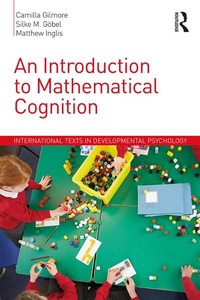
An Introduction to Mathematical Cognition
1st Edition
Published on 13. June 2018
264 pages
978-1-317-41011-9 (ISBN)
Description

The last decade has seen a rapid growth in our understanding of the cognitive systems that underlie mathematical learning and performance, and an increased recognition of the importance of this topic. This book showcases international research on the most important cognitive issues that affect mathematical performance across a wide age range, from early childhood to adulthood. The book considers the foundational competencies of nonsymbolic and symbolic number processing before discussing arithmetic, conceptual understanding, individual differences and dyscalculia, algebra, number systems, reasoning and higher-level mathematics such as formal proof. Drawing on diverse methodology from behavioural experiments to brain imaging, each chapter discusses key theories and empirical findings and introduces key tasks used by researchers. The final chapter discusses challenges facing the future development of the field of mathematical cognition and reviews a set of open questions that mathematical cognition researchers should address to move the field forward. This book is ideal for undergraduate or graduate students of psychology, education, cognitive sciences, cognitive neuroscience and other academic and clinical audiences including mathematics educators and educational psychologists.
Reviews / Votes
"Not only does this book provide up-to-date, accurate summaries of topics that have been well studied (basically aspects of mathematics acquired in the first decade of life among most children in Western and East Asian countries), it also examines less-studied topics that are likely to become increasingly important in the future, such as number systems, mathematical argumentation, and proof. Everyone interested in mathematical cognition will want to have this book." - Robert Siegler, Carnegie Mellon University, USA"The field of mathematical cognition has grown tremendously over the past few decades. This book, written by three leading experts, provides a comprehensive summary and analysis of these advances. It represents an invaluable resource not only for those interested in mathematical cognition but also for instructors teaching courses on this field and their undergraduate and graduate students." - Daniel Ansari, The University of Western Ontario, Canada
"An Introduction to Mathematical Cognition is a much-welcomed addition to this growing and important literature. The volume is written by three highly respected scientists and covers an impressive range of topics from our evolved number sense to students' understanding of mathematical proofs. It will be of interest to experts in the field and students wanting to learn more about the field." - David C. Geary, University of Missouri, USA
"An impressively coherent, systematic and clear introduction into the cognitive systems that underlie mathematical learning and performance from early childhood to adulthood, relying on a rich diversity of behavioural and neuroscientific methods. A vital book for students and researchers in mathematical cognition and adjacent fields." - Lieven Verschaffel, Katholieke Universiteit Leuven, Belgium
More details
Series
Edition
1. Auflage
Language
English
Place of publication
London
United Kingdom
Publishing group
Taylor & Francis Ltd
Target group
College/higher education
Professional and scholarly
Illustrations
9 Tables, black and white
ISBN-13
978-1-317-41011-9 (9781317410119)
Copyright in bibliographic data and cover images is held by Nielsen Book Services Limited or by the publishers or by their respective licensors: all rights reserved.
Schweitzer Classification
Other editions
Additional editions
Camilla Gilmore | Silke M. Goebel | Matthew Inglis
An Introduction to Mathematical Cognition
Book
06/2018
1st Edition
Routledge
€62.00
Shipment within 10-20 days
Camilla Gilmore | Silke M. Goebel | Matthew Inglis
An Introduction to Mathematical Cognition
Book
06/2018
1st Edition
Routledge
€206.60
Shipment within 10-20 days
Persons
Camilla Gilmore is a Reader in Mathematical Cognition in the Mathematics Education Centre at Loughborough University. Her research explores the development of numerical skills in children and adults.
Silke Goebel is a Senior Lecturer in Psychology at the University of York. She teaches courses on Numerical Cognition, Dyscalculia, Mathematics Anxiety and Neuroscience of Numbers and Arithmetic. Her current research focuses on predictors of mathematical development.
Matthew Inglis is a Reader in Mathematical Cognition in the Mathematics Education Centre at Loughborough University. He is interested in understanding the processes involved in numerical and mathematical reasoning, and how these can be promoted through education.
Silke Goebel is a Senior Lecturer in Psychology at the University of York. She teaches courses on Numerical Cognition, Dyscalculia, Mathematics Anxiety and Neuroscience of Numbers and Arithmetic. Her current research focuses on predictors of mathematical development.
Matthew Inglis is a Reader in Mathematical Cognition in the Mathematics Education Centre at Loughborough University. He is interested in understanding the processes involved in numerical and mathematical reasoning, and how these can be promoted through education.
Content
1. Introduction 2. Nonsymbolic number 3. Symbolic number 4. The development of arithmetic skills 5. Understanding arithmetic concepts 6. Individual differences and mathematical difficulties 7. Number systems 8. Algebra and equivalence 9. Mathematical argumentation and proof 10. Logic, conditional reasoning and mathematics 11. Where next for mathematical cognition?
