

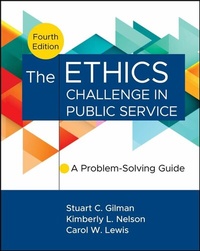
The Ethics Challenge in Public Service
Description

Newly revised edition of the classic text for ethics in public service
Since it was first published in 1991, The Ethics Challenge in Public Service has become the classic text on public sector ethics used by public managers and in public administration programs across the country. This essential text features strategies, tactics, analytic tools, and on-the-job cases that have become invaluable for public managers and staff resolving ethical dilemmas. A digital instructor's guide is available that has resources, discussion questions, and slide templates for each chapter.
This thoroughly revised and updated Fourth Edition features a wealth of new material on topics including:
- The ethics of information (e.g., social networking, Wikileaks, information management, and e-government)
- The interaction between the branches of government, including expanded coverage of the role of the judiciary
- Global trends and links with practical concerns of American and international readers
- Determining the public interest and understanding how members of the public, administrators, and elected officials can work towards achieving this interest
- The relationship between ethics and accountability in government.
The Ethics Challenge in Public Service is an ideal textbook for foundation courses in public administration as well as for courses in public sector ethics. It also serves as a valuable tool for public managers who work in a world filled with ethical challenges-the grey areas of decision-making rather than those that are black and white.
More details
Other editions
Additional editions
Persons
Stuart C. Gilman is a consultant in Washington, D.C., working with state government and federal agencies, large corporations, nonprofit organizations, and multinational organizations. He is a former senior executive with the U.S. Office of Government Ethics.
Kimberly L. Nelson is a Professor of Public Administration and Government at the School of Government. Her expertise includes local government management, form and structure, and corruption.
Carol W. Lewis is a Professor of Political Science at the University of Connecticut. She is a consultant and trainer for public agencies and professional organizations at local, regional, state, national, and international levels.
Content
Preface vii
Introduction ix
Part I Ethical Duties of Public Managers 1
Chapter 1 Ethics in Public Service 3
Chapter 2 Obeying and Implementing the Law 29
Chapter 3 Serving the Public Interest 47
Chapter 4 Taking Individual Responsibility 71
Part II Tools for Individual Decision-Making 91
Chapter 5 Finding Solid Ground 93
Chapter 6 Resolving Ethical Dilemmas 115
Chapter 7 Understanding Who and What Matters 127
Part III Ethics and the Organization 149
Chapter 8 Designing and Implementing Ethics Codes 151
Chapter 9 Broadening the Horizon 187
Chapter 10 Building an Ethical Agency 211
Afterword 245
Resource A: Glossary 247
References 257
Author Biographies 281
Index 283
Introduction
We revised this new edition to capture changes that are important for public administrators to understand. This version of The Ethics Challenge in Public Service was written with optimism but as well as with some concerns. We are optimistic that the current fires raging in the United States and abroad against the public sector and its millions of public servants will subside. We are also optimistic that the insistent ideological and partisan claims are a short-lived storm. Our confidence stems from our profound appreciation for public administrators' contributions to our society and democracy. We sincerely hope that you, the reader, will understand and even come to share these sentiments with us.
As we wrote this new edition, we were captivated by the many remarkable incidents and changes in public service since the previous edition in 2012. These include the rise of social media and e-government; the intense pressures created by the COVID-19 epidemic; the fissures of a divided electorate and their uncompromising elected leaders; demographic changes; natural catastrophes; ill-considered risk assessments biased by greed on a grand scale; the widespread recognition of pressing needs for collaboration; and the global availability of information (and disinformation) through the internet. These and other developments challenge our increasingly complex, interdependent, and fragile public life. Research findings in the cognitive sciences, neuroscience, genetics, and economics challenge several of our long-held but wrong-headed beliefs about human motivation, human morality, and even what being human means.
In his "Metamorphoses," Ovid tells us, "Omnia mutantur" (everything changes). This all-too-human fascination with change is countered by the adage, "Plus ça change, plus c'est la même chose" (the more things change, the more they stay the same). Some fundamentals, such as our inborn human nature, surely have not changed even over several millennia. So, we decided to follow the ancient Greeks, aim at a balanced view, and highlight continuities as well as change.
As in the earlier editions, this book's subject is managing in-not moralizing about-public service today. It is written for professional managers in government and nonprofit agencies, where unprecedented demands for ethical judgment and decisive action resound at increasingly higher decibel levels. It is also written for those who work with public agencies and for public purposes.
Again, we encounter low ethics in high places. Scandals rock boardrooms, bedrooms, Wall Street, and Main Street. Political leaders are outed for ethical violations, along with their counterparts in just about every walk of life. A pervasive public disillusionment and loss of confidence touch political, economic, and even religious leaders and institutions.
Is behavior today better or worse than in the past? Is there more corruption in government and society generally? Is moral character-that ingrained sense of right and wrong-a thing of the past? There really is no evidence either way, except through anecdotes, media images, and public opinion polls. More important (and the reason these questions are not confronted with evidence and argument in this book) is that the answers are intellectually interesting but practically irrelevant to managers in public service. First, we depend on the moral character of public administrators and employees. Whole administrative systems in the United States and around the globe are built on this foundation. Second, to work at all, public managers must work with what is here now. Nostalgia contributes nothing to daily operations; it solves no ethical problems on the job.
We argue that public service attracts a special breed and that most of the many millions of practicing and aspiring public administrators and employees are well-intentioned and bring good moral character to public service. It is the job itself-the ambiguous, complex, pressured world of public service-that presents special problems for ethical people who want to do the right thing. We offer some examples to make our point. Ethical issues involve information in a public setting where public disclosure and transparency vie with concerns over confidentiality and privacy; expert analysis sometimes slips into outright advocacy. Assessing and communicating risk were critical in understanding the scope of the emergency following the massive fires in Los Angeles in 2025 and the breakdown of the air traffic control in the U.S. that same year. Social media and global banking reach across political boundaries and environmental challenges, and natural disasters respect no barriers at all. A final example is the changing makeup of the public service environment-in the workplace, among service recipients, and in the general population. Professional managers need to overcome cultural and linguistic barriers and appreciate cultural differences. Practical managers know how to work with and for people of different backgrounds, and ethical managers know why they should.
Best practices address the public workplace directly by helping to reinforce moral character and engage adults in a dialogue about ethics where it counts. And count it does, for supervisors, subordinates, colleagues, citizens, taxpayers, people around the world, and generations to come.
Our Approach to the Challenge
Given our purpose of promoting ethical practice and assisting ethical managers in making ethical decisions, we aim at ethical literacy. We provide the ideas and vocabulary needed to raise and address ethical concerns in a professional setting in a professional way. This book is meant to be a shortcut through a maze of information and perspectives. We chose issues according to our assessment of their current and future managerial impact rather than academic coinage or strict philosophical import.
Our method is, first, to link good character with the ranking of values and principles that distinguishes public from personal ethics. Respect for individuals' feelings and informed judgments pervade our arguments. The same approach obligates us to provide readers with some explanations of inclusions, omissions, emphases, and biases. We argue that the dominant values and guiding principles in public ethics are different from personal ethics: the public's expectations are higher, and the burdens are heavier.
Second, we provide practical tools and techniques for resolving workaday dilemmas at the individual and agency levels. Third, our purpose is to help ethical managers structure the work environment so that it fosters ethical behavior and eases the transition of good intentions into meaningful action in the agency.
Experiential learning tunes up sensitivity to ethical challenges and polishes the skills needed to resolve them ethically and practically. This book's cases at the ends of the chapters highlight common problems and are test runs in applied problem-solving. They allow readers to practice in private (and at no public cost) until, following Aristotle, ethics becomes a habit. The cases exercise the two-step by requiring informed, systematic reasoning, followed by simulated action. The open-ended questions that follow them encourage analysis, and more pointed questions force decision-making. Some resolutions depend on empathy and imagination. Cases work best when readers alter decision premises and circumstances to double-check ethical judgments or reconcile different philosophical perspectives. The cases, like the book itself, are driven by democratic processes, for which accommodation is the vehicle and tolerance the grease.
Anecdotes and stories help us make sense of things. Throughout human history, we have relied on stories (parables, allegories, fables, and myths) to communicate visions of the ideal and our distance from it. These stories often suggest alternatives to the status quo. These stories arouse feelings, demand thought, and inspire understanding of ethics in public service.
Winston Churchill, the great British leader who shepherded his besieged country through the blitzkrieg of World War II, told the world, "The farther back you can look, the farther forward you are likely to see." We draw on history for this purpose. Likewise, we use a comparative framework to stretch beyond our own political boundaries for best practices and important lessons. Why repeat mistakes that we can avoid? Why ignore valuable insights just because they need translation or adaptation? Efficiency is on the list of important values today, but surely parochialism is not.
A touch of humor here and there helps learning by reducing the tension that is unavoidable when we confront hard questions and tough choices. Humor need not trivialize the serious; rather, it helps us face serious issues head-on. Similarly, popular culture and graphics help us connect to these issues, and we suggest films, videos, and literature in this spirit.
Our multidisciplinary perspective draws on philosophy, genetics, sociology, political science, economics, public administration, business management, history, cognitive and developmental psychology, and other disciplines. We incorporate normative and empirical approaches, along with a variety of theories and academic disciplines. We consider factors that are independent of context and other factors with a social or situational focus. We shift the unit of analysis among the several possibilities: the individual, the organization, and the community or jurisdiction. We agree with...
