

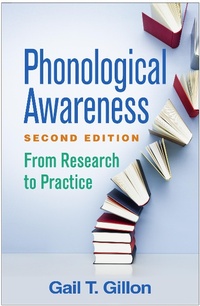
Phonological Awareness
From Research to Practice
2nd Edition
Published on 20. November 2017
272 pages
978-1-4625-3291-9 (ISBN)
Description

Reading specialists, teachers, and special educators working with children ages 3-17 (PreK-12); speech-language pathologists; school psychologists. May serve as a supplemental text in graduate-level courses.
More details
Other editions
Additional editions
Book
01/2018
2nd Edition
Guilford Press
€42.00
Shipment within 15-20 days
Person
Gail T. Gillon, PhD, is Professor and Director of the Child Well-being Research Institute at the University of Canterbury in Christchurch, New Zealand. A native New Zealander with academic qualifications in speech-language therapy, teaching, and education, her research has focused on understanding the relationship between children's spoken and written language development. In particular, Dr. Gillon is well known internationally for her research and publications on the importance of phonological awareness to early reading success, particularly for young children at risk for literacy difficulties. She is a Life Member of the New Zealand Speech-Language Therapy Association and a Fellow of the American Speech-Language-Hearing Association (ASHA). Dr. Gillon is also a three-time recipient of ASHA Editor's Awards for research articles of highest merit. Dr. Gillon is currently Co-Director of a 10-year National Science Research Challenge called "A Better Start," which includes a focus on ensuring early learning and literacy success for all New Zealand children.
Content
1. Phonological Awareness Defined
2. Theoretical Background
3. Phonological Awareness Development
4. Phonological Awareness Development in Speakers of Languages Other Than English, with Amir Sadeghi and John Everatt
5. The Importance of Phonological Processing Skills in Dyslexia, with John Everatt
6. Phonological Awareness Development in Children with Spoken Language Impairment, with Brigid McNeill
7. Phonological Awareness and Spelling Development, with Brigid McNeill
8. Phonological Awareness Assessment, with John Everatt and Amir Sadeghi
9. Phonological Awareness Intervention
10. Instructional Frameworks
11. Phonological Awareness in Children with Complex Communication Needs, with Sally Clendon
12. Concluding Remarks
Appendix. English Phonemes
References
Index
2. Theoretical Background
3. Phonological Awareness Development
4. Phonological Awareness Development in Speakers of Languages Other Than English, with Amir Sadeghi and John Everatt
5. The Importance of Phonological Processing Skills in Dyslexia, with John Everatt
6. Phonological Awareness Development in Children with Spoken Language Impairment, with Brigid McNeill
7. Phonological Awareness and Spelling Development, with Brigid McNeill
8. Phonological Awareness Assessment, with John Everatt and Amir Sadeghi
9. Phonological Awareness Intervention
10. Instructional Frameworks
11. Phonological Awareness in Children with Complex Communication Needs, with Sally Clendon
12. Concluding Remarks
Appendix. English Phonemes
References
Index
