
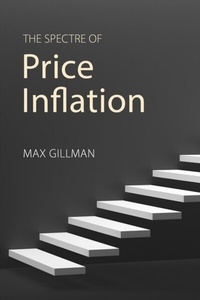
The Spectre of Price Inflation
Description
Alles über E-Books | Antworten auf Fragen rund um E-Books, Kopierschutz und Dateiformate finden Sie in unserem Info- & Hilfebereich.
Inflation, hyperinflation and deflation have all had profound effects on societies, especially during periods of war and crisis. Today's approach to managing inflation has been shaped by these episodes and informed by debates between different schools of economic thought from Fisher and Hayek to Keynes and the monetarists. This accessible and authoritative overview explores the role of inflation in the modern economy, from its place in monetary policy and in money supply to its effects on everyday business.
In a compelling analysis, the book shows that since the financial crisis in 2008-09, inflation rates have remained persistently higher than interest rates worldwide, which is the inverse of our basic understanding of how inflation normally affects markets. The result of this inversion has been that the effective real return on investment has become negative, and consequently, the investment rate has dropped across western economies. At a time when inflation once again challenges the world's leading economies, the book offers valuable insight into the monetary policy of central banks.
All prices
More details
Other editions
Additional editions
Person
Max Gillman is Hayek Professor of Economic History at the University of Missouri-St Louis. His books include Advanced Modern Macroeconomics (2011) and Inflation Theory in Economics (2009). He has also edited Collected Papers on Monetary Theory by Robert E. Lucas, Jr. (2011).
Content
Introduction
Part I: Innocence: when principles guided policy
1. Drs Fisher, Friedman and no inflation
2. The rise of inflation
3. The end of metal for money
4. War, peace, deflation and recession
5. Seigniorage versus hyperinflation
6. Blaming the victim
7. Inflation and unemployment
Part II: Ignominy: central banks, insurance and inflation
8. The rise of central banks
9. Fractured insurance
10. Bank failure and crisis
11. The problem of excess reserves
12. Giving away the inflation tax
Part III: Purgatory: capital markets, interest and inflation
13. Fed price-fixing
14. A plague of negative interest rates
15. Shifting money demand
16. The new usury prohibition?
17. Money, inflation and banking reform

System requirements
File format: ePUB
Copy protection: Adobe-DRM (Digital Rights Management)
System requirements:
- Computer (Windows; MacOS X; Linux): Install the free reader Adobe Digital Editions prior to download (see eBook Help).
- Tablet/smartphone (Android; iOS): Install the free app Adobe Digital Editions or the app PocketBook before downloading (see eBook Help).
- E-reader: Bookeen, Kobo, Pocketbook, Sony, Tolino and many more (not Kindle).
The file format ePub works well for novels and non-fiction books – i.e., „flowing” text without complex layout. On an e-reader or smartphone, line and page breaks automatically adjust to fit the small displays.
This eBook uses Adobe-DRM, a „hard” copy protection. If the necessary requirements are not met, unfortunately you will not be able to open the eBook. You will therefore need to prepare your reading hardware before downloading.
Please note: We strongly recommend that you authorise using your personal Adobe ID after installation of any reading software.
For more information, see our ebook Help page.
File format: ePUB
Copy protection: Watermark-DRM (Digital Rights Management)
System requirements:
- Computer (Windows; MacOS X; Linux): Use a reading software that can process the file format ePUB: e.g., Adobe Digital Editions or FBReader – both free (see eBook Help).
- Tablet/Smartphone (Android; iOS): Before downloading, install the free app Adobe Digital Editions (see eBook Help).
- E-reader: Bookeen, Kobo, Pocketbook, Sony, Tolino and many more (not Kindle).
The file format ePUB works well for novels and non-fiction books – i.e., „flowing” text without complex layout. On an e-reader or smartphone, line and page breaks automatically adjust to fit the small displays.
This eBook uses Watermark-DRM, a „soft” copy protection. This means that there are no technical restrictions to prevent illegal distribution. However, there is a personalised watermark embedded in the eBook that can be used to identify the purchaser of the eBook in the event of misuse and to provide evidence for legal purposes.
For more information, see our eBook Help page.