

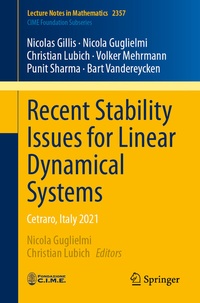
Recent Stability Issues for Linear Dynamical Systems
Description

This book concerns matrix nearness problems in the framework of spectral optimization. It addresses some current research directions in spectral-based stability studies for differential equations, with material on ordinary differential equations (ODEs), differential algebraic equations and dynamical systems. Here, 'stability' is interpreted in a broad sense which covers the need to develop stable and reliable algorithms preserving some qualitative properties of the computed solutions, methodologies which are helpful to assess the onset of potential instabilities or loss of robustness, and tools to determine the asymptotic properties of the solution or its discretization.
The topics considered include the computation of robustness measures for linear problems, the use of low-rank ODEs to approximate such measures via gradient systems, the regularity, stability, passivity and controllability analysis of structured linear descriptor systems, and the use of acceleration techniques to deal with some of the presented computational problems.
Although the emphasis is on the numerical study of differential equations and dynamical systems, the book will also be of interest to researchers in matrix theory, spectral optimization and spectral graph theory, as well as in dynamical systems and systems theory.
More details
Other editions
Additional editions
Persons
Nicola Guglielmi has been a full professor in Numerical Analysis at Gran Sasso Science Institute, School of Advanced Studies since 2018 and a visiting professor at the Courant Institute, University of Geneva, University of Zurich, McGill University and Georgia Institute of Technology. His research focuses on numerical methods for delay and functional differential equations, eigenvalue optimization with applications to matrix nearness problems and data science, switched and non smooth dynamical systems, joint spectral characteristics of sets of linear operators, implementation issues for stiff and implicit delay equations, stability properties, stiff problems, and the development of related code. He edited with L. Dieci the volume Current challenges in stability issues for numerical differential equations. CIME Lecture Notes in Mathematics, 2082, Springer, Cham, 2014. With Ernst Hairer he is the co-author of the software RADAR5. He was awarded the New Talent Prize (SciCADE, Fraser Island) in 1999 and a young researcher prize (Volterra Centennial, Tempe) in 1996.
Christian Lubich is a professor of Numerical Mathematics at the University of Tübingen. In his research he develops and analyses numerical methods for time-dependent problems including ordinary differential equations and parabolic partial differential equations, geometric flows, wave propagation and quantum dynamics. Among the methods and techniques proposed and studied by him and his coauthors, convolution quadrature, exponential integrators, modulated Fourier expansions for highly oscillatory problems, and dynamical low-rank approximation have gained wide acceptance. He is the author, with Ernst Hairer and Gerhard Wanner, of "Geometric Numerical Integration: Structure-Preserving Algorithms for Ordinary Differential Equations" (Springer 2002, 2006) and of "From Quantum to Classical Molecular Dynamics: Reduced Models and Numerical Analysis" (European Mathematical Society 2008). He was awarded the SIAM Dahlquist Prize in 2001 and was a plenary speaker at the International Congress of Mathematicians in 2018.
Content
Introduction.- Chapter 1. Solving Matrix Nearness Problems via Hamiltonian Systems, Matrix Factorization and Optimisation.- Chapter 2. Eigenvalue Optimization and Matrix Nearness Problems via Constrained Gradient Systems.- Chapter 3. Regularity, Stability, Passivity and Controllability of Structured Linear Descriptor Systems.- Chapter 4. Algorithms for Eigenvalue Optimization Related to Stability of Dynamical Systems.
