

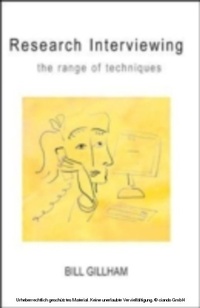
Research Interviewing
The Range of Techniques
1st Edition
Published in December 2005
195 pages
978-0-335-22513-2 (ISBN)
Description

* The most comprehensive book available on methods in research interviewing! * What is research interviewing? * What techniques are used? Exactly what do you do in each technique? * How is interview data analysed and written up? The robust, real-world approach makes this book appropriate for practitioner researchers and postgraduate students up to PhD level. Covers distance and face-to-face interviewing, from the un-structured and naturalistic to the highly structured, focused and time-efficient. Emphasis is placed on using the most appropriate methods for the research purpose and how to identify which method is practicable. Based on over thirty years of teaching and supervising research and postgraduate students, the author anticipates questions and difficulties at a level of practical detail. Practical and easy to use, this book is essential for anyone doing research interviewing.
* The most comprehensive book available on methods in research interviewing! * What is research interviewing? * What techniques are used? Exactly what do you do in each technique? * How is interview data analysed and written up? The robust, real-world approach makes this book appropriate for practitioner researchers and postgraduate students up to PhD level. Covers distance and face-to-face interviewing, from the un-structured and naturalistic to the highly structured, focused and time-efficient. Emphasis is placed on using the most appropriate methods for the research purpose and how to identify which method is practicable. Based on over thirty years of teaching and supervising research and postgraduate students, the author anticipates questions and difficulties at a level of practical detail. Practical and easy to use, this book is essential for anyone doing research interviewing.
* The most comprehensive book available on methods in research interviewing! * What is research interviewing? * What techniques are used? Exactly what do you do in each technique? * How is interview data analysed and written up? The robust, real-world approach makes this book appropriate for practitioner researchers and postgraduate students up to PhD level. Covers distance and face-to-face interviewing, from the un-structured and naturalistic to the highly structured, focused and time-efficient. Emphasis is placed on using the most appropriate methods for the research purpose and how to identify which method is practicable. Based on over thirty years of teaching and supervising research and postgraduate students, the author anticipates questions and difficulties at a level of practical detail. Practical and easy to use, this book is essential for anyone doing research interviewing.
More details
Language
English
Place of publication
Buckingham
United Kingdom
Target group
Professional and scholarly
ISBN-13
978-0-335-22513-2 (9780335225132)
Copyright in bibliographic data and cover images is held by Nielsen Book Services Limited or by the publishers or by their respective licensors: all rights reserved.
Schweitzer Classification
Other editions
Additional editions
Book
08/2005
Open University Press
€29.00
Shipment within 15-20 days
Content
- Front Cover
- Half Title
- Title
- Copyright
- Contents
- Preface
- Acknowledgements
- Figures
- Tables
- PART I Principles and Practice
- Chapter 01 Research interviewing: key issues
- Context, resources and research purpose
- Distance versus face-to-face interviewing
- The reliability and validity of interview data
- Disguising the personality of the researcher
- Self-construction of the interviewee
- The unique power of interview data
- 'Hard' and 'soft' research
- Recognizing our prejudices
- Chapter 02 The ethics of interviewing
- Identifying yourself as a researcher
- Identifying the purposes of the research and what is expected of those taking part
- Storing and analysing personal research data
- The right of interviewees to review the transcript of their interview
- Gender, racial and social class issues
- Issues surrounding vulnerable or dependent groups
- Ensuring the safety and well-being of research subjects
- Protecting identity information
- Formal ethical guidelines and procedures
- Chapter 03 The importance of question/ topic development
- The process of question development
- Identifying topics
- Other topic sources
- Pruning and revising possible questions
- Improving question wording and format
- Trialling the questions
- Principles for selecting questions and topics
- Piloting and pre-piloting
- Chapter 04 Different techniques and the 'cost' development factor
- The time-cost factor
- Making your choice
- Chapter 05 The core skills of interviewing
- The unimportant skills
- Practising interviewing
- Seeing yourself being yourself
- The fine art of probing
- Clarification
- Showing appreciation and understanding
- Justification
- Giving an example
- Relevance
- Extending the narrative
- Accuracy
- Reflecting
- PART II Face-to-face Methods
- Chapter 06 Ethnographic methods
- Access
- Sponsors and key informants
- Cost and quality
- Problems with naturalistic interviewing
- Putting what you are told 'in context'
- Single context and generalization
- Detachment and participation
- Summary
- Chapter 07 The unstructured interview
- The unstructured interview as an exploratory or preliminary technique
- The unstructured interview as open-ended inquiry
- The unstructured interview as narrative inquiry
- Narrative interviewing: conceptual origins and reality
- Structuring the unstructured interview
- How many interviews?
- Preparing the interviewees
- Running the interview
- Summary
- Chapter 08 The élite interview
- Access and control
- The specialist academic
- The advanced practitioner
- The expert administrator
- Entering the network
- Reporting the interview in the research report
- Summary
- Chapter 09 Group interviewing
- People in interaction
- The level of structure in different kinds of group interviews
- Managing and recording a group interview
- Joint management
- What happens in group interviews
- The group interview as an exploratory device
- Size and composition of the group
- The limitations of an unfocused group composition
- Setting up a focus group
- The role of the facilitator
- Keeping the group on the topic
- The role of disagreement
- What a group interview distinctively contributes
- Putting group findings together
- The limitations of group interviews
- Summary
- Chapter 10 The semi-structured interview
- The central role of preparation
- The devil is in the detail
- Developing an interview focus
- The pre-piloting stage
- The stage of final piloting
- Lessons from the analysis of content
- What are the main lessons of the piloting stage?
- Ensuring that questions are equivalent for all respondents
- The conduct of the interview
- Summary
- Chapter 11 Structured interviewing
- The definition of a recording schedule
- The advantages of recording schedules
- Developing questions and topics
- Constructing and conducting a recording schedule interview
- The design of a recording schedule
- The use of 'show cards'
- Different kinds of answer formats
- Presentation of findings
- Inferential statistics
- Combining different kinds of interview data
- Summary
- Chapter 12 The video interview
- What is lost in audio recording and transcription?
- The video interview as a form of reference
- Other positive features of the video interview
- Setting up a video interview
- Does video recording affect the behaviour of those being filmed?
- The uses of video recording interviews
- The role of video in a research report
- Summary
- Chapter 13 The interview as a qualitative experiment
- What is an experiment?
- The notion of structured comparison
- A practical example
- Interviewing and practical trialling
- Summary
- PART III Distance Methods
- Chapter 14 The telephone interview
- Privacy, intrusion and persuasion
- The advantages of telephone interviewing over other distance methods
- The disadvantages of telephone interviewing
- The level of structure in telephone interviews
- Preparing respondents
- The structured telephone interview
- The semi-structured or unstructured telephone interview
- Summary
- Chapter 15 The e-mail interview
- Applications of e-mail
- Some advantages of e-mail interviewing
- A more informal register?
- Speed and flexibility
- Recommended approaches
- Summary
- Chapter 16 The 'open' questionnaire interview
- When would one use an open questionnaire interview?
- Number of questions and length of response
- How open should the questions be?
- The audio-tape variant
- Ensuring prompt returns
- Summary
- PART IV Analysis and Interpretation of Content
- Chapter 17 Transcribing the interview
- What is lost in transcription?
- Where transcription is not needed
- Couldn't computer software do it for you?
- Couldn't someone else do it?
- The basic rules for transcription
- Transcription: managing the detail
- Reviewing the transcripts
- Chapter 18 Narrative overview versus categorical analysis
- The emergence of significant elements
- An edited or paraphrased account
- Editing the transcript
- Reducing the data and retaining the meaning
- Chapter 19 Deriving categories (coding) from the data
- Categories and interpretation
- Categorizing what people say
- 'Classic' content analysis
- Speaking and writing
- Identifying substantive statements
- Forming categories
- An organizational hierarchy
- Narrative analysis and categorical analysis
- Ten-point procedure for analysis
- High and low inference
- Content analysis: a first practical exercise
- Computer-assisted qualitative data analysis software (CAQDAS)
- When and why would you use CAQDAS?
- The limits of the machine
- Chapter 20 Quantitative analysis of categorical data
- Descriptive and inferential statistics
- Putting categorical data into numerical form
- The computation of chi square
- Correlating ranked judgements
- Averaging ranks: a caution
- Endnote
- Chapter 21 Writing up interview data
- The formal conventions of research report writing
- The argument for a more naturalistic style of reporting
- Logic and chronologic: the development of research questions
- Acknowledging the process of discovery
- Writing as discovery
- Weaving a narrative
- Integrating quantitative analysis
- The balance of selected quotations
- The balance between quotation and linking narrative
- Chapter 22 Combining interview data with data from other sources
- Triangulation in practice
- Words and deeds: knowledge and behaviour
- Interviews as a complement to survey data
- Interviews combined with questionnaire survey data
- Interviews combined with participant observation
- Interviews as part of case studies
- Data collection in real-life settings
- References
- Index
- Back cover
