

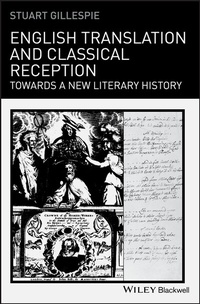
English Translation and Classical Reception
Description

- The first book-length study of English translation as a topic in classical reception
- Draws on the author's exhaustive knowledge of English literary translation from the early Renaissance to the present
- Argues for a remapping of English literary history which would take proper account of the currently neglected history of classical translation, from Chaucer to the present
- Offers a widely ranging chronological analysis of English translation from ancient literatures
- Previously little-known, unknown, and sometimes suppressed translated texts are recovered from manuscripts and explored in terms of their implications for English literary history and for the interpretation of classical literature
More details
Other editions
Additional editions
Person
THE AUTHOR
STUART GILLESPIE is Reader in English Literature at the University of Glasgow, Scotland. His recent publications include Shakespeare's Books: A Dictionary of Shakespeare Sources (2001), Shakespeare and Elizabethan Popular Culture, edited with Neil Rhodes (2006), and The Cambridge Companion to Lucretius, edited with Philip Hardie (2007). He edits the journal Translation and Literature and is co-editor of the Oxford History of Literary Translation in English.
Content
Preface vi
Acknowledgements viii
Note on Texts x
1. Making the Classics Belong: A Historical Introduction 1
2. Creative Translation 20
3. English Renaissance Poets and the Translating Tradition 33
4. Two-Way Reception: Shakespeare's Influence on Plutarch 47
5 Transformative Translation: Dryden's Horatian Ode 60
6. Statius and the Aesthetics of Eighteenth-Century Poetry 76
7. Classical Translation and the Formation of the English Literary Canon 93
8. Evidence for an Alternative History: Manuscript Translations of the Long Eighteenth Century 104
9. Receiving Wordsworth, Receiving Juvenal: Wordsworth's Suppressed Eighth Satire 123
10. The Persistence of Translations: Lucretius in the Nineteenth Century 150
11. 'Oddity and struggling dumbness': Ted Hughes's Homer 163
12. Afterword 180
References 183
Index of Ancient Authors and Passages 200
General Index 203
1
Making the Classics Belong: A Historical Introduction
One of the oddities of the way the academic disciplines of English Literature and Classical Studies have developed, especially given early connections between them, is that translation history, an area which could in principle be of equal interest to each field, has been largely ignored by both.1 The book you are now reading is a sign of change and has affiliations on both sides: it is published within a series falling under a 'Classical Studies' rubric, while looming large in its immediate background is the ongoing Oxford History of Literary Translation in English, the first full-scale history of English literary translation and a publishing project of Oxford University Press's Literature (not Classics, not Modern Languages) department. But these are very late omens and much remains to be done. Just as we are becoming used to reception moving towards the forefront of the study of ancient literatures,2 my view is that translation should move towards the forefront of the study of reception. The increasingly monoglot nature of the Anglo-American academic world might provide some excuse for the neglect of translations within the study of English literature, but it cannot do the same for Classics.
What follows in this chapter is a historical sketch designed to provide an overall context for the discussions of individual periods and works that follow. But its further purpose is to suggest in brief compass the scale and centrality of translation from ancient Latin and Greek works in the literature of the anglophone world over the centuries. Its scale and centrality are the reasons why, as I argue from various angles below, a change in the way we write the history of this literature is needed. As things currently stand, 'translation' is not a heading with a lot of entries below it in literary historians' indexes. Within the current Oxford English Literary History, for example, the first volume to be published, on the period 1350-1547, offers four index entries on 'translation' to a 600-page study. The work of Chaucer, who was thought of even by his contemporary Deschamps as a 'grand translateur', falls entirely within this period. The Cambridge Guide to Literature in English has no entry for 'translation', though there are entries for 'tragedy', 'epic' and even 'imitation'.3
The activity of translation had, of course, been at the centre of western culture well before the arrival of the earliest forms of the English language. Translation was fundamental to Roman literature: it is taken for granted as much in modern as in ancient times that Latin letters grew expressly out of translations from works in the Greek epic and dramatic tradition. Livius Andronicus (c. 284-204 BCE), sometimes claimed as the 'father of Roman literature', introduced Greek writing to the Romans by translating the Odyssey into the Italian Saturnian metre and adapting Greek tragedy to the Roman stage. Others soon followed with closer or looser forms of translation and adaptation: Gnaeus Naevius with plays on the Trojan War; Ennius, Pacuvius and Accius with tragedy; Caecilius Statius with comedy. Translation, that is, had the effect of directly inaugurating Roman epic and drama at a time when these genres were barely emergent in their own right.
As a cultural phenomenon in antiquity, the history of translation is every bit as diverse as it will later become in the anglophone world. Horace's famous claim about rendering Greek lyrics into Latin (Odes 3.30.13) covers what is in almost every respect a different kind of thing from the exotic Latin framing by 'Lucius Septimus' of the Greek Diaries of the Trojan War by 'Dictys'.4 The Roman experience is likewise an emphatic but not unique instance of the centrality of translation. In the European Renaissance the medieval literary tradition was invigorated and the literary idiom much enriched by fresh contact with classical sources through translation and imitation, sometimes of a directly experimental kind. It can be said without qualification that in every phase of English literature, and for that matter many phases of other western literatures too, much of the innovative impulse comes directly or indirectly through translation from ancient Greek and Roman texts, and in some eras their impact is fundamental. The effect is often one that is hidden or hard to discern, partly because of the frequent difficulty of determining whether originals or translations were being used in a given instance - did Shakespeare know Ovid's Latin epic, Arthur Golding's English Metamorphoses, or both? (The answer here happens to be 'both'.) What is certain is that translations from the classics have been enormously widely read in the West, and that their readers and their creators have over the centuries included the most influential of figures (not only artistic figures). Today more than ever, the number of individuals who will read a classical text in one of the readily available series of modern English translations (Penguin Classics, Oxford World's Classics, Everyman's Library, and so on) is many times the number that will read it in Greek or Latin, whether as part of an educational programme or not.
It's a good question what continuity might be said to exist in terms of individual translation practice between, say, Livius Andronicus' Latin rendering of the Odyssey and a popular twentieth-century English version of the Homeric poem.5 In respect at least of how translation has been theorized in the West, continuity over the centuries has been ensured by the influential, though hardly extensive remarks on the subject by Cicero in De oratore and De optimo genere oratorum, Horace in the Ars poetica, Pliny the Younger in the letter To Fuscus, Quintilian in the Institutio oratoria and Aulus Gellius in the Noctes Atticae.6 Much Renaissance thinking on translation was done around Horace's and Cicero's brief statements especially; their drift is against over-scrupulous, word-for-word translation.7 But Christianity has successfully intervened in this tradition, with St Jerome and St Augustine, in particular, battling over the translatability of the Word in a fourth-century controversy. Many of the subsequent striations of western theory derive from Augustine's promotion of the idea of a single, true translation.8
Because of its sheer scale, the growth and development over time of the corpus of classical texts translated into vernaculars is still imperfectly documented. By as early as the seventeenth century, publishing activity in this area had become so voluminous that a comprehensive bibliographical record even of translations of classical texts into English has not yet been assembled.9 But perhaps a few statistics will be suggestive. The latest bibliographies of English classical translations for the 250-year period 1550-1800, a period which might be held to constitute the golden age of the tradition, run to some 1,500 items for about 100 ancient authors.10 These are not comprehensive listings of every individual translation, but records of the more substantial and significant for these years. They may represent the complete works of an ancient writer, a selection, or a single text; the single texts may range from an epic poem to a satire, but are usually substantial enough to have been printed as a book, whether long or short, in themselves. Virgil, for instance, collects 103 entries, 95 of which are in verse. The most substantial of these are half-a-dozen complete Works and the same number of separate Aeneids, followed by nine or ten complete translations apiece of the Georgics and Eclogues. Most of the remainder are selections of one kind or another, frequently one or more Books of the Aeneid, with a few 'translations' into burlesque or parodic form thrown in. Naturally enough, because the originals are of a more manageable average length, Horace attracts more translations: some 160 are listed, with interest taking off after 1650, and with satires as popular as odes during the eighteenth century. Ovid's total is about 100 translations for the same period. But a checklist for Ovid continuing on to the present finds a similar total again for the years 1800 to 2004, even with the more routine prose translations and school texts excluded for the nineteenth and twentieth centuries. It also records a further 37 English translators who were responsible for short excerpts or individual items such as elegies.11 That's almost 250 Ovid translations all told, many of them by very recognizable English literary figures, and including 28 complete Metamorphoses. All these totals are confined to printed works, whereas I will be suggesting later that texts remaining in manuscript often made up a significant part of translating activity too. There is absolutely no shortage of material to address here.
But there is no difficulty in sketching out a general history of classical translation in post-classical times, thanks not least to the pioneering work of the Oxford History of Literary Translation in English (soon to be joined by the Oxford History of Classical Reception in English). Such a narrative might begin with a prequel to the accounts such sources make available for the vernacular, which is to say...
