

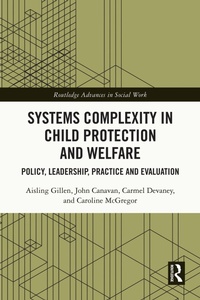
Systems Complexity in Child Protection and Welfare
Policy, Leadership, Practice and Evaluation
1st Edition
Published on 3. December 2024
186 pages
978-1-040-26620-5 (ISBN)
Description

This book examines systems complexity theory and specifically, system and dynamic characteristics of complexity, with a key focus on self/organisation/emergence/adaptation; path-dependence; and bifurcation.
Exploring systems complexity at the heart of child protection and welfare policymaking, leadership, practice, and evaluation and implications for policymakers, leaders, practitioners and evaluators in managing its impact, it proposes a systems complexity evaluation framework to assist identification, accommodation and decision-making in child protection and welfare practice, services, and systems. Using national case studies, practice, and research examples, it illustrates how adopting a complexity focus to Child Protection Work in any jurisdiction can augment decision-making and critical analysis acumen at all levels in practice, services, and systems.
This book will be of interest to all scholars and students of social work, child protection, family support, education, nursing and criminology.
Exploring systems complexity at the heart of child protection and welfare policymaking, leadership, practice, and evaluation and implications for policymakers, leaders, practitioners and evaluators in managing its impact, it proposes a systems complexity evaluation framework to assist identification, accommodation and decision-making in child protection and welfare practice, services, and systems. Using national case studies, practice, and research examples, it illustrates how adopting a complexity focus to Child Protection Work in any jurisdiction can augment decision-making and critical analysis acumen at all levels in practice, services, and systems.
This book will be of interest to all scholars and students of social work, child protection, family support, education, nursing and criminology.
More details
Series
Edition
1. Auflage
Language
English
Place of publication
London
United Kingdom
Publishing group
Taylor & Francis Ltd
Target group
College/higher education
Professional and scholarly
Illustrations
7 Tables, black and white; 1 Line drawings, black and white; 1 Illustrations, black and white
ISBN-13
978-1-040-26620-5 (9781040266205)
Copyright in bibliographic data and cover images is held by Nielsen Book Services Limited or by the publishers or by their respective licensors: all rights reserved.
Schweitzer Classification
Other editions
Additional editions
Aisling Gillen | John Canavan | Carmel Devaney
Systems Complexity in Child Protection and Welfare
Policy, Leadership, Practice and Evaluation
Book
05/2026
1st Edition
Routledge
€57.00
Shipment within 10-20 days

Aisling Gillen | John Canavan | Carmel Devaney
Systems Complexity in Child Protection and Welfare
Policy, Leadership, Practice and Evaluation
Book
01/2025
Routledge
Unfortunately, price unknown
Available (delivery time upon request)
Aisling Gillen | John Canavan | Carmel Devaney
Systems Complexity in Child Protection and Welfare
Policy, Leadership, Practice and Evaluation
Book
12/2024
1st Edition
Routledge
€195.90
Shipment within 10-20 days
Persons
Aisling Gillen is a Visiting Research Fellow in the UNESCO Child and Family Research Centre in the School of Political Science and Sociology at the University of Galway and former Service Director with Ireland's Child Protection Agency.
John Canavan is Director of the UNESCO Child and Family Research Centre and Personal Professor in the School of Political Science and Sociology at the University of Galway.
Carmel Devaney is Associate Director of the UNESCO Child and Family Research Centre, Lecturer and Head of Discipline of Applied Social Science in the School of Political Science and Sociology at the University of Galway.
Caroline McGregor is Senior Research Fellow in the UNESCO Child and Family Research Centre and Personal Professor in the School of Political Science and Sociology at the University of Galway.
John Canavan is Director of the UNESCO Child and Family Research Centre and Personal Professor in the School of Political Science and Sociology at the University of Galway.
Carmel Devaney is Associate Director of the UNESCO Child and Family Research Centre, Lecturer and Head of Discipline of Applied Social Science in the School of Political Science and Sociology at the University of Galway.
Caroline McGregor is Senior Research Fellow in the UNESCO Child and Family Research Centre and Personal Professor in the School of Political Science and Sociology at the University of Galway.
Content
1.Introduction: Understanding and responding to complexity in Child Protection and Welfare practice, services, and systems. 2.The Global Challenges of Child Protection that contribute to complexity. 3.Systems Complexity Theory- Concepts and Characteristics. 4.Systems Complexity Theory and Policymaking. 5.Systems complexity theory and practice, service, and system leadership. 6.Informing practice through the application of complexity theory and a complexity 'lens'. 7.Applying complexity-theory thinking to practice, service and system evaluation in complex child protection and welfare (CPW) work. 8.Towards a Systems Complexity Framework: for Child Protection and Welfare: Key learnings and future considerations.
