

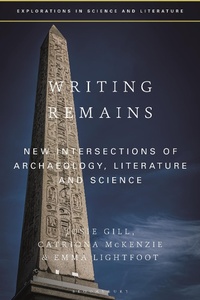
Writing Remains
New Intersections of Archaeology, Literature and Science
1st Edition
Published on 14. January 2021
248 pages
978-1-350-10947-6 (ISBN)
Description

Writing Remains brings together a wide range of leading archaeologists and literary scholars to explore emerging intersections in archaeological and literary studies. Drawing upon a wide range of literary texts from the nineteenth century to the present, the book offers new approaches to understanding storytelling and narrative in archaeology, and the role of archaeological knowledge in literature and literary criticism.
The book's eight chapters explore a wide array of archaeological approaches and methods, including scientific archaeology, identifying intersections with literature and literary studies which are textual, conceptual, spatial, temporal and material. Examining literary authors from Thomas Hardy and Bram Stoker to Sarah Moss and Paul Beatty, scholars from across disciplines are brought into dialogue to consider fictional narrative both as a site of new archaeological knowledge and as a source and object of archaeological investigation.
The book's eight chapters explore a wide array of archaeological approaches and methods, including scientific archaeology, identifying intersections with literature and literary studies which are textual, conceptual, spatial, temporal and material. Examining literary authors from Thomas Hardy and Bram Stoker to Sarah Moss and Paul Beatty, scholars from across disciplines are brought into dialogue to consider fictional narrative both as a site of new archaeological knowledge and as a source and object of archaeological investigation.
More details
Series
Edition
1. Auflage
Language
English
Place of publication
London
United Kingdom
Publishing group
Bloomsbury Publishing PLC
Target group
Professional and scholarly
Illustrations
5 bw illus
ISBN-13
978-1-350-10947-6 (9781350109476)
Copyright in bibliographic data and cover images is held by Nielsen Book Services Limited or by the publishers or by their respective licensors: all rights reserved.
Schweitzer Classification
Other editions
Additional editions
Josie Gill | Catriona Mckenzie | Emma Lightfoot
Writing Remains
New Intersections of Archaeology, Literature and Science
Book
06/2022
Bloomsbury Academic
€44.90
Shipment within 15-20 days
Josie Gill | Catriona Mckenzie | Emma Lightfoot
Writing Remains
New Intersections of Archaeology, Literature and Science
Book
01/2021
Bloomsbury Academic
€141.36
Shipment within 15-20 days
Persons
Josie Gill is Lecturer in Black British Writing in the Department of English at the University of Bristol, UK.
Catriona McKenzie is a Senior Lecturer in Human Osteoarchaeology in the Department of Archaeology at the University of Exeter, UK.
Emma Lightfoot is Post-Doctoral Research Associate in Biomolecular Archaeology at the McDonald Institute for Archaeological Research at the University of Cambridge, UK.
Catriona McKenzie is a Senior Lecturer in Human Osteoarchaeology in the Department of Archaeology at the University of Exeter, UK.
Emma Lightfoot is Post-Doctoral Research Associate in Biomolecular Archaeology at the McDonald Institute for Archaeological Research at the University of Cambridge, UK.
Content
List of Figures
List of Tables
Introduction: New Intersections of Archaeology, Literature and Science. Josie Gill, University of Bristol, UK, Catriona McKenzie, University of Exeter, UK and Emma Lightfoot, University of Cambridge, UK
Genetics and Human Inheritance
1. New Materialism, Archaeogenetics and Tracing the Human. Jerome de Groot, University of Manchester, UK
2. Jack London and Before Adam: Ahead of his Time, or a Cautionary Tale in the Study of Prehistoric Hominins? James Walker, University of Bradford, UK and David Clinnick, St Mary's College of California, USA
Innovations in Practice through Collaborative Projects
3. 'Handle with Care': Literature, Archaeology, Slavery. Josie Gill, Catriona McKenzie and Emma Lightfoot
4. Creative Facticity and 'Hyper-Archaeology': The Spatial and Performative Textualities of Psychogeography. Spencer Jordan, University of Nottingham, UK
Literature, Archaeology and Layering the Past
5. Deciphering the City: Ancient Egypt in Victorian London and Psychogeographical Archaeology. Eleanor Dobson, University of Birmingham, UK
6. From the Great Castle of the Hill to the Great Mound on the River: Imperialism and Transatlantic Archaeology in Thomas Hardy's 'Ancient Earthworks'. Anna West, independent scholar
Narrative Archaeology and the Narratives of Archaeologists
7. Something More than Imagination: Archaeology and Fiction. Robert E.Witcher, Durham University, UK and Daniël P. van Helden, University of Leicester, UK
8. The Death of the Archaeologist: Imagining Science, Storytelling and Self-Understanding in Contemporary Archaeofiction. Anna Auguscik, University og Oldenburg, Germany
Index
List of Tables
Introduction: New Intersections of Archaeology, Literature and Science. Josie Gill, University of Bristol, UK, Catriona McKenzie, University of Exeter, UK and Emma Lightfoot, University of Cambridge, UK
Genetics and Human Inheritance
1. New Materialism, Archaeogenetics and Tracing the Human. Jerome de Groot, University of Manchester, UK
2. Jack London and Before Adam: Ahead of his Time, or a Cautionary Tale in the Study of Prehistoric Hominins? James Walker, University of Bradford, UK and David Clinnick, St Mary's College of California, USA
Innovations in Practice through Collaborative Projects
3. 'Handle with Care': Literature, Archaeology, Slavery. Josie Gill, Catriona McKenzie and Emma Lightfoot
4. Creative Facticity and 'Hyper-Archaeology': The Spatial and Performative Textualities of Psychogeography. Spencer Jordan, University of Nottingham, UK
Literature, Archaeology and Layering the Past
5. Deciphering the City: Ancient Egypt in Victorian London and Psychogeographical Archaeology. Eleanor Dobson, University of Birmingham, UK
6. From the Great Castle of the Hill to the Great Mound on the River: Imperialism and Transatlantic Archaeology in Thomas Hardy's 'Ancient Earthworks'. Anna West, independent scholar
Narrative Archaeology and the Narratives of Archaeologists
7. Something More than Imagination: Archaeology and Fiction. Robert E.Witcher, Durham University, UK and Daniël P. van Helden, University of Leicester, UK
8. The Death of the Archaeologist: Imagining Science, Storytelling and Self-Understanding in Contemporary Archaeofiction. Anna Auguscik, University og Oldenburg, Germany
Index
