

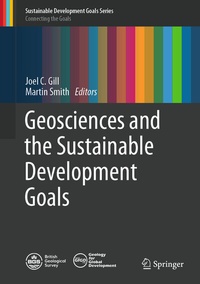
Geosciences and the Sustainable Development Goals
Description

Meeting the targets of the UN Sustainable Development Goals (SDGs) requires contributions by scientists focusing on understanding, monitoring, protecting, managing and restoring the natural environment, including geoscientists. This book presents the first detailed discussion on the role of the geological sciences (geosciences) community in the implementation of the SDGs. Unlike traditional geosciences textbooks, it is structured according to development priorities, framed in the context of the 17 SDGs. Written by international experts from diverse range of geosciences / development disciplines, it explores themes linked to both science and the professional practice of science (e.g., ethics, equity, conduct, and partnerships). The book is intended for graduate and senior undergraduate students in the earth sciences, as well as practicing geologists and experts from other sectors involved in sustainability initiatives.
More details
Other editions
Additional editions
Persons
Joel Gill is International Development Geoscientist at the British Geological Survey, and Founder/Executive Director of the not-for-profit organisation Geology for Global Development. Joel has a degree in Natural Sciences (Cambridge, UK), a Masters degree in Engineering Geology (Leeds, UK), and a PhD focused on multi-hazards and disaster risk reduction (King's College London, UK). For the last decade, Joel has worked at the interface of Earth science and international development, and plays a leading role internationally in championing the role of geoscience in delivering the UN Sustainable Development Goals. He has coordinated research, conferences, and workshops on geoscience and sustainable development in the UK, India, Tanzania, Kenya, South Africa, Zambia, and Guatemala. Joel regularly engages in international forums for science and sustainable development, leading an international delegation of Earth scientists to the United Nations in 2019. Joel has prizes from the London School of Economics and Political Science for his teaching related to disaster risk reduction, and Associate Fellowship of the Royal Commonwealth Society for his international development engagement. Joel is a Fellow and Trustee of the Geological Society of London. Joel tweets at @JoelCGill.
Martin Smith is a Science Director with the British Geological Survey and Principle Investigator for the BGS ODA Programme Geoscience for Sustainable Futures (2017-2021). He has a first degree in Geology (Aberdeen) and a PhD on tectonics (Aberystwyth, UK). A survey geologist by training Martin has spent a career studying geology both in the UK and across Africa and India. As Chief Geologist for Scotland and then for the UK he has worked closely with government and industry on numerous applied projects including in the UK on national crises, major infrastructure problems, decarbonisation research and urban geology and overseas for DIFD-funded development projects in Kenya, Egypt and Central Asia. Martin is a Chartered Geologist and fellow of the Geological Society of London. He was awarded an MBE for services to geology in 2016.
